Review
. 2021 Nov 8:8:752875.
doi: 10.3389/fmed.2021.752875. eCollection 2021.

Acute-on-Chronic Liver Failure: Pathophysiological Mechanisms and Management

Affiliations
Review

Acute-on-Chronic Liver Failure: Pathophysiological Mechanisms and Management

Arshi Khanam et al. Front Med (Lausanne). .

Abstract

Acute-on-chronic liver failure (ACLF) is a multifaceted condition with poor treatment options and high short-term mortality. ACLF can develop in patients with or without liver cirrhosis, where patients with decompensated cirrhosis display a higher risk of short-term mortality. Pathophysiological mechanisms include systemic inflammation due to bacterial and fungal infections and acute hepatic insult with drug, alcohol, and viral hepatitis. Cryptogenic factors also contribute to the development of ACLF. The clinical outcome of patients with ACLF gets further complicated by the occurrence of variceal hemorrhage, hepatorenal syndrome, hepatic encephalopathy, and systemic immune dysfunction. Regardless of the better understanding of pathophysiological mechanisms, no specific and definitive treatment is available except for liver transplantation. The recent approach of regenerative medicine using mesenchymal stem cells (MSCs) could be advantageous for the treatment of ACLF as these cells can downregulate inflammatory response by inducing antiinflammatory events and prevent hepatic damage and fibrosis by inhibiting hepatic stellate cell activation and collagen synthesis. Moreover, MSCs are involved in tissue repair by the process of liver regeneration. Considering the broad therapeutic potential of MSCs, it can serve as an alternative treatment to liver transplant in the near future, if promising results are achieved.

Keywords: acute-on-chronic liver failure; cirrhosis; immunopathology; liver transplantation; stem cell therapy.


Conflict of interest statement

The authors declare that the research was conducted in the absence of any commercial or financial relationships that could be construed as a potential conflict of interest.

Figures
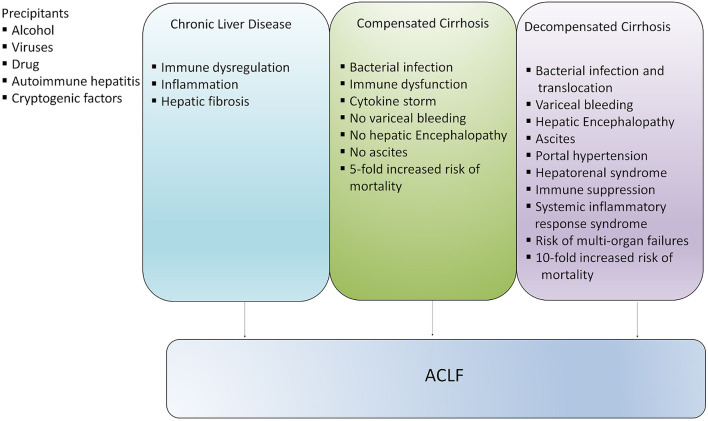
Figure 1
Figure 1
Development of ACLF in different stages of liver disease. ACLF can develop directly in patients with chronic liver disease (CLD), compensated and decompensated cirrhosis or it may progress slowly from CLD to compensated and decompensated cirrhosis and eventually develop into ACLF. However, development of ACLF in patients with compensated and decompensated cirrhosis inflict higher risk of mortality.
Figure 2
Figure 2
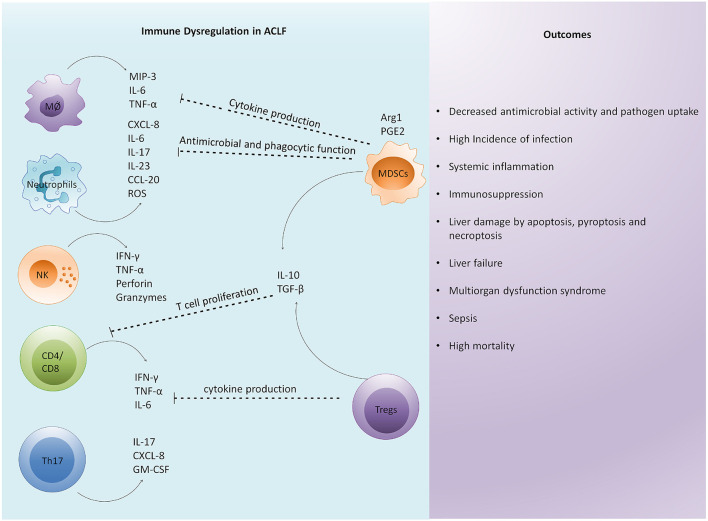
Immune dysregulation is a critical factor in the pathophysiology of ACLF. Excessive immune activation drives systemic and intrahepatic cytokine storms in patients with ACLF leading to inflammation. Enormous cytokine secretion in the liver results in the infiltration of circulating immune cells that further induce hepatic damage. Subsequently, an antiinflammatory response is generated to control excessive inflammation. However, excessive antiinflammatory response by regulatory cells impairs the function of other immune cells by inhibiting their antimicrobial and phagocytic activities, cytokine secretion, and T cell proliferation. The overall immune dysregulation increases the risk of infection and sepsis development. In addition, it induces distinct cell death related pathways in the liver, causing multiorgan dysfunction leading to high mortality. MØ, macrophage; NK cells, natural killer cells; MIP-3, macrophage inflammatory protein; TNF-α, tumor necrosis factor- α; IFN-γ, interferon-γ; ROS, reactive oxygen species; GM-CSF, granulocyte macrophage colony stimulating factor; Arg1, arginase-1; PGE2, prostaglandin E2; MDSC, myeloid derived suppressor cells; Tregs, regulatory T cells; TGF-β, transforming growth factor-β.
Figure 3
Figure 3
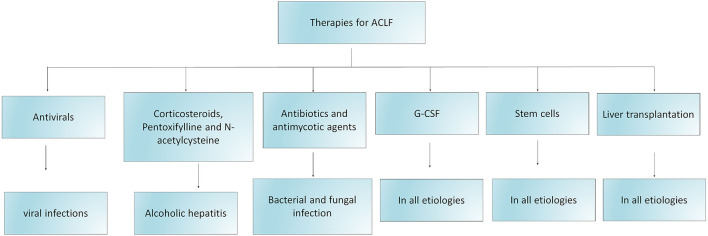
Schematic diagram indicating therapeutic strategies for the management of ACLF. The figure demonstrates different treatment options for patients with ACLF based on their etiology, precipitating events, complications and the requirement of liver transplantation. Several clinical trials are investigating the efficacy of stem cell therapy as one of the potential therapeutic approach for the treatment of ACLF. G-CSF: granulocyte macrophage colony stimulating factor.
Figure 4
Figure 4
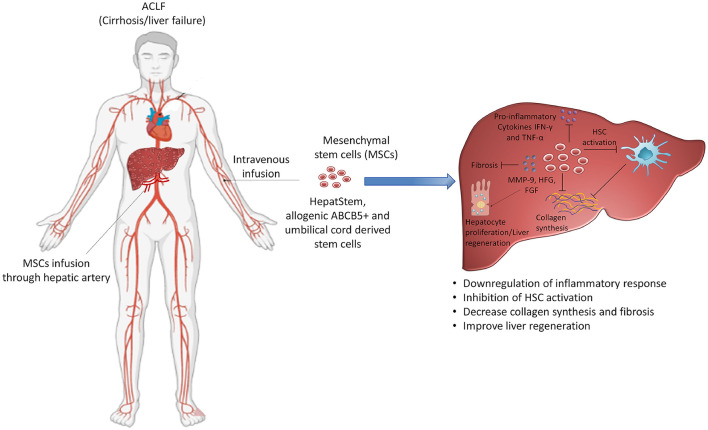
Targeting stem cell therapy for the treatment of ACLF. Use of mesenchymal stem cells is under consideration and is being investigated in clinical trials for the treatment of ACLF. Mesenchymal stem cells possess different functions including the suppression of hyperactive inflammatory response, inhibition of hepatic stellate cell activation and collagen synthesis, reducing fibrosis and inducing liver regeneration. The diverse role of mesenchymal stem cells may benefit patients with ACLF and emerge as a potential therapeutic option for these patients. HSC: hepatic stellate cells. Some parts of this figure (Human structure) were prepared with the help of BioRender.

References

    1. Moreau R, Jalan R, Gines P, Pavesi M, Angeli P, Cordoba J, et al. Acute-on-chronic liver failure is a distinct syndrome that develops in patients with acute decompensation of cirrhosis. Gastroenterology. (2013) 144:1426–37:37 e1–9. 10.1053/j.gastro.2013.02.042 - DOI - PubMed
    1. Sarin SK, Kedarisetty CK, Abbas Z, Amarapurkar D, Bihari C, Chan AC, et al. Acute-on-chronic liver failure: consensus recommendations of the Asian Pacific Association for the Study of the Liver (APASL) (2014). Hepatol Int. (2014) 8:453–71. 10.1007/s12072-014-9580-2 - DOI - PubMed
    1. Mahmud N, Kaplan DE, Taddei TH, Goldberg DS. Incidence and mortality of acute-on-chronic liver failure using two definitions in patients with compensated cirrhosis. Hepatology. (2019) 69:2150–63. 10.1002/hep.30494 - DOI - PMC - PubMed
    1. O'Leary JG, Reddy KR, Garcia-Tsao G, Biggins SW, Wong F, Fallon MB, et al. NACSELD acute-on-chronic liver failure (NACSELD-ACLF) score predicts 30-day survival in hospitalized patients with cirrhosis. Hepatology. (2018) 67:2367–74. 10.1002/hep.29773 - DOI - PubMed
    1. Huang K, Hu JH, Wang HF, He WP, Chen J, Duan XZ, et al. Survival and prognostic factors in hepatitis B virus-related acute-on-chronic liver failure. World J Gastroenterol. (2011) 17:3448–52. 10.3748/wjg.v17.i29.3448 - DOI - PMC - PubMed

LinkOut - more resources