Review
. 2020 Feb 13:16:18-24.
doi: 10.1016/j.clinms.2020.02.001. eCollection 2020 Apr.

Quantification of volatile metabolites in exhaled breath by selected ion flow tube mass spectrometry, SIFT-MS

Affiliations
Review

Quantification of volatile metabolites in exhaled breath by selected ion flow tube mass spectrometry, SIFT-MS

Patrik Španěl et al. Clin Mass Spectrom. .

Abstract

Selected ion flow tube mass spectrometry, SIFT-MS, is a non-separative method for direct quantitative analyses of volatile compounds, VOCs, in air and humid breath based on chemical ionization. Selected reagent ions, either H3O+, NO+ or O2 + (non-reactive with major components of air), ionize analyte molecules during a defined time in a flow tube by ion-molecule reactions thus producing analyte ions that are characteristic of the neutral analyte VOCs. Concentrations can be calculated in real-time from the ion count rates. Direct on-line analysis of single or multiple breath exhalations or off-line analysis of breath samples collected into bags can be performed. Several volatile breath metabolites have been quantified by SIFT-MS, including ammonia, acetone, hydrogen cyanide, alcohols, pentane, acetic acid, methane, and sulphur compounds. Their potential as biomarkers is discussed.

Keywords: Biomarkers; Breath VOCs; Metabolites; SIFT-MS.


Figures

Fig. 1
Fig. 1
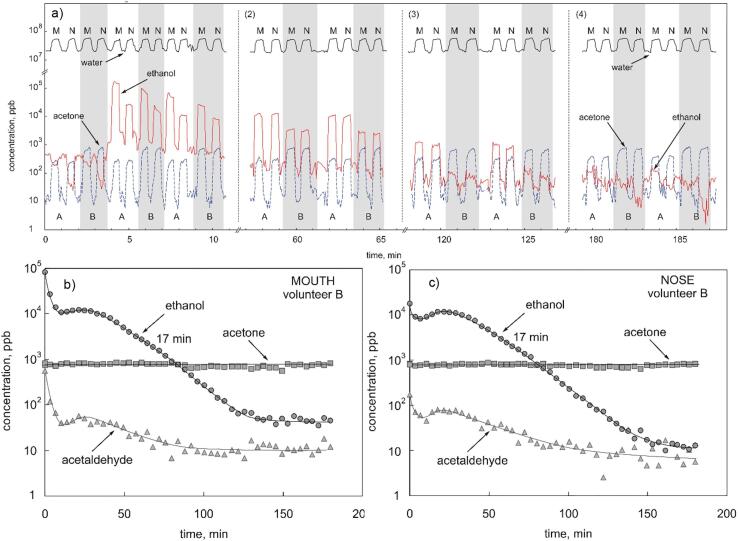
SIFT-MS MIM time profiles of water vapour, acetone and ethanol concentrations (in ppbv) measured in alternating mouth (M) and nose (N) exhalations of two volunteers, labelled A and B, after ingestion of 15 mL (by A) and 7.5 mL (by B) of ethanol diluted in 250 mL of water. a) raw data showing concentration in single exhalations, b) variation of concentration with time, including acetaldehyde, for these compounds in mouth exhalations (by B), c) the same for the nose exhalations. The exponential decay rates are both indicated as 17 min. Reproduced from with permission from Wiley.
Fig. 2
Fig. 2
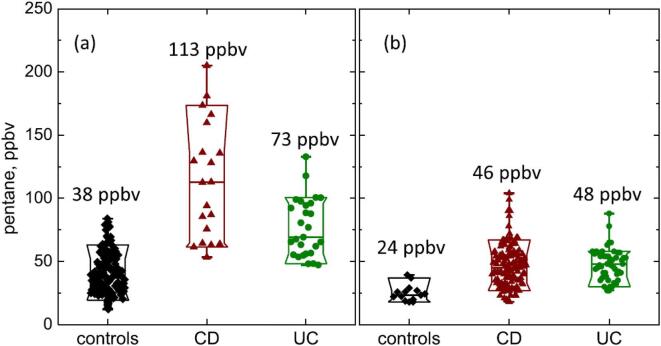
Box-and-whisker plot of breath pentane concentrations, in ppbv, for healthy controls, CD and UC cohorts: (a) data obtained from direct exhalations , (b) data obtained from bag samples of breath . Median values are as indicated. Reproduced from with permission from IOP Publishing.
Fig. 3
Fig. 3
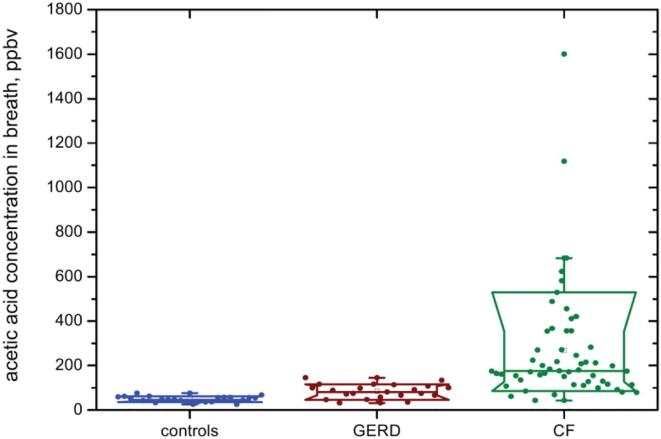
Exhaled breath concentrations of acetic acid measured by SIFT-MS in healthy controls and in patients with GERD and CF. Reproduced from with permission from IOP publishing.
Fig. 4
Fig. 4
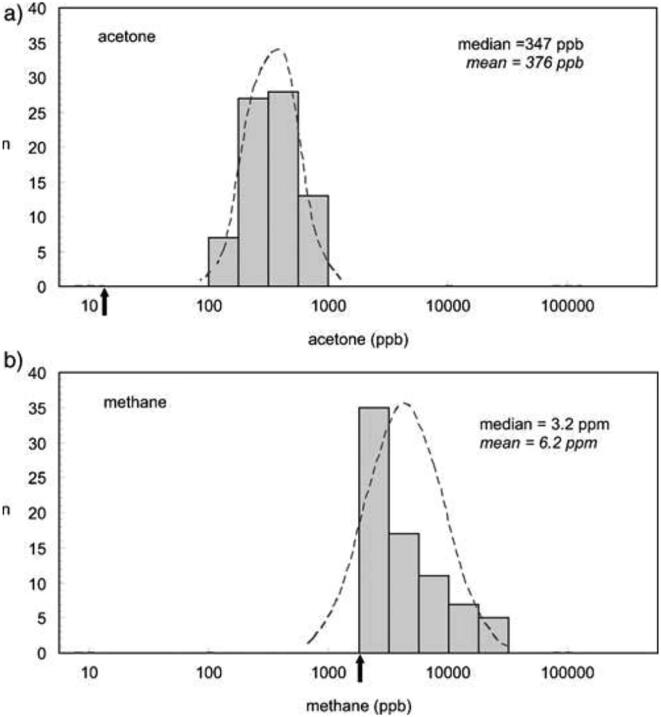
Vertical bar charts of the population distributions of the log-transformed concentrations (in ppbv) of a) acetone and b) methane. The dashed curves are fitted log-normal distributions, indicating a good match for acetone, as is usual, and a poor match for methane. The ambient air concentrations are indicated by the black arrows. Reproduced from with permission from IOP publishing.

References

    1. Turner C. Techniques and issues in breath and clinical sample headspace analysis for disease diagnosis. Bioanalysis. 2016;8:677–690. doi: 10.4155/bio.16.22. - DOI - PubMed
    1. Casas-Ferreira A.M., del Nogal-Sanchez M., Perez-Pavon J.L., Moreno-Cordero B. Non-separative mass spectrometry methods for non-invasive medical diagnostics based on volatile organic compounds: a review. Anal. Chim. Acta. 2019;1045:10–22. doi: 10.1016/j.aca.2018.07.005. - DOI - PubMed
    1. Smith D., Španěl P., Herbig J., Beauchamp J. Mass spectrometry for real-time quantitative breath analysis. J. Breath Res. 2014;8 doi: 10.1088/1752-7155/8/2/027101. - DOI - PubMed
    1. Sinues P.M.L., Kohler M., Zenobi R. Monitoring diurnal changes in exhaled human breath. Anal. Chem. 2013;85:369–373. doi: 10.1021/ac3029097. - DOI - PubMed
    1. Španěl P., Smith D. Progress in SIFT-MS; breath analysis and other applications. Mass Spectrom. Rev. 2011;30:236–267. doi: 10.1002/mas.20303. - DOI - PubMed