Meta-Analysis
. 2021 Nov 22;11(11):469.
doi: 10.3390/bios11110469.

Accuracy of the Electronic Nose Breath Tests in Clinical Application: A Systematic Review and Meta-Analysis

Affiliations
Meta-Analysis

Accuracy of the Electronic Nose Breath Tests in Clinical Application: A Systematic Review and Meta-Analysis

Hsiao-Yu Yang et al. Biosensors (Basel). .

Abstract

(1) Background: An electronic nose applies a sensor array to detect volatile biomarkers in exhaled breath to diagnose diseases. The overall diagnostic accuracy remains unknown. The objective of this review was to provide an estimate of the diagnostic accuracy of sensor-based breath tests for the diagnosis of diseases. (2) Methods: We searched the PubMed and Web of Science databases for studies published between 1 January 2010 and 14 October 2021. The search was limited to human studies published in the English language. Clinical trials were not included in this review. (3) Results: Of the 2418 records identified, 44 publications were eligible, and 5728 patients were included in the final analyses. The pooled sensitivity was 90.0% (95% CI, 86.3-92.8%, I2 = 47.7%), the specificity was 88.4% (95% CI, 87.1-89.5%, I2 = 81.4%), and the pooled area under the curve was 0.93 (95% CI 0.91-0.95). (4) Conclusion: The findings of our review suggest that a standardized report of diagnostic accuracy and a report of the accuracy in a test set are needed. Sensor array systems of electronic noses have the potential for noninvasiveness at the point-of-care in hospitals. Nevertheless, the procedure for reporting the accuracy of a diagnostic test must be standardized.

Keywords: breath test; breathomics; electronic nose; sensors; volatile organic compound.


Conflict of interest statement

The authors declare no conflict of interest.

Figures
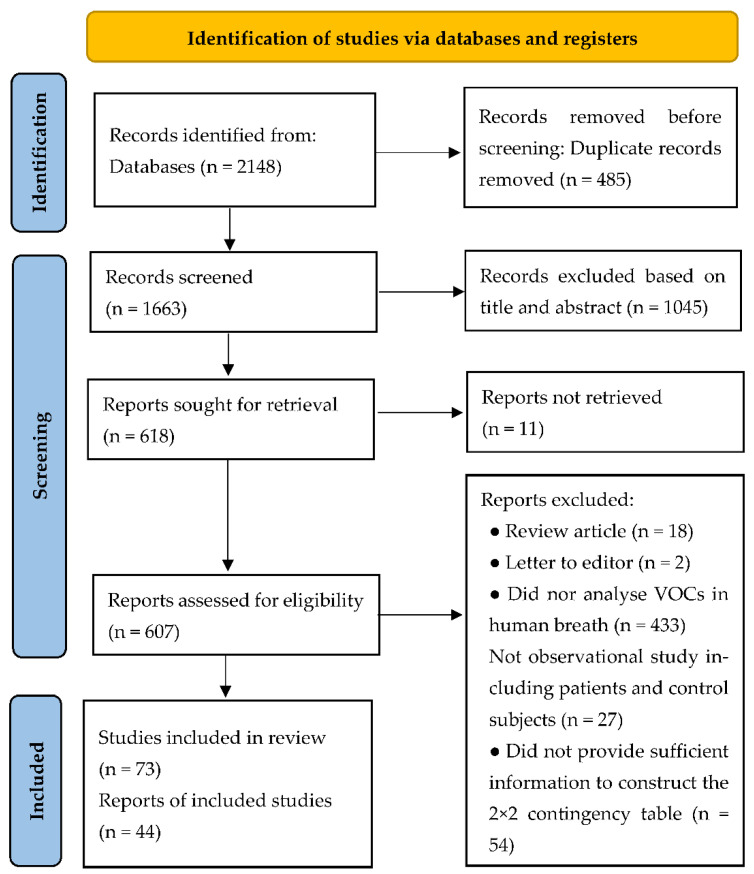
Figure 1
Figure 1
PRISMA flow chart of literature search.
Figure 2
Figure 2
Summary receiver operating characteristic curve graph of the included studies. The accuracy using all data was higher than that of the test set.
Figure 3
Figure 3
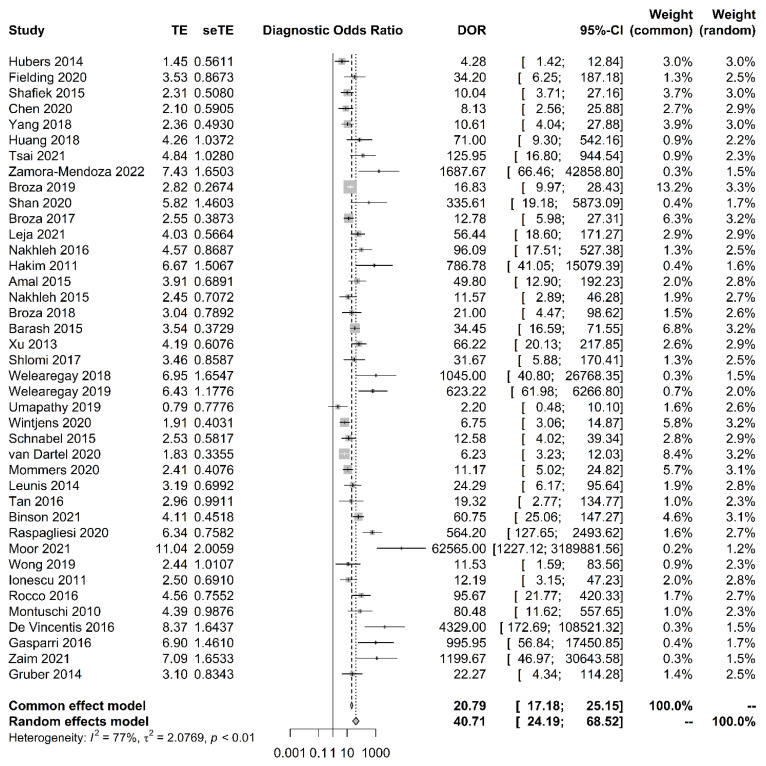
Forest plot and pooled diagnostic odds ratio analysis. Vertical dashed lines indicate 95% CI for the pooled effect. The size of the data markers reflects the weight. Error bars indicate 95% CI.
Figure 4
Figure 4
Funnel plot of the diagnostic odds ratio. A skewed asymmetrical funnel plot shows that there is publication bias. In the right lower corner, the small sample size studies (therefore large standard error) are more prone to publication bias than large studies.
Figure 5
Figure 5
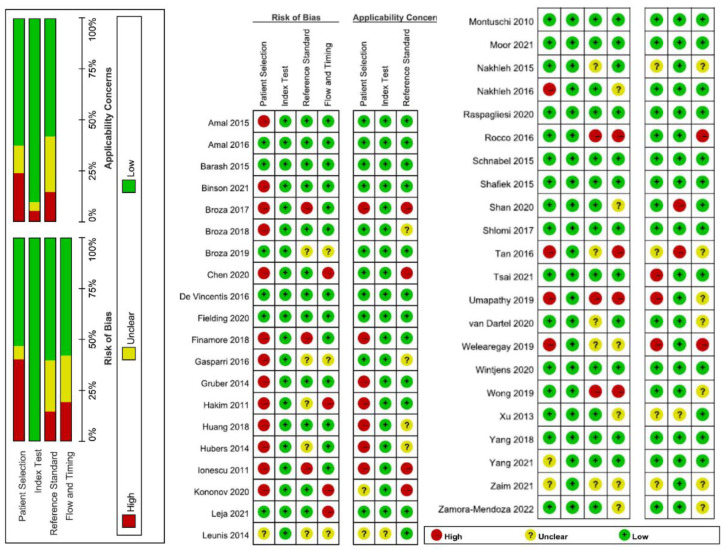
Quality assessment of included studies by the QUADAS-2 tool. This figure shows the proportion of studies with low (green colour), unclear (yellow), and high risk/concern (red). In terms of the overall risk of bias, there were concerns about the risk of bias for 26.5% of the studies (13/44), with two of these assessed as at high risk of bias.
Figure 6
Figure 6
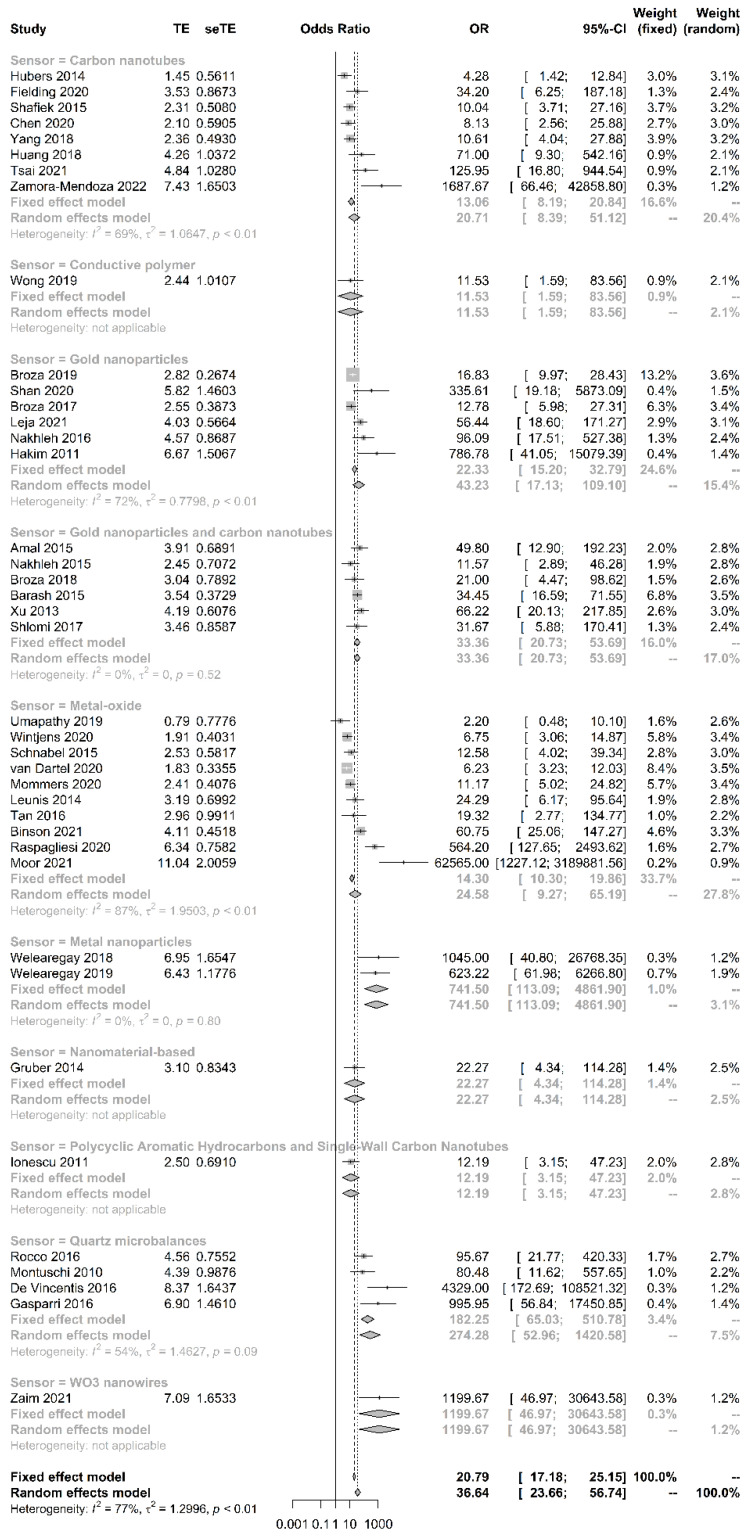
Subgroup analysis for pooled diagnostic odds ratio based on the type of sensor. The type of sensor is based on the classification provided in the literature.

References

    1. Van der Schee M.P., Paff T., Brinkman P., van Aalderen W.M., Haarman E.G., Sterk P.J. Breathomics in lung disease. Chest. 2015;147:224–231. doi: 10.1378/chest.14-0781. - DOI - PubMed
    1. Hakim M., Broza Y.Y., Barash O., Peled N., Phillips M., Amann A., Haick H. Volatile organic compounds of lung cancer and possible biochemical pathways. Chem. Rev. 2012;112:5949–5966. doi: 10.1021/cr300174a. - DOI - PubMed
    1. Queralto N., Berliner A.N., Goldsmith B., Martino R., Rhodes P., Lim S.H. Detecting cancer by breath volatile organic compound analysis: A review of array-based sensors. J. Breath Res. 2014;8:027112. doi: 10.1088/1752-7155/8/2/027112. - DOI - PubMed
    1. Huang C.H., Zeng C., Wang Y.C., Peng H.Y., Lin C.S., Chang C.J., Yang H.Y. A Study of diagnostic accuracy using a chemical sensor array and a machine learning technique to detect lung cancer. Sensors. 2018;18:2845. doi: 10.3390/s18092845. - DOI - PMC - PubMed
    1. Yang H.Y., Wang Y.C., Peng H.Y., Huang C.H. Breath biopsy of breast cancer using sensor array signals and machine learning analysis. Sci. Rep. 2021;11:9. doi: 10.1038/s41598-020-80570-0. - DOI - PMC - PubMed

LinkOut - more resources