. 2021 Oct 28;11(11):740.
doi: 10.3390/metabo11110740.

Untargeted Lipidomics of Non-Small Cell Lung Carcinoma Demonstrates Differentially Abundant Lipid Classes in Cancer vs. Non-Cancer Tissue

Affiliations

Untargeted Lipidomics of Non-Small Cell Lung Carcinoma Demonstrates Differentially Abundant Lipid Classes in Cancer vs. Non-Cancer Tissue

Joshua M Mitchell et al. Metabolites. .

Abstract

Lung cancer remains the leading cause of cancer death worldwide and non-small cell lung carcinoma (NSCLC) represents 85% of newly diagnosed lung cancers. In this study, we utilized our untargeted assignment tool Small Molecule Isotope Resolved Formula Enumerator (SMIRFE) and ultra-high-resolution Fourier transform mass spectrometry to examine lipid profile differences between paired cancerous and non-cancerous lung tissue samples from 86 patients with suspected stage I or IIA primary NSCLC. Correlation and co-occurrence analysis revealed significant lipid profile differences between cancer and non-cancer samples. Further analysis of machine-learned lipid categories for the differentially abundant molecular formulas identified a high abundance sterol, high abundance and high m/z sphingolipid, and low abundance glycerophospholipid metabolic phenotype across the NSCLC samples. At the class level, higher abundances of sterol esters and lower abundances of cardiolipins were observed suggesting altered stearoyl-CoA desaturase 1 (SCD1) or acetyl-CoA acetyltransferase (ACAT1) activity and altered human cardiolipin synthase 1 or lysocardiolipin acyltransferase activity respectively, the latter of which is known to confer apoptotic resistance. The presence of a shared metabolic phenotype across a variety of genetically distinct NSCLC subtypes suggests that this phenotype is necessary for NSCLC development and may result from multiple distinct genetic lesions. Thus, targeting the shared affected pathways may be beneficial for a variety of genetically distinct NSCLC subtypes.

Keywords: Fourier-transform mass spectrometry; SMIRFE; lipidomics; non-small cell lung carcinoma.


Conflict of interest statement

The authors declare no conflict of interest. The funders had no role in the design of the study; in the collection, analyses, or interpretation of data; in the writing of the manuscript, or in the decision to publish the results.

Figures
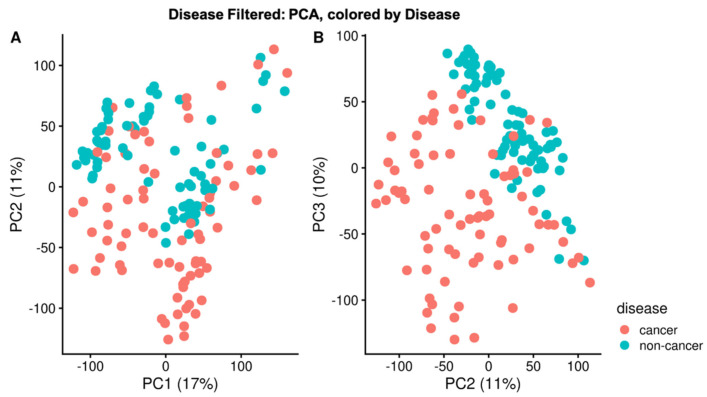
Figure 1
Figure 1
PCA by disease. PCA was performed on the normalized intensities of filtered corresponded peaks. Cancer and non-cancer samples separate partially along PC2 (Panel (A)) and more clearly along PC2 and PC3 (Panel (B)). This strongly suggests that PC2 and PC3 capture some of the biological variance between cancer and non-cancer Separation by disease class does not occur along PC1, instead, PC1 corresponds to the instrument on which the spectrum was acquired (Figure S1).
Figure 2
Figure 2
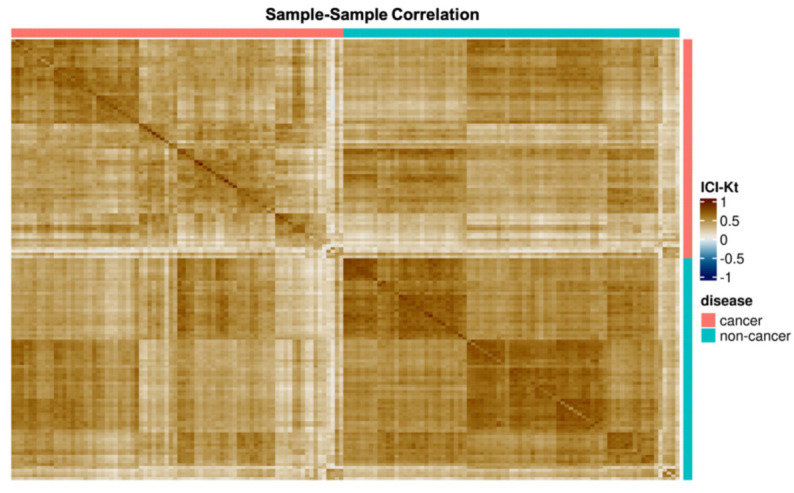
Correlation heatmap by disease. In general, samples belonging to the same disease class correlate more strongly with other samples in the same disease class. Stronger correlation patterns are observed within the non-cancer samples as compared to the cancer samples. In both cancer and non-cancer samples, there are multiple subgroups of samples that correlate more strongly with one another as well as occasional samples that have poor correlation with any other sample.
Figure 3
Figure 3
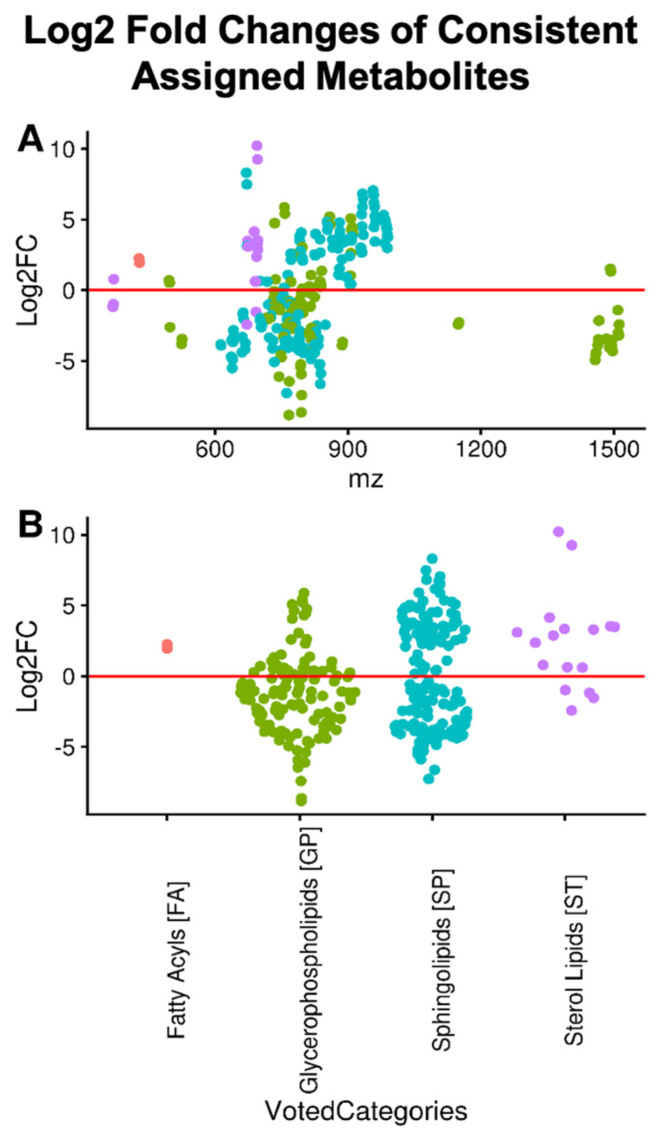
Log2 fold change by category and m/z. The Log2 fold-change (Log2FC) of corresponded peaks assigned to one lipid category are shown in panel (A) with respect to m/z and by class in panel (B). The extremely high fold-changes observed for some members of the sphingolipid and sterol lipid categories are due, in part, to imputed values. Most of the differentially abundant lipids occur in the 600 to 1000 m/z range; however, this region also has the highest density of assignments. Although no lipid category is exclusively more abundant, sterols are predominantly more abundant while substantial numbers of both sphingolipids and glycerophospholipids are more and less abundant.
Figure 4
Figure 4
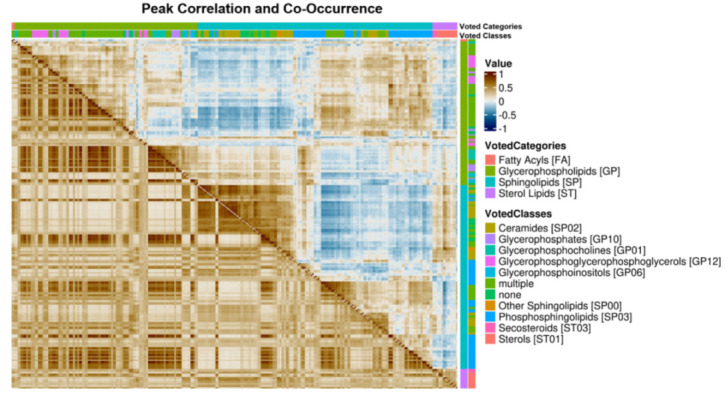
Peak correlation and peak co-occurrence combined heatmap. The upper-right corner shows the Kendall-tau correlation among consistently assigned lipid features. Strong intra-category correlation is observed for some lipids which possibly results from co-regulation. Shown in the bottom-left is the co-occurrence of consistently assigned lipid features. There are two sub-populations of sterols: one that co-occurs with a sub-population of sphingolipids and another that co-occurs with a sub-population of glycerophospholipids. The biological relevance of this co-occurrence is unclear. Alternatively, this co-occurrence may simply be artifactual, if these lipids were generally of lower relative abundance.
Figure 5
Figure 5
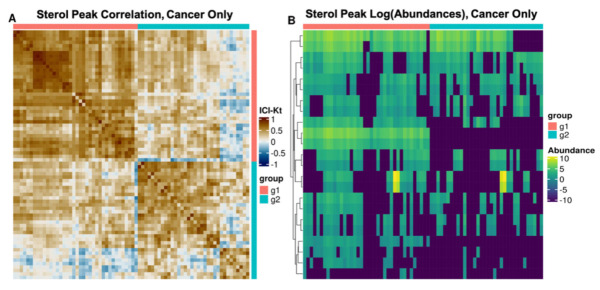
Sterol-only cancer sample-sample correlation heatmap. ICI-Kendall-tau correlation heatmap (A) and abundance heatmap across samples (B). Both plots show that the cancer samples can be separated into two groups based on the sample-sample correlation; however, these groups do not correspond to a histological subtype of NSCLC. As indicated in Figure 4, there also appear to be two main groups of sterol peaks in (B).

References

    1. Kanitkar A.A., Schwartz A.G., George J., Soubani A.O. Causes of death in long-term survivors of non-small cell lung cancer: A regional Surveillance, Epidemiology, and End Results study. Ann. Thorac. Med. 2018;13:76. - PMC - PubMed
    1. Molina J.R., Yang P., Cassivi S.D., Schild S.E., Adjei A.A. Non-small cell lung cancer: Epidemiology, risk factors, treatment, and survivorship. Mayo. Clin. Proc. 2008;83:584–594. doi: 10.1016/S0025-6196(11)60735-0. - DOI - PMC - PubMed
    1. Onoi K., Chihara Y., Uchino J., Shimamoto T., Morimoto Y., Iwasaku M., Kaneko Y., Yamada T., Takayama K. Immune checkpoint inhibitors for lung cancer treatment: A review. J. Clin. Med. 2020;9:1362. doi: 10.3390/jcm9051362. - DOI - PMC - PubMed
    1. Gettinger S., Choi J., Hastings K., Truini A., Datar I., Sowell R., Wurtz A., Dong W., Cai G., Melnick M.A. Impaired HLA class I antigen processing and presentation as a mechanism of acquired resistance to immune checkpoint inhibitors in lung cancer. Cancer Discov. 2017;7:1420–1435. doi: 10.1158/2159-8290.CD-17-0593. - DOI - PMC - PubMed
    1. Liu W.-j., Du Y., Wen R., Yang M., Xu J. Drug resistance to targeted therapeutic strategies in non-small cell lung cancer. Pharmacol. Ther. 2020;206:107438. doi: 10.1016/j.pharmthera.2019.107438. - DOI - PubMed

LinkOut - more resources