


Plant LHC-like proteins show robust folding and static non-photochemical quenching
- PMID: 34824207
- PMCID: PMC8617258
- DOI: 10.1038/s41467-021-27155-1
Plant LHC-like proteins show robust folding and static non-photochemical quenching
Erratum in
-
Author Correction: Plant LHC-like proteins show robust folding and static non-photochemical quenching.Nat Commun. 2022 Mar 16;13(1):1528. doi: 10.1038/s41467-022-29099-6. Nat Commun. 2022. PMID: 35296680 Free PMC article. No abstract available.
Abstract
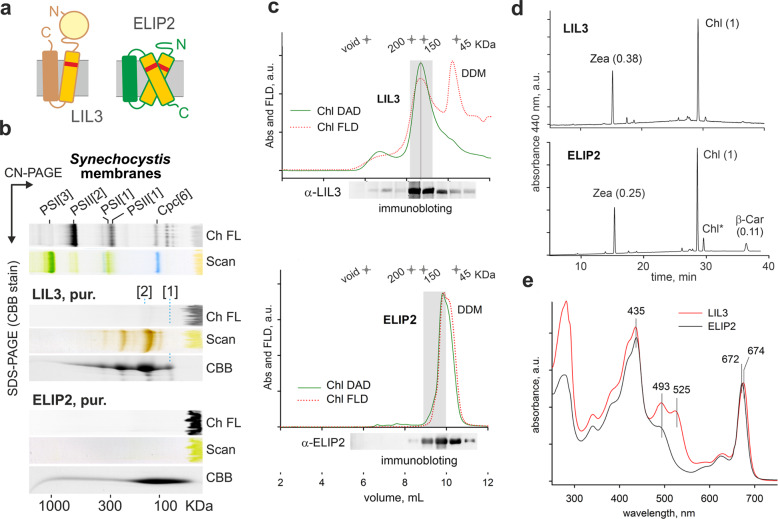
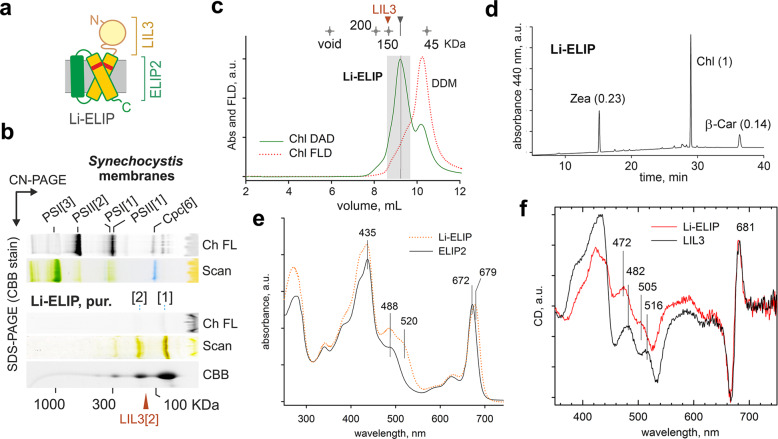
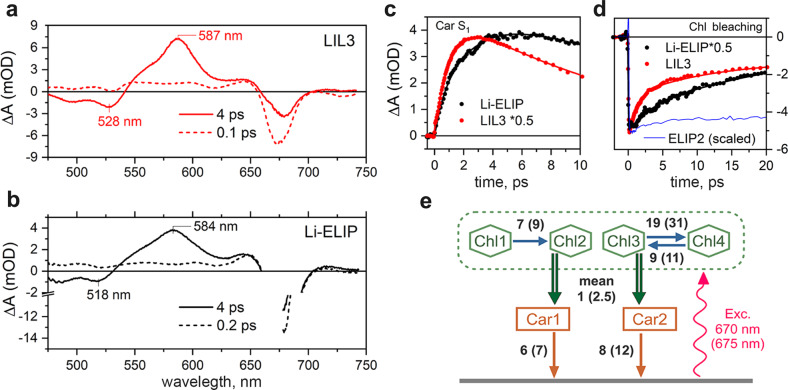
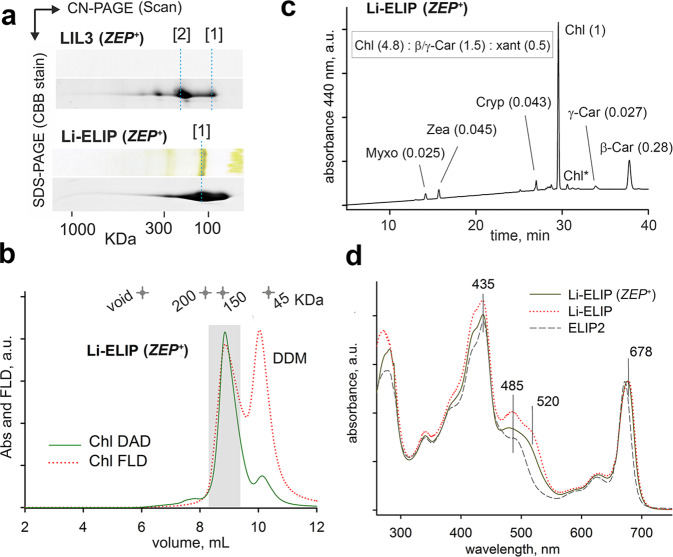
Life on Earth depends on photosynthesis, the conversion of light energy into chemical energy. Plants collect photons by light harvesting complexes (LHC)-abundant membrane proteins containing chlorophyll and xanthophyll molecules. LHC-like proteins are similar in their amino acid sequence to true LHC antennae, however, they rather serve a photoprotective function. Whether the LHC-like proteins bind pigments has remained unclear. Here, we characterize plant LHC-like proteins (LIL3 and ELIP2) produced in the cyanobacterium Synechocystis sp. PCC 6803 (hereafter Synechocystis). Both proteins were associated with chlorophyll a (Chl) and zeaxanthin and LIL3 was shown to be capable of quenching Chl fluorescence via direct energy transfer from the Chl Qy state to zeaxanthin S1 state. Interestingly, the ability of the ELIP2 protein to quench can be acquired by modifying its N-terminal sequence. By employing Synechocystis carotenoid mutants and site-directed mutagenesis we demonstrate that, although LIL3 does not need pigments for folding, pigments stabilize the LIL3 dimer.
© 2021. The Author(s).
Conflict of interest statement
The authors declare no competing interests.
Figures
References
-
- Hashimoto H, Uragami C, Cogdell RJ. Carotenoids and photosynthesis. Subcell. Biochem. 2016;79:111–139. - PubMed
-
- Toporik H, Li J, Williams D, Chiu PL, Mazor Y. The structure of the stress-induced photosystem I-IsiA antenna supercomplex. Nat. Struct. Mol. Biol. 2019;26:443–449. - PubMed
-
- Shukla MK, et al. Binding of pigments to the cyanobacterial high-light-inducible protein HliC. Photosyn. Res. 2018;137:29–39. - PubMed
-
- Staleva H, et al. Mechanism of photoprotection in the cyanobacterial ancestor of plant antenna proteins. Nat. Chem. Biol. 2015;11:287–291. - PubMed
Publication types
MeSH terms
Substances
Grants and funding
LinkOut - more resources
Full Text Sources
Other Literature Sources
