


Impact of the COVID-19 pandemic on breast and cervical cancer stage at diagnosis in Brazil
- PMID: 34824622
- PMCID: PMC8580713
- DOI: 10.3332/ecancer.2021.1299
Impact of the COVID-19 pandemic on breast and cervical cancer stage at diagnosis in Brazil
Abstract
Background: The COVID-19 pandemic has led to the need for health services adjustments, which may have compromised management of other diseases. For cancer patients, delays may significantly impair outcomes in some situations. We aimed to assess the impact of the COVID-19 pandemic in breast and cervical cancer diagnosis and treatment compared to the same period prior to the pandemic.
Methods: Data were collected from patients attending their first visit to a Brazilian cancer centre from 1 September 2020 to 31 January 2021 and from 1 September 2019 to 31 January 2020. The pandemic started in February 2020 in Brazil and is still ongoing. We considered this period (September/20-January/21) to be representative of the pandemic impact on cancer management. The primary endpoint was breast and cervical cancer stages at diagnosis.
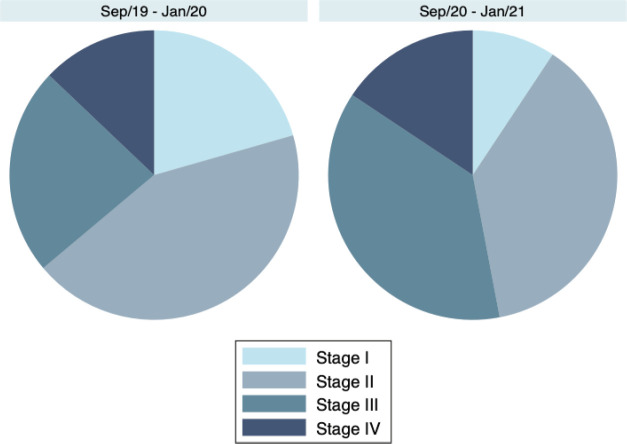
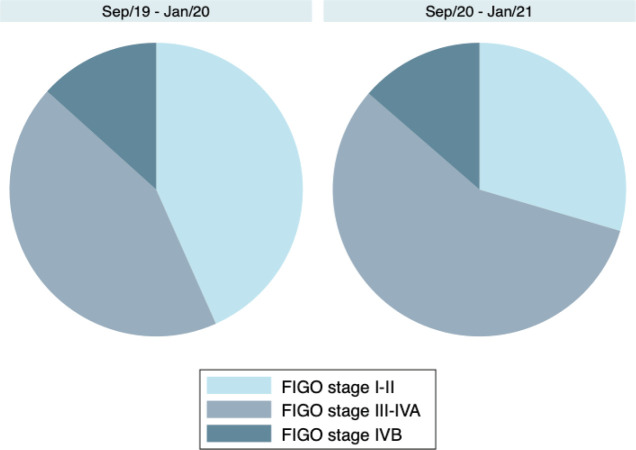
Results: A total of 268 breast cancer patients and 44 cervical cancer patients had their first consult in our cancer centre from September/20 to January/21; 457 and 60, respectively, occurred from September/19 to January/20. Patients who attended their first visit during the pandemic (September/20-January/21) presented with more advanced-stage breast cancer (p < 0.001) and cervical cancer (p = 0.328) than those in the period prior to the pandemic (September/19-January/20), although the difference was not statistically significant for cervical cancer. The proportion of cervical cancer patients diagnosed with locally advanced disease (stages III-IVA) was 56.8% (N = 25) in September/20-January/21 compared to 43.3% (N = 26) in September/19-January/20. Similarly, 37.3% (N = 100) of breast cancer patients had stage III disease in September/20-January/21 compared to 23.2% (N = 106) in September/19-January/20. Fewer breast cancer patients (13.7%) were diagnosed due to screening tests during the pandemic than before it (25.5%) (p < 0.001).
Conclusions: Breast and cervical cancer patients had more advanced-stage diseases in their first visit to a cancer centre during the COVID-19 pandemic compared to a similar period prior to the pandemic. Efforts should be made not to compromise essential cancer services since this results in long-term negative impacts for oncologic patients.
Keywords: COVID-19; breast cancer; cervical cancer; diagnosis; pandemic; stage.
© the authors; licensee ecancermedicalscience.
Conflict of interest statement
RCB has received grant and financial support for educational programmes from AstraZeneca; grant from Novartis; financial support for attending symposia from Roche and AstraZeneca; and personal fee for expert testimony from Ache, outside the submitted work. LT has received grant from Novartis, personal fee for expert testimony from MSD, Lilly, Novartis and Genomic Health, fee for non-continuing medical education services from Lilly, Novartis, Pfizer, Roche and Libbs, travel support from Pfizer, Roche, Libbs and United Medical, outside the submitted work. All other authors have no disclosure/conflict of interest.
Figures
References
-
- INCA. Nota técnica sobre Detecção precoce de câncer durante a pandemia de Covid-19. 2020. [03/20]. [ https://www.inca.gov.br/sites/ufu.sti.inca.local/files//media/document//....
-
- Suplementar. ANdS. ANS orienta: consultas, exames e cirurgias que não sejam urgentes devem ser adiados. 2020. [17/03/20]. [ http://www.ans.gov.br/aans/noticias-ans/consumidor/5426-ans-orienta-cons...]
-
- Paulo RVS. “Não temos mais quarentena em São Paulo”, diz João Doria. 2021. [18/08/21]. [ https://vejasp.abril.com.br/saude/nao-temos-mais-quarentena-joao-doria-s...]
LinkOut - more resources
Full Text Sources