


Different Resting Methods in Improving Laypersons Hands-Only Cardiopulmonary Resuscitation Quality and Reducing Fatigue: A Randomized Crossover Study
- PMID: 34825237
- PMCID: PMC8605240
- DOI: 10.1016/j.resplu.2021.100177
Different Resting Methods in Improving Laypersons Hands-Only Cardiopulmonary Resuscitation Quality and Reducing Fatigue: A Randomized Crossover Study
Abstract
Objective: To determine the effects of different resting methods with various rest-start points or rest-compression ratios on improving cardiopulmonary resuscitation (CPR) quality and reducing fatigue during continuous chest compressions (CCC) in 10-min hands-only CPR scenario.
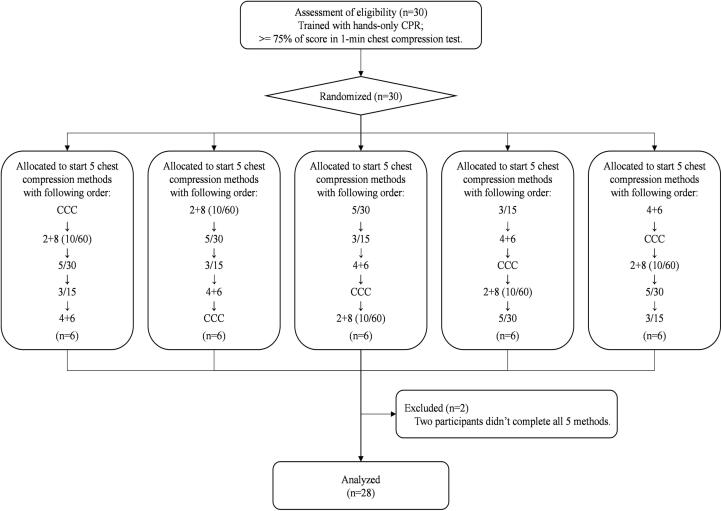
Methods: This prospective crossover study was conducted in 30 laypersons aged 18-65. Trained participants were randomized to follow different orders to perform following hands-only CPR methods: (1) CCC, 10-min CCC; (2) 4+6, 4-min CCC + 6-min of 10-s pause after 60-s compressions; (3) 2+8 (10/60), 2-min CCC + 8-min of 10-s pause after 60-s compressions; (4) 5/30, 2-min CCC + 8-min of 5-s pause after 30-s compressions; (5) 3/15, 2-min CCC + 8-min of 3-s pause after 15-s compressions. CPR quality (depth, rate, hands-off duration, chest compression fraction (CCF)) and participants' fatigue indicators (heart rate, blood pressure, rating of perceived exertion (RPE)) were compared among methods of different rest-start points and different rest-compression ratios with CCC.
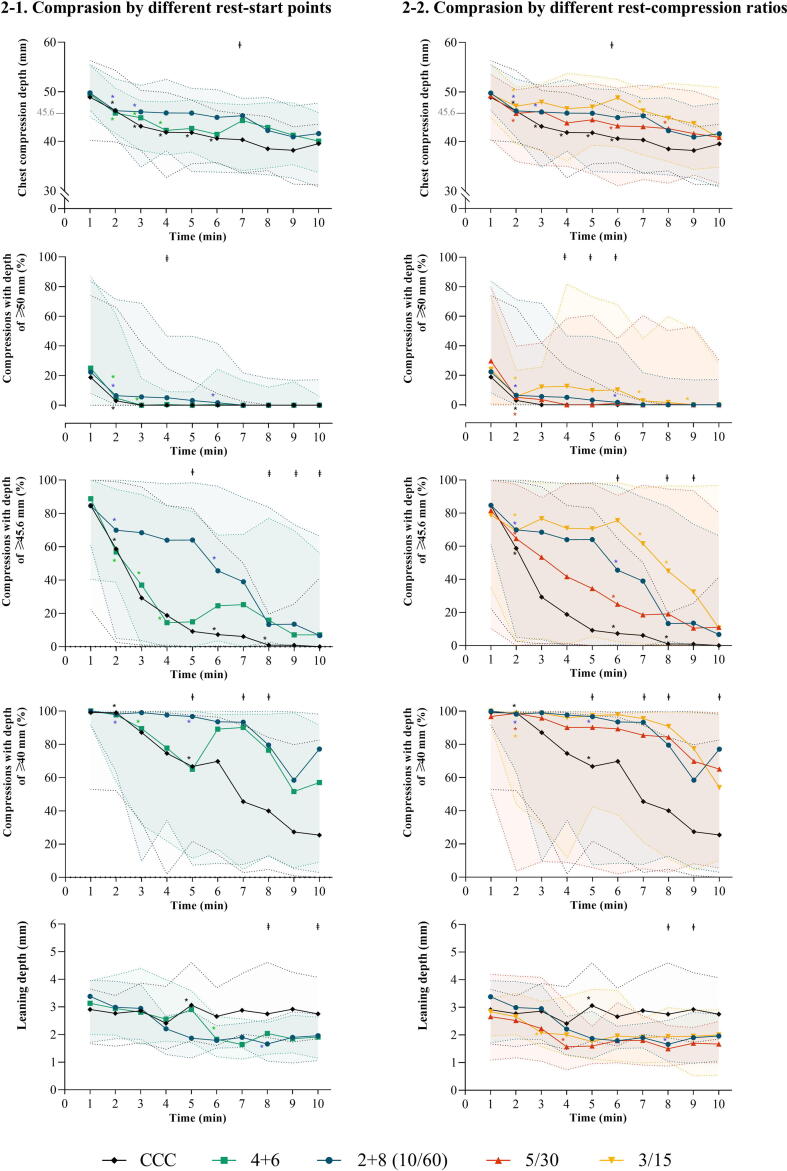
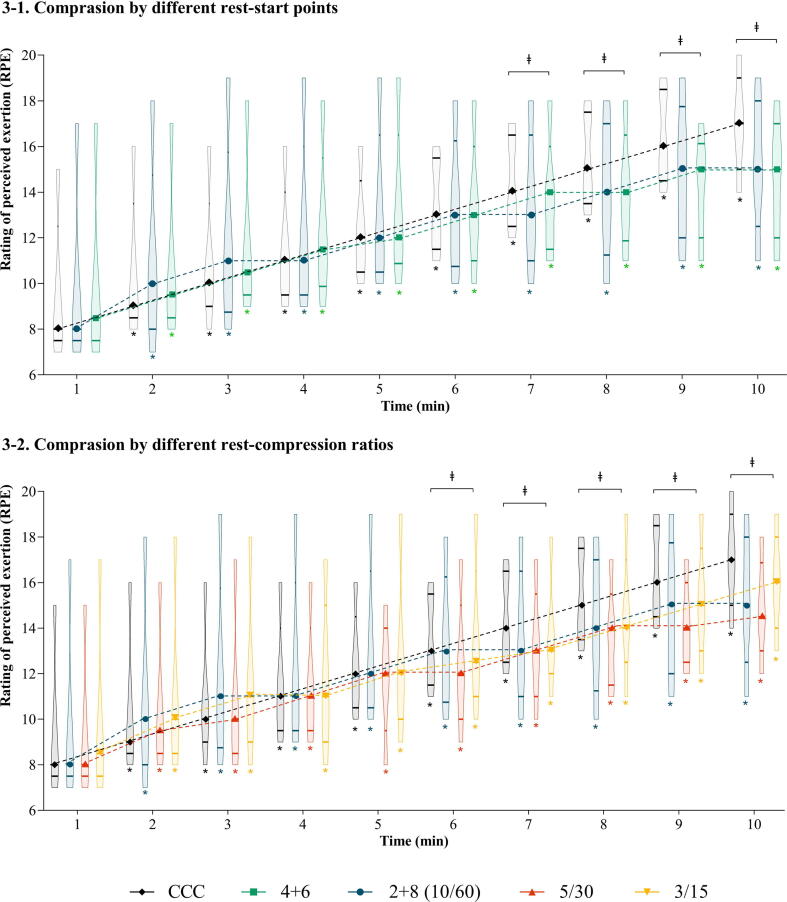
Results: Twenty-eight participants completed all methods. All resting methods reduced the trend of declining compression depth and the trend of increasing RPE while maintaining CCF of more than 86%. In methods with different rest-start points, the 2+8 method showed no difference in overall CPR quality or fatigue, but better CPR quality of every minute than 4+6 method. In methods with different rest-compression ratios, the 3/15 method showed the best CPR quality and the highest heart rate increment.
Conclusion: During prolonged hands-only CPR, appropriate transient rests were associated with higher CPR quality and lower subjectively perceived fatigue in laypersons.
Keywords: Hands-only CPR; High-quality CPR; Laypeople; Rescuer fatigue; Rest.
© 2021 The Author(s).
Conflict of interest statement
The authors declare that they have no known competing financial interests or personal relationships that could have appeared to influence the work reported in this paper.
Figures
References
-
- Olasveengen TM, Mancini ME, Perkins GD, et al. Adult Basic Life Support: 2020 International Consensus on Cardiopulmonary Resuscitation and Emergency Cardiovascular Care Science With Treatment Recommendations. Circulation 2020;142(16_suppl_1):S41-s910.1161/cir.0000000000000892 [published Online First: 2020/10/22]. - PubMed
-
- Olasveengen T.M., Semeraro F., Ristagno G., et al. European Resuscitation Council Guidelines 2021: Basic Life Support. Resuscitation. 2021;161:98–114. - PubMed
-
- Panchal AR, Bartos JA, Cabañas JG, et al. Part 3: Adult Basic and Advanced Life Support: 2020 American Heart Association Guidelines for Cardiopulmonary Resuscitation and Emergency Cardiovascular Care. Circulation 2020;142(16_suppl_2):S366-s468. 10.1161/cir.0000000000000916 [published Online First: 2020/10/22]. - PubMed
-
- Ogawa T., Akahane M., Koike S., et al. Outcomes of chest compression only CPR versus conventional CPR conducted by lay people in patients with out of hospital cardiopulmonary arrest witnessed by bystanders: nationwide population based observational study. Bmj. 2011;342 doi: 10.1136/bmj.c7106. - DOI - PubMed
LinkOut - more resources
Full Text Sources
