


doi: 10.1016/j.ipej.2021.11.007.
Epub 2021 Nov 24.
Coumel's sign reversed: What is the mechanism?
Affiliations
- PMID: 34826604
- PMCID: PMC8981158
- DOI: 10.1016/j.ipej.2021.11.007
Item in Clipboard
Coumel's sign reversed: What is the mechanism?
Indian Pacing Electrophysiol J.
2022 Mar-Apr.
Erratum in
-
Erratum regarding missing ethical statements in previously published articles.Indian Pacing Electrophysiol J. 2024 May-Jun;24(3):178. doi: 10.1016/j.ipej.2024.04.004. Epub 2024 Apr 12. Indian Pacing Electrophysiol J. 2024. PMID: 38615823 Free PMC article. No abstract available.
Abstract
A patient presented with documented narrow QRS tachycardia. During electrophysiological study, he has orthodromic reciprocating tachycardia with atrial activation consistent with left free wall accessory pathway. With induction of tachycardia, beats with LBBB morphology have shorter cycle length than those with narrow QRS. What is the mechanism?
Keywords: CL increase with narrow QRS; Dual AV nodal Physiology; Reverse Coumel.
Copyright © 2021 Indian Heart Rhythm Society. Published by Elsevier B.V. All rights reserved.
Conflict of interest statement
Declaration of competing interest None for any of the authors.
Figures
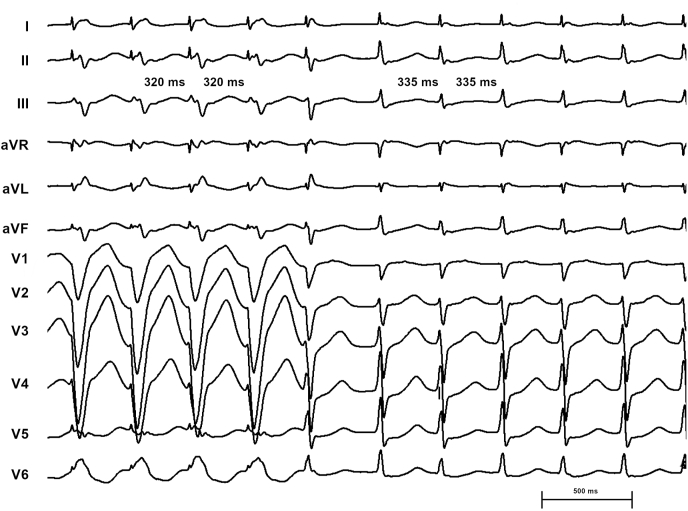
Electrocardiogram showing increase in tachycardia cycle length on transition from LBBB to narrow QRS LBBB- Left bundle branch block.

Same as Fig. 1 with intracardiac recordings CS 9, 10 to CS 1,2 – coronary sinus proximal to distal, Hisd, Hism and His p- His distal to proximal, HRA-high right atrium, RV- right ventricle.
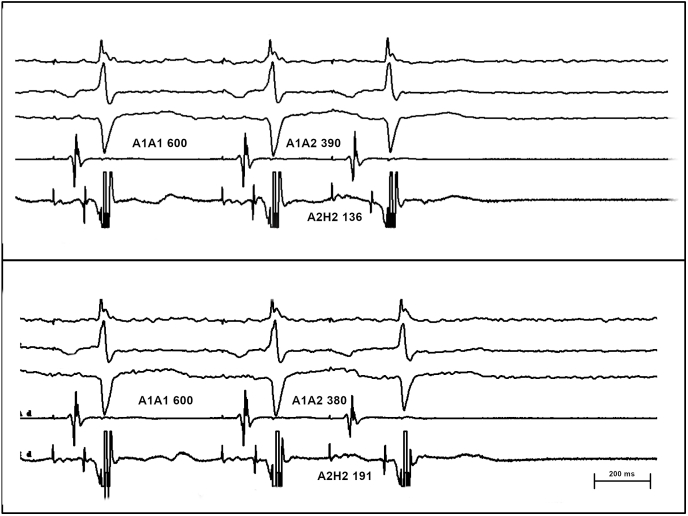
AH jump (55 ms) produced by 10 ms decrement in atrial extrastimulus suggesting dual AV nodal physiology. Stimulation was done from mid coronary sinus electrodes (not shown in the image).
References
-
- Coumel P., Attuel P. Reciprocating tachycardia in overt and latent preexcitation. Influence of functional bundle branch block on the rate of the tachycardia. Eur J Cardiol. 1974;1(4):423–436. - PubMed
-
- Extramiana F., Takatsuki S., Hayashi M., Leenhardt A. Functional bundle branch block and orthodromic reciprocating tachycardia cycle length: do not bet on accessory pathway location. Europace. 2007;9(10):920–922. - PubMed
LinkOut - more resources
Full Text Sources
