


Endolysin, a Promising Solution against Antimicrobial Resistance
- PMID: 34827215
- PMCID: PMC8614784
- DOI: 10.3390/antibiotics10111277
Endolysin, a Promising Solution against Antimicrobial Resistance
Abstract
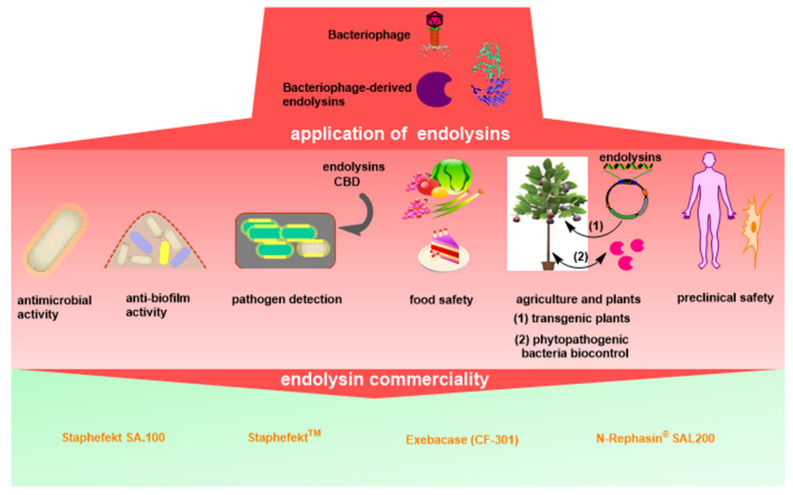
Antimicrobial resistance (AMR) is a global crisis for human public health which threatens the effective prevention and control of ever-increasing infectious diseases. The advent of pandrug-resistant bacteria makes most, if not all, available antibiotics invalid. Meanwhile, the pipeline of novel antibiotics development stagnates, which prompts scientists and pharmacists to develop unconventional antimicrobials. Bacteriophage-derived endolysins are cell wall hydrolases which could hydrolyze the peptidoglycan layer from within and outside of bacterial pathogens. With high specificity, rapid action, high efficiency, and low risk of resistance development, endolysins are believed to be among the best alternative therapeutic agents to treat multidrug resistant (MDR) bacteria. As of now, endolysins have been applied to diverse aspects. In this review, we comprehensively introduce the structures and activities of endolysins and summarize the latest application progress of recombinant endolysins in the fields of medical treatment, pathogen diagnosis, food safety, and agriculture.
Keywords: antimicrobial resistance; biofilm; endolysin; food safety; pathogen detection.
Conflict of interest statement
The authors declare no conflict of interest.
Figures
References
-
- Hadizadeh M., Norouzi A., Taghadosi R., Mohebi S., Mohammadi M., Hasanzade A., Moghadam M.T. Prevalence of qnr, intI, and intII genes in extendedspectrum beta-lactamase (ESBL)-producing Escherichia coli isolated from clinical samples in Iran. Trop. J. Pharm. Res. 2017;16:141–147. doi: 10.4314/tjpr.v16i1.18. - DOI
-
- Yang Y.-S., Wei W., Hu X.-X., Tang S., Pang J., You X.-F., Fan T.-Y., Wang Y.-X., Song D.-Q. Evolution and antibacterial evaluation of 8-hydroxy-cycloberberine derivatives as a novel family of antibacterial agents against MRSA. Molecules. 2019;24:984. doi: 10.3390/molecules24050984. - DOI - PMC - PubMed
-
- Summers W. Felix d1Herelle and the Origins of Molecular Biology. Yale University Press; New Haven, CT, USA: 1999. Bacteriophage discovered; pp. 47–59.
Publication types
Grants and funding
LinkOut - more resources
Full Text Sources
Research Materials
