Review
. 2021 Nov 4;11(11):1633.
doi: 10.3390/biom11111633.

An Overview of Mitochondrial Protein Defects in Neuromuscular Diseases

Affiliations
Review

An Overview of Mitochondrial Protein Defects in Neuromuscular Diseases

Federica Marra et al. Biomolecules. .

Abstract

Neuromuscular diseases (NMDs) are dysfunctions that involve skeletal muscle and cause incorrect communication between the nerves and muscles. The specific causes of NMDs are not well known, but most of them are caused by genetic mutations. NMDs are generally progressive and entail muscle weakness and fatigue. Muscular impairments can differ in onset, severity, prognosis, and phenotype. A multitude of possible injury sites can make diagnosis of NMDs difficult. Mitochondria are crucial for cellular homeostasis and are involved in various metabolic pathways; for this reason, their dysfunction can lead to the development of different pathologies, including NMDs. Most NMDs due to mitochondrial dysfunction have been associated with mutations of genes involved in mitochondrial biogenesis and metabolism. This review is focused on some mitochondrial routes such as the TCA cycle, OXPHOS, and β-oxidation, recently found to be altered in NMDs. Particular attention is given to the alterations found in some genes encoding mitochondrial carriers, proteins of the inner mitochondrial membrane able to exchange metabolites between mitochondria and the cytosol. Briefly, we discuss possible strategies used to diagnose NMDs and therapies able to promote patient outcome.

Keywords: Leigh syndrome; MELAS; MERF; OXPHOS; mitochondrial carrier family; mitochondrial metabolism; myopathy; neuromuscular diseases; neuromuscular junction; therapy.


Conflict of interest statement

The authors declare no conflict of interest.

Figures
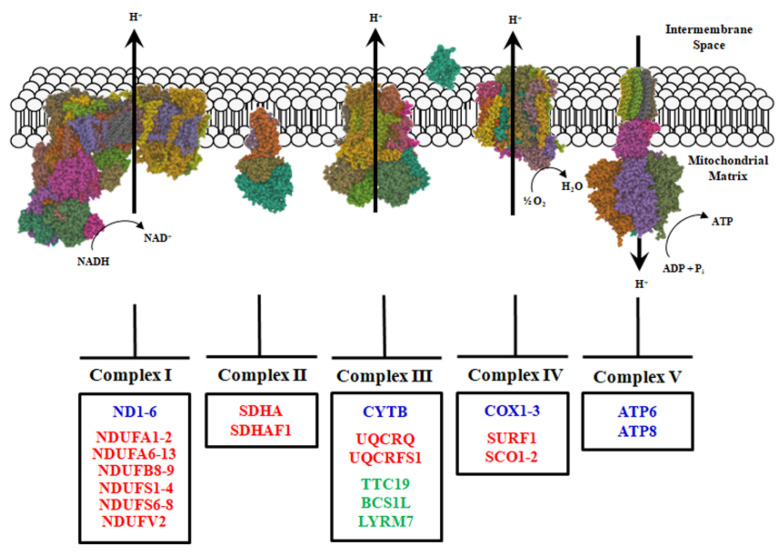
Figure 1
Figure 1
Mutations of the respiratory chain components in NMDs. The five complexes of the respiratory chain are schematized, and the various mutated subunits found in NMDs are reported. mtDNA-encoded subunits are highlighted in blue, while nDNA-encoded subunits are in red. Assembly factors that are not part of the mature complex are indicated in green. The structures of Complexes I–V were obtained from the Protein Data Bank (PDB) (http://www.rcsb.org/, accessed on 13 September 2021) with the accession codes PBD ID: 5LNK (Complex I), 1NEN (Complex II), 6FO0 (Complex III), 5Z62 (Complex IV), and 2XND (Complex V). For details see the text.
Figure 2
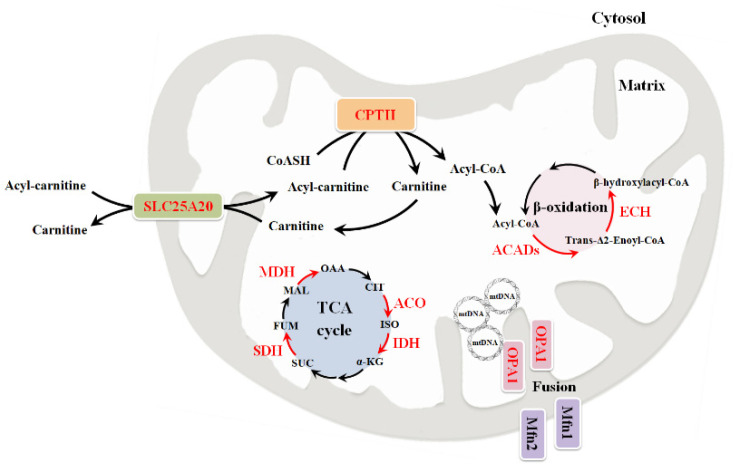
Figure 2
Schematic representation of altered mitochondrial enzymes in NMDs. Mitochondrial metabolic pathways involved in NMDs are shown, and mutated enzymes are highlighted in red. For details, see the text. α-KG, α-ketoglutarate; ACAD, acyl-CoA dehydrogenase; ACO, aconitase; ASP, aspartate; CIT, citrate; CoASH, coenzyme A; ECH, 2-enoyl-CoA hydratase; FUM, fumarate; IDH, isocitrate dehydrogenase; ISO, isocitrate; MAL, malate; MDH, malate dehydrogenase; Mfn1/2, mitofusins 1 and 2; OAA, oxaloacetate; OPA1, optic atrophy 1 protein; SDH, succinate dehydrogenase; SUC, succinate; TCA, tricarboxylic acid cycle.
Figure 3
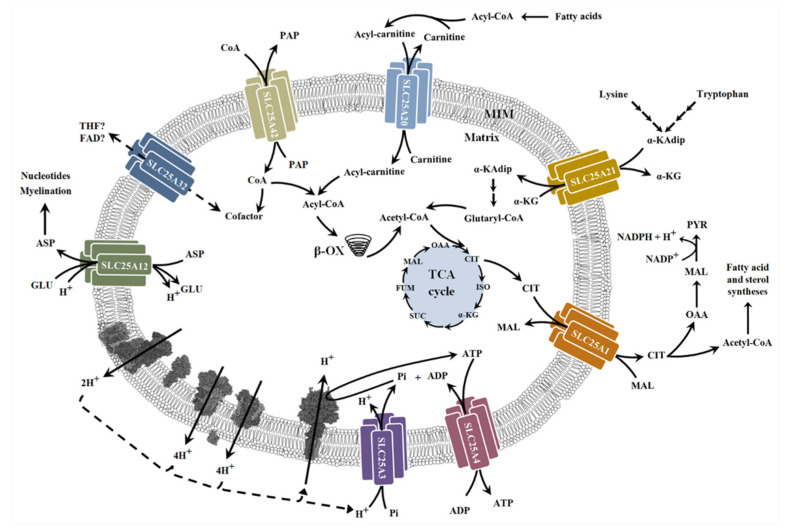
Figure 3
Metabolic role of the SLC25A members involved in NMDs. Mitochondrial carriers are indicated with the coding gene name, and the main transported substrates, when known, are reported. α-KAdip, α-ketoadipate; α-KG, α-ketoglutarate; ASP, aspartate; β-OX, β-oxidation; CIT, citrate; CoA, coenzyme A; FAD, flavin adenine dinucleotide; FUM, fumarate; GLU, glutamate; ISO, isocitrate; MAL, malate; MIM, mitochondrial inner membrane; OAA, oxaloacetate; PAP, adenosine 3′,5′-diphosphate; Pi, inorganic phosphate; PYR, pyruvate; SUC, succinate; TCA, tricarboxylic acid; THF, tetrahydrofolate.

References

    1. Bonne G., Rivier F., Hamroun D. The 2018 Version of the Gene Table of Monogenic Neuromuscular Disorders (Nuclear Genome) Neuromuscul. Disord. NMD. 2017;27:1152–1183. doi: 10.1016/j.nmd.2017.10.005. - DOI - PubMed
    1. Vasli N., Laporte J. Impacts of Massively Parallel Sequencing for Genetic Diagnosis of Neuromuscular Disorders. Acta Neuropathol. 2013;125:173–185. doi: 10.1007/s00401-012-1072-7. - DOI - PubMed
    1. Scotton C., Passarelli C., Neri M., Ferlini A. Biomarkers in Rare Neuromuscular Diseases. Exp. Cell Res. 2014;325:44–49. doi: 10.1016/j.yexcr.2013.12.020. - DOI - PubMed
    1. Benditt J.O., Boitano L.J. Pulmonary Issues in Patients with Chronic Neuromuscular Disease. Am. J. Respir. Crit. Care Med. 2013;187:1046–1055. doi: 10.1164/rccm.201210-1804CI. - DOI - PubMed
    1. Pleasure D. Advances in Translational Research in Neuromuscular Diseases. Arch. Neurol. 2011;68:429–433. doi: 10.1001/archneurol.2011.44. - DOI - PubMed

Publication types

Substances