Review
. 2021 Nov 10;11(11):1665.
doi: 10.3390/biom11111665.

LncRNAs: Novel Biomarkers for Pancreatic Cancer

Affiliations
Review

LncRNAs: Novel Biomarkers for Pancreatic Cancer

Soudeh Ghafouri-Fard et al. Biomolecules. .

Abstract

Pancreatic cancer is one of the most deadly neoplasms and the seventh major cause of cancer-related deaths among both males and females. This cancer has a poor prognosis due to the lack of appropriate methods for early detection of cancer. Long non-coding RNAs (lncRNAs) have been recently found to influence the progression and initiation of pancreatic cancer. MACC1-AS1, LINC00976, LINC00462, LINC01559, HOXA-AS2, LINC00152, TP73-AS1, XIST, SNHG12, LUCAT1, and UCA1 are among the oncogenic lncRNAs in pancreatic cancer. On the other hand, LINC01111, LINC01963, DGCR5, MEG3, GAS5, and LINC00261 are among tumor suppressor lncRNAs in this tissue. In the current review, we summarize the roles of these two classes of lncRNAs in pancreatic cancer and discuss their potential as attractive diagnostic and prognostic biomarkers for pancreatic cancer. We also identified that the low expression of MEG3, LINC01963, and LINC00261 and the high expression of MACC1-AS1, LINC00462, LINC01559, and UCA1 were significantly correlated with worse survival in pancreatic cancer patients. Further research on these lncRNAs will provide new clues that could potentially improve the early diagnosis, prognostic prediction, and personalized treatments of patients with pancreatic cancer.

Keywords: biomarker; diagnosis; lncRNAs; pancreatic cancer; prognosis.


Conflict of interest statement

The authors declare no conflict of interest.

Figures

Figure 1
Figure 1
A schematic diagram shows the role of various lncRNAs in modulating the TGF-β/SMAD signaling pathway in pancreatic cancer. According to this cascade, when bioavailable TGF-β binds a homodimer of TβRII, transphosphorylation of the TβRI can trigger the activation of kinase activity. SMAD proteins, the substrates for TβRI kinases, are downstream of the BMP–analogous ligand–receptor systems. SMAD1, SMAD2, SMAD3, SMAD5, and SMAD8 can bind to membrane-bound serine/threonine receptors and are up-regulated via their kinase function. As a co-factor, the Co-SMAD (SMAD4) can bind to the up-regulated R-SMAD to create a complex that translocates into the nucleus. Consequently, I-SMAD (SMAD7) can deactivate the impacts of R-SMADs [36,37]. Previous studies have authenticated that several lncRNAs can play an effective role in regulating the TGF-β/SMAD cascade in pancreatic cancer. LINC00462 can up-regulate expression levels of TGFBR1 and TGFBR2 and activate the SMAD2/3 pathway in pancreatic cancer cells through down-regulating miR-665 expression [8]. Furthermore, lncRNA XIST can promote TGF-β2 expression via inhibiting the expression of miR-141-3p, thus enhancing cell proliferation, migration, and invasion of PC cells [33]. Green arrows indicate the up-regulation of target genes by lncRNAs; red arrows depict the inhibitory effects of lncRNAs.
Figure 2
Figure 2
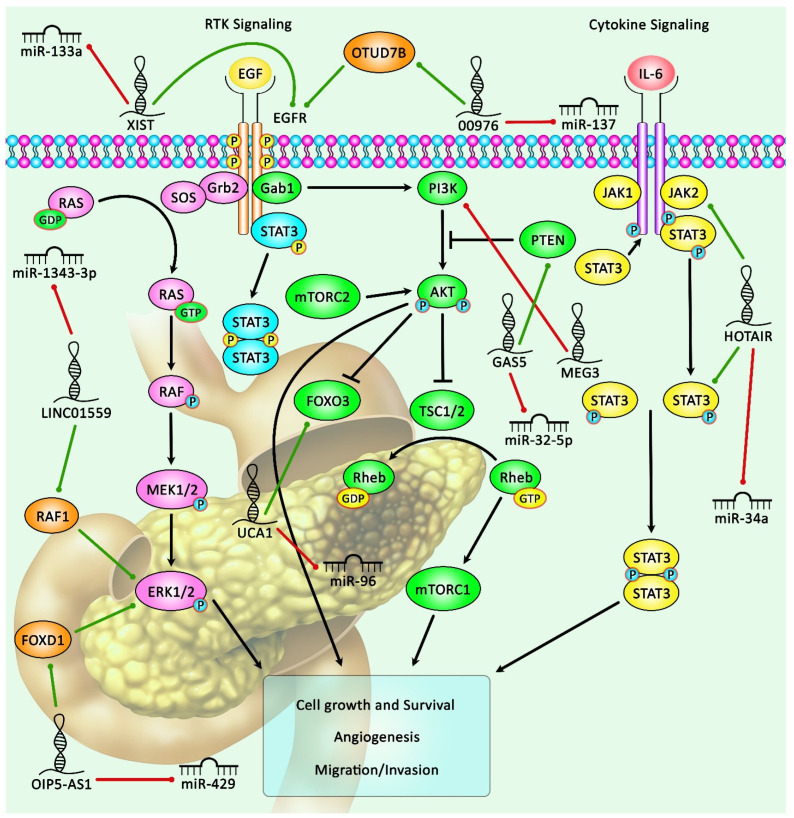
A schematic representation shows that several lncRNAs regulate the PI3K/AKT, MAPK/ERK and JAK2/STAT3 pathways in pancreatic cancer. Growth factor-driven RTK (e.g., EGFR) or cytokine (e.g., IL- 6) signaling can trigger the activation of PI3K/AKT, MAPK/ERK, and JAK2/STAT3 cascades. LncRNAs can affect the activity of these cascades. For instance, HOTAIR can trigger the activation of the JAK2/STAT3 pathway via down-regulating miR-34a expression, thus promoting invasion and migration of pancreatic ductal adenocarcinoma [12]. In addition, GAS5 can up-regulate PTEN expression by down-regulating the expression level of miR-32-5p, therefore inhibiting pancreatic cancer metastasis [41]. LINC01559, through sponging miR-1343-3p, can up-regulate RAF1 expression that can further activate the ERK signaling pathway, thereby enhancing pancreatic cancer progression and metastasis [15]. Green arrows indicate the up-regulation of target genes modulated via lncRNAs; red arrows depict the inhibitory effects.
Figure 3
Figure 3
The prognostic value of lncRNA MEG3, LINC01963, and LINC00261 in pancreatic cancer patients was analyzed using the KM-plotter database.
Figure 4
Figure 4
The prognostic value of lncRNA MACC1-AS1, LINC00462, LINC01559, and UCA1 in pancreatic cancer patients was investigated using the KM-plotter database.

References

    1. Siegel R.L., Miller K.D., Fuchs H.E., Jemal A. Cancer Statistics, 2021. CA A Cancer J. Clin. 2021;71:7–33. - PubMed
    1. Arnold M., Abnet C.C., Neale R.E., Vignat J., Giovannucci E.L., McGlynn K.A., Bray F. Global burden of 5 major types of gastrointestinal cancer. Gastroenterology. 2020;159:335–349.e315. doi: 10.1053/j.gastro.2020.02.068. - DOI - PMC - PubMed
    1. Grant T.J., Hua K., Singh A. Molecular Pathogenesis of Pancreatic Cancer. Prog. Mol. Biol. Transl. Sci. 2016;144:241–275. - PMC - PubMed
    1. Schmitt A.M., Chang H.Y. Long Noncoding RNAs in Cancer Pathways. Cancer Cell. 2016;29:452–463. doi: 10.1016/j.ccell.2016.03.010. - DOI - PMC - PubMed
    1. Statello L., Guo C.-J., Chen L.-L., Huarte M. Gene regulation by long non-coding RNAs and its biological functions. Nat. Rev. Mol. Cell Biol. 2021;22:96–118. doi: 10.1038/s41580-020-00315-9. - DOI - PMC - PubMed

MeSH terms