Review
. 2021 Nov 18;11(11):1716.
doi: 10.3390/biom11111716.

D-Amino Acids and D-Amino Acid-Containing Peptides: Potential Disease Biomarkers and Therapeutic Targets?

Affiliations
Review

D-Amino Acids and D-Amino Acid-Containing Peptides: Potential Disease Biomarkers and Therapeutic Targets?

Mohamed Abdulbagi et al. Biomolecules. .

Abstract

In nature, amino acids are found in two forms, L and D enantiomers, except for glycine which does not have a chiral center. The change of one form to the other will lead to a change in the primary structure of proteins and hence may affect the function and biological activity of proteins. Indeed, several D-amino acid-containing peptides (DAACPs) were isolated from patients with cataracts, Alzheimer's and other diseases. Additionally, significant levels of free D-amino acids were found in several diseases, reflecting the disease conditions. Studying the molecular mechanisms of the DAACPs formation and the alteration in D-amino acids metabolism will certainly assist in understanding these diseases and finding new biomarkers and drug targets. In this review, the presence of DAACPs and free D-amino acids and their links with disease development and progress are summarized. Similarly, we highlight some recent advances in analytical techniques that led to improvement in the discovery and analysis of DAACPs and D-amino acids.

Keywords: D-Asp; D-Ser; D-amino acids; DAACPs; LC-MS; biomarker; therapeutic targets.


Conflict of interest statement

The authors declare no conflict of interest.

Figures
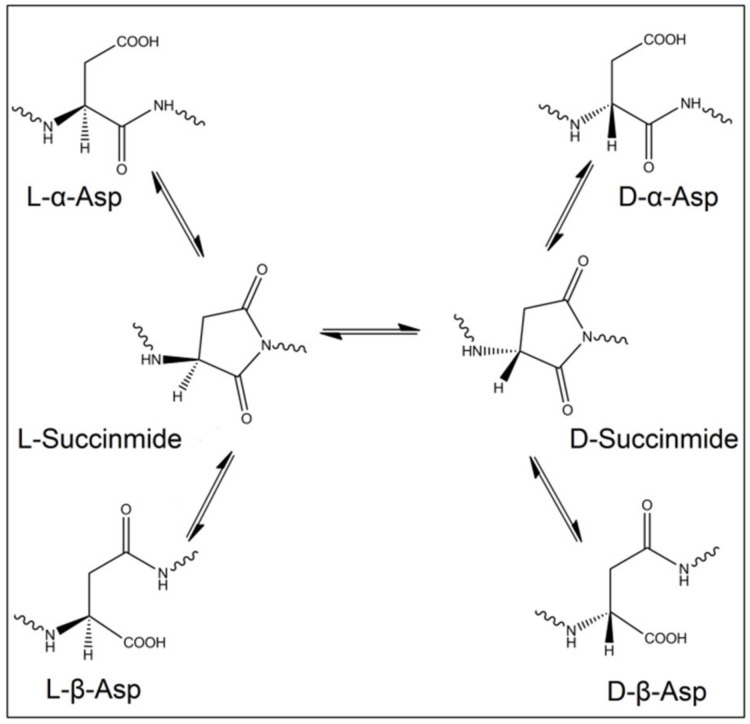
Figure 1
Figure 1
Scheme of the spontaneous isomerization of the four isomers of Asp through the succinimide intermediate.
Figure 2
Figure 2
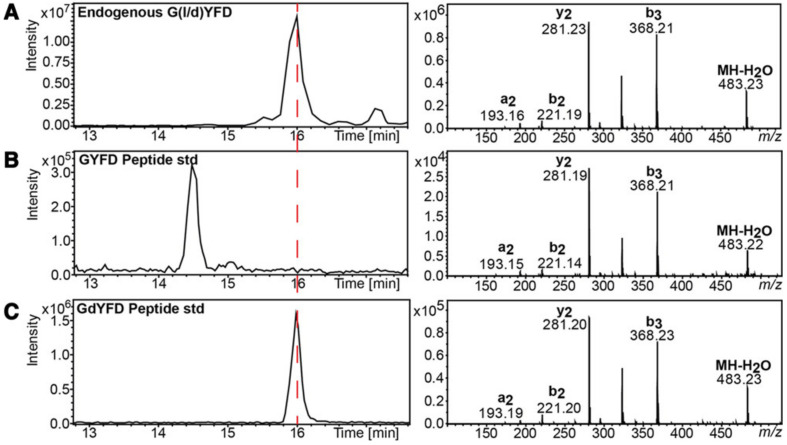
LC–MS analysis of DAACP isolated from Aplysia californica, the retention times of the indigenous (A) and synthetic DAACP (C) are identical and are different from the peptides with all L-amino acids (B). However, the MS profiles of the three peptides are similar. Reproduced with permission from [94].
Figure 3
Figure 3
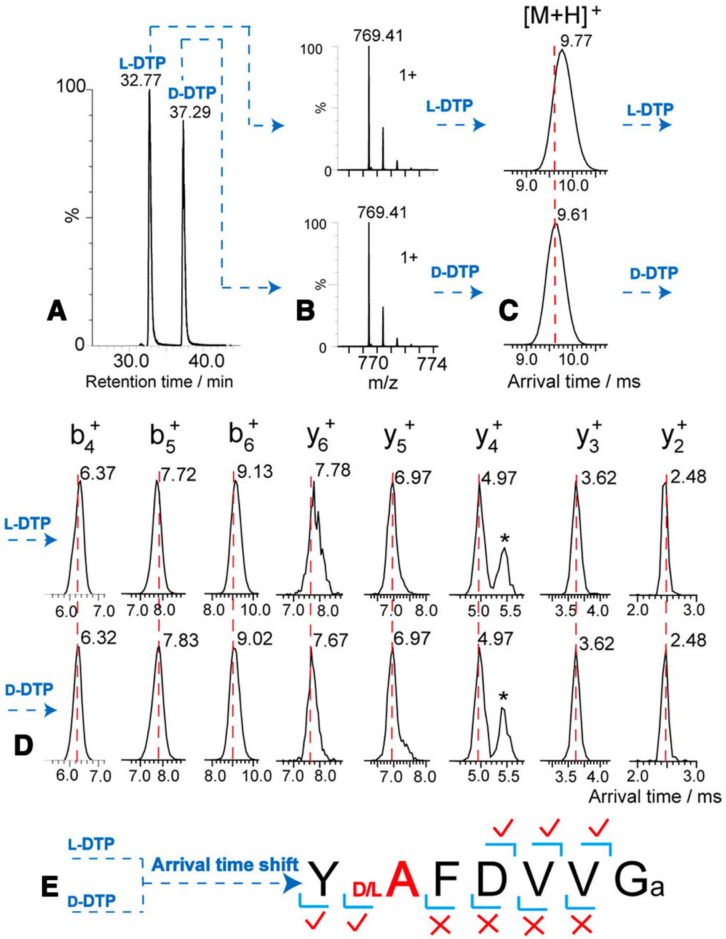
Identification of the epimerization site with LC–MS IMS by comparing the arrival times of the ions of deltorphin having L-Ala (labeled L-DTP) or D-Ala (labeled D-DTP). (A,B) LC–MS separation shows similar MS profiles and different retention times, indicating that they are isomeric peptides. (C) A shift in arrival time is detected for the L/D-forms. (D,E) Following IMS fragmentation, the arrival times of y2+, y3+, y4+ and y5+ are similar in both L-DTP and D-DTP, while the arrival times of the y6+ ions are different, therefore determining the epimerization site. *, interference ions. Reproduced with permission from [107].

References

    1. Grishin D.V., Zhdanov D.D., Pokrovskaya M.V., Sokolov N.N. D-amino acids in nature, agriculture and biomedicine. Front. Life Sci. 2020;13:11–22. doi: 10.1080/21553769.2019.1622596. - DOI
    1. Ollivaux C., Soyez D., Toullec J.Y. Biogenesis of D-amino acid containing peptides/proteins: Where, when and how? J. Pept. Sci. 2014;20:595–612. doi: 10.1002/psc.2637. - DOI - PubMed
    1. Koehbach J., Gruber C.W., Becker C., Kreil D.P., Jilek A. MALDI TOF/TOF-Based Approach for the Identification of d- Amino Acids in Biologically Active Peptides and Proteins. J. Proteome Res. 2016;15:1487–1496. doi: 10.1021/acs.jproteome.5b01067. - DOI - PMC - PubMed
    1. Yoshimura T., Esaki N. Amino acid racemases: Functions and mechanisms. J. Biosci. Bioeng. 2003;96:103–109. doi: 10.1016/S1389-1723(03)90111-3. - DOI - PubMed
    1. Genchi G. An overview on D-amino acids. Amino Acids. 2017;49:1521–1533. doi: 10.1007/s00726-017-2459-5. - DOI - PubMed

LinkOut - more resources