Review
. 2021 Nov 20;11(11):1731.
doi: 10.3390/biom11111731.

Piezoelectric Signals in Vascularized Bone Regeneration

Affiliations
Review

Piezoelectric Signals in Vascularized Bone Regeneration

Delfo D'Alessandro et al. Biomolecules. .

Abstract

The demand for bone substitutes is increasing in Western countries. Bone graft substitutes aim to provide reconstructive surgeons with off-the-shelf alternatives to the natural bone taken from humans or animal species. Under the tissue engineering paradigm, biomaterial scaffolds can be designed by incorporating bone stem cells to decrease the disadvantages of traditional tissue grafts. However, the effective clinical application of tissue-engineered bone is limited by insufficient neovascularization. As bone is a highly vascularized tissue, new strategies to promote both osteogenesis and vasculogenesis within the scaffolds need to be considered for a successful regeneration. It has been demonstrated that bone and blood vases are piezoelectric, namely, electric signals are locally produced upon mechanical stimulation of these tissues. The specific effects of electric charge generation on different cells are not fully understood, but a substantial amount of evidence has suggested their functional and physiological roles. This review summarizes the special contribution of piezoelectricity as a stimulatory signal for bone and vascular tissue regeneration, including osteogenesis, angiogenesis, vascular repair, and tissue engineering, by considering different stem cell sources entailed with osteogenic and angiogenic potential, aimed at collecting the key findings that may enable the development of successful vascularized bone replacements useful in orthopedic and otologic surgery.

Keywords: angiogenesis; biomaterials; mesodermal progenitor cells; orthopedics; osteogenesis; otology; scaffold; stem cells; tissue engineering.


Conflict of interest statement

The authors declare no conflict of interest.

Figures

Figure 1
Figure 1
Direct piezoelectric effect in a biomaterial element: (A) without external stress, and (B) subject to compressive stress with charge generation. P: polarization vector; V: voltage; red arrows: dipoles; black arrows: direction of polarization vector.
Figure 2
Figure 2
Effect of piezoelectric biomaterials on the cells. Mechanical stress compresses the scaffold or ECM generating the activation of voltage-dependent channels and channel/transmembrane proteins activated by mechanical stimuli. Calcium ions and protein kinases generate a signal cascade that in turn activate nuclear factors able to migrate in cell nuclei, generating different cell responses [4]. SACC = stretch activated calcium channels; SATP = stretch activated transmembrane proteins; VACC = Voltage activated calcium channels; PKs = protein kinases; NFs = nuclear factors; CM = cell membrane; NM = nuclear membrane.
Figure 3
Figure 3
Bone tissue schematic showing: (A) bone structures (e.g., osteon, blood vessels, lamellae, periosteum, and trabeculae); and (B) the main bone cells (i.e., osteocyte, osteoblast, osteogenic cell, osteoclast) and their location. Adapted from OpenStax.
Figure 4
Figure 4
Structure and piezoelectric behavior of collagen molecule. (A) Hierarchical schematic showing the amino acid sequence in which X and Y are usually proline and hydroxyproline, thus being able to form a unique α helix secondary structure. Fibrillar collagen is a triple helix containing crosslinks formed through the action of lysyl oxidase. Collagen fibrils form fibers with varying thickness and a D-banding pattern of 67 nm. Adapted from [47], reused under Creative Commons Attribution (CC BY) license. (B) Schematic showing permanent polarization in α-helix. Red arrows indicate the direction of the dipole moment. Adapted from [26], reused under Elsevier & Copyright Clearance Center (license number 5185310303078). (C) Single collagen fibril analysis obtained via atomic force microscopy: (i) topography, and (ii) corresponding shear piezoelectricity obtained under piezoforce microscopy mode. Reprinted with permission from [50], Copyright 2009, American Chemical Society.
Figure 5
Figure 5
Schematic of the mesengenic process showing MSCs upstream and their differentiation capacity across diverse mesoderm tissues, including bone. Reprinted with permission from [61], under Elsevier and Copyright Clearance Center (license number 5166410951759).
Figure 6
Figure 6
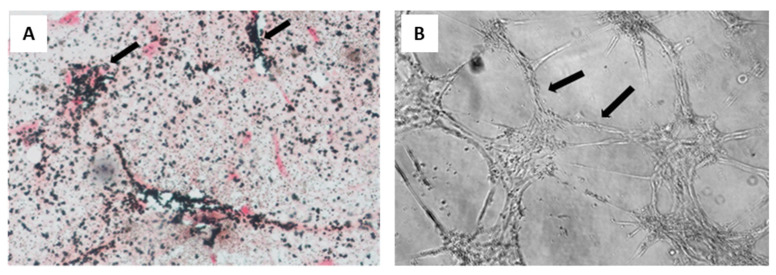
Osteogenic and vasculogenic potential of dental pulp MSCs: (A) von Kossa staining of osteo-differentiated dental pulp MSCs, showing calcium deposits in black and cells in red. Arrows point to representative areas of intense mineral deposition in proximity to osteoblasts; and (B) light micrograph of dental pulp MSCs after endothelial differentiation, showing capillary tube-like structures. Reprinted with permission and adapted from [61], under Elsevier and Copyright Clearance Center (license number 5166500137992).
Figure 7
Figure 7
MPCs versus MSCs. Immunofluorescent staining confirms the expression of Nanog, Oct-4 and Sox15 (green) in MPC but not in MSC nuclei (blue) MPCs and MSCs show different spatial organization of F-actin (red). MPCs also differ from MSCs due to their unexpected high expression of well-organized Nestin filaments (green). Reused from [89] under Creative Commons Attribution License.
Figure 8
Figure 8
Schematic showing: (A) a fracture involving bone tissue including vasculature; (B) a porous scaffold; and (C) histological analysis displaying a pore colonized by a dual cell population: osteoblast-like cells producing mineral matrix (by von Kossa staining positive, in black), and endothelial cells surrounding the pore walls (von Kossa staining negative, in red), reprinted with permission and adapted from [101], under John Wiley and Sons Copyright Clearance Center (license number 5170741359741).
Figure 9
Figure 9
Blood vessel arrangement in long bones: (A) longitudinal view showing arteries branching into H type capillaries, and veins branching into L type capillaries in the epiphysis, metaphysis, and diaphysis; (B) cross view showing a main central vein and a few arteries in the medullary region; and (C) zoomed-in panel showing the connection between cortical and medullary blood flow. Adapted from [111] and reused under Creative Commons Attribution (CC BY) license.
Figure 10
Figure 10
Piezoelectric small caliber vascular graft: (A) photograph; (B) schematic of the polymer network incorporating BaTiO2 nanoparticles; (C) representative displacement-voltage curves, obtained for the nano-doped samples; and (D) piezoelectric force microscope images showing signal amplitude maps and corresponding average and maximum d33 values for the nano-doped samples. Reprinted with permission and adapted from [61], under Elsevier and Copyright Clearance Center (license number 5166600438237).
Figure 11
Figure 11
Vascularization in PHBHV-based fiber scaffolds: (A,B) PHBHV fibers after implantation in nude rats, arrows indicate the blood vessels, stars point to scaffold fibers [173]: (A) hematoxylin/eosin staining, and (B) 1A4 actin staining, reprinted and adapted under John Wiley and Sons Copyright Clearance Center (license number 5170801144911); and (C) PHB/PHBHV fibers cultured in vitro with adipose-derived MSCs: expression of VEGFR-2 as an endothelial marker [172], reused under Creative Commons Attribution License.
Figure 12
Figure 12
Schematic showing stem cell embedded in its extracellular matrix (ECM) and possible routes of using piezoelectric biomaterials to regulate its differentiation: (A) as substrates or scaffolds, which upon the application of an external force (F) give rise to electric stimuli in contact with the cell membrane; and (B) as nanoparticle systems trafficking intracellularly, which can be activated by ultrasound (US), thus inducing intracellular electric stimulation.

References

    1. Langer R., Vacanti J.P. Tissue Engineering. Science. 1993;260:920–926. doi: 10.1126/science.8493529. - DOI - PubMed
    1. Beldjilali-Labro M., Garcia Garcia A., Farhat F., Bedoui F., Grosset J.-F., Dufresne M., Legallais C. Biomaterials in tendon and skeletal muscle tissue engineering: Current trends and challenges. Materials. 2018;11:1116. doi: 10.3390/ma11071116. - DOI - PMC - PubMed
    1. Kyburz K.A., Anseth K.S. Synthetic mimics of the extracellular matrix: How simple is complex enough? Ann. Biomed. Eng. 2015;43:489–500. doi: 10.1007/s10439-015-1297-4. - DOI - PMC - PubMed
    1. Khare D., Basu B., Dubey A.K. Electrical stimulation and piezoelectric biomaterials for bone tissue engineering applications. Biomaterials. 2020;258:120280. - PubMed
    1. Levin M. Molecular bioelectricity: How endogenous voltage potentials control cell behavior and instruct pattern regulation in vivo. Mol. Biol. Cell. 2014;25:3835–3850. doi: 10.1091/mbc.e13-12-0708. - DOI - PMC - PubMed