Review
. 2021 Oct 29;11(11):3092.
doi: 10.3390/ani11113092.

Allonursing in Wild and Farm Animals: Biological and Physiological Foundations and Explanatory Hypotheses

Affiliations
Review

Allonursing in Wild and Farm Animals: Biological and Physiological Foundations and Explanatory Hypotheses

Daniel Mota-Rojas et al. Animals (Basel). .

Abstract

The dams of gregarious animals must develop a close bond with their newborns to provide them with maternal care, including protection against predators, immunological transference, and nutrition. Even though lactation demands high energy expenditures, behaviors known as allonursing (the nursing of non-descendant infants) and allosuckling (suckling from any female other than the mother) have been reported in various species of wild or domestic, and terrestrial or aquatic animals. These behaviors seem to be elements of a multifactorial strategy, since reports suggest that they depend on the following: species, living conditions, social stability, and kinship relations, among other group factors. Despite their potential benefits, allonursing and allosuckling can place the health and welfare of both non-filial dams and alien offspring at risk, as it augments the probability of pathogen transmission. This review aims to analyze the biological and physiological foundations and bioenergetic costs of these behaviors, analyzing the individual and collective advantages and disadvantages for the dams' own offspring(s) and alien neonate(s). We also include information on the animal species in which these behaviors occur and their implications on animal welfare.

Keywords: animal perinatology; fostering; lactation; mismothering; non-offspring nursing.


Conflict of interest statement

The authors declare no conflict of interest.

Figures
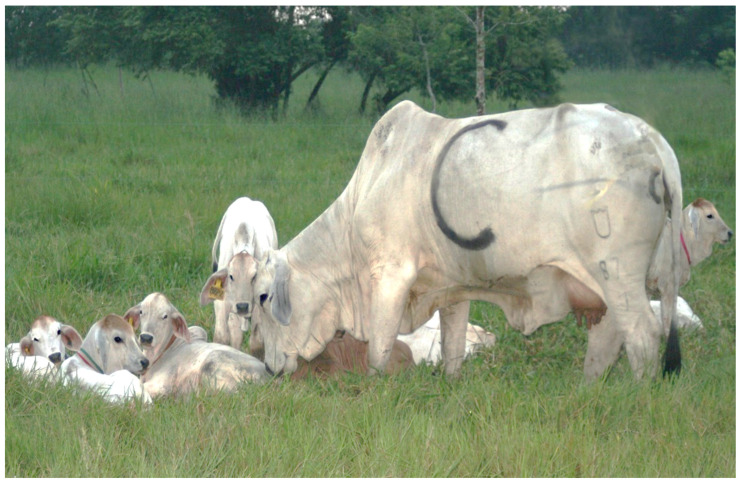
Figure 1
Figure 1
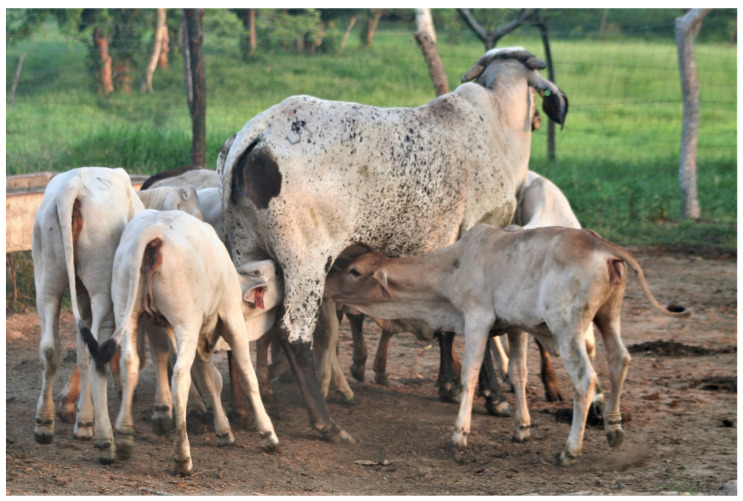
In extensive livestock production, it has recently been shown that specific cows of the herd take care of groups of zebu (Bos indicus) calves while their mothers graze, adepted from [22].
Figure 2
Figure 2
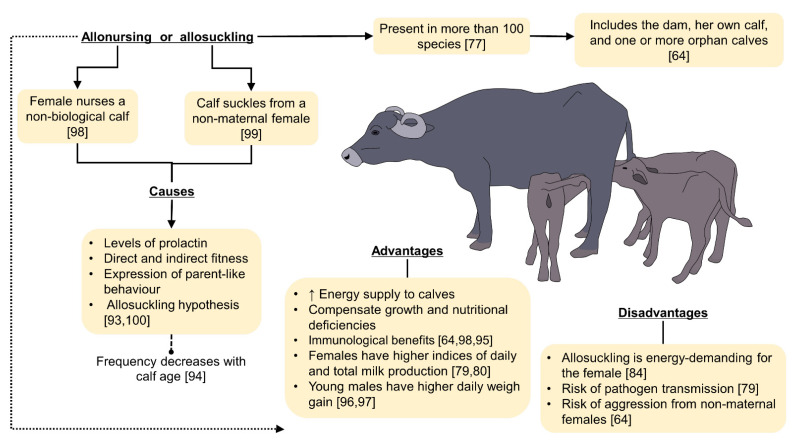
Allonursing and allosuckling causes, disadvantages and advantages to the mother and the offspring. While allonursing and allosuckling respond to endocrine and social contexts, they involve difficulties to the mother, such as the high energy demand, and to the young because of the risk of aggression of the foster mother, and the risk of pathogen transmission to the calves. However, some benefits include the compensation of nutritional deficiencies in the calves, and the acquisition of a wider range of immunoglobulins to enhance the immune system, as well as an enhancement in productivity parameters, such as daily weight gain.
Figure 3
Figure 3
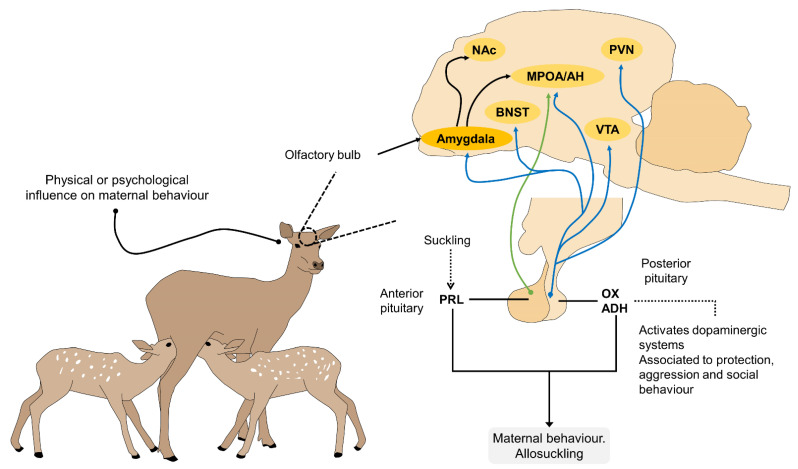
The neurophysiology of maternal behavior, milk let down, suckling and allosuckling. The main hormones associated with these processes (PRL, OX and ADH) act on different cerebral structures. The OX response is mediated by the VTA, PVN, amygdala, BNST and MPOA/AH. PRL site of action is in the MPOA/AH. The amygdala, NAc and BDNST also have a role in the reward system and maternal memory, and the former in the olfactory recognition of the offspring. ADH: antidiuretic hormone; BNST: bed nucleus of the stria terminalis; MPOA/AH: medial preoptic area/anterior hypothalamus; NAc: nucleus accumbens; OX: oxytocin; PRL: prolactin; PVN: paraventricular nucleus; VTA: ventral tegmental area, adepted from [110,111,112,113,114].
Figure 4
Figure 4
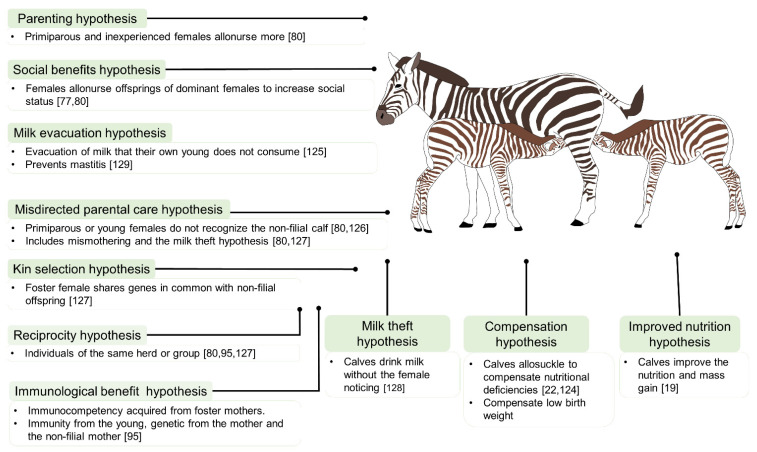
The main hypotheses explaining allonursing and allosuckling. Some of the hypotheses of these two cooperative maternal behaviors include genetic origins of the foster mother and the non-filial young, social and health benefits for the female, and advantages to the offspring to compensate and improve nutrition and immunocompetency.
Figure 5
Figure 5
Even though, in most ungulates, cows develop exclusive care towards the young that they recognize in the first hours postpartum, adepted from [56], some cows display no rejection to calves from other cows. In practice, these cows may be selected for the rearing of orphaned calves or for those whose mothers do not produce enough milk.

References

    1. Zilkha N., Sofer Y., Beny Y., Kimchi T. From classic ethology to modern neuroethology: Overcoming the three biases in social behavior research. Curr. Opin. Neurobiol. 2016;38:38–96. doi: 10.1016/j.conb.2016.04.014. - DOI - PubMed
    1. Martínez J.G. La evolución y la conservación de la biodiversidad. In: Sur P., editor. Evolución: La Base de la Biología. Universidad de Extremadura; Extremadura, Spain: 2012. pp. 407–416.
    1. Lévy F., Keller M. Neurobiology of maternal behavior in sheep. Adv. Study Behav. 2008;38:399–437. doi: 10.1016/S0065-3454(08)00008-9. - DOI
    1. Mora-Medina P., Orihuela-Trujillo A., Santiago R., Arch-Tirado E., Vázquez-Cruz C., Mota-Rojas D. Metabolic changes during brief periods of ewe-lamb separation at different ages. Anim. Prod. Sci. 2018;58:1297–1306. doi: 10.1071/AN16221. - DOI
    1. Mandujano C. Ecología y sociobiología de la impronta: Perspectivas para su estudio en los Crocodylia. Cienc. Mar. 2010;14:49–54.

LinkOut - more resources