Review
. 2021 Nov 19;8(11):1067.
doi: 10.3390/children8111067.

Current Insights into Atopic March

Affiliations
Review

Current Insights into Atopic March

Mitsuru Tsuge et al. Children (Basel). .

Abstract

The incidence of allergic diseases is increasing, and research on their epidemiology, pathophysiology, and the prevention of onset is urgently needed. The onset of allergic disease begins in infancy with atopic dermatitis and food allergy and develops into allergic asthma and allergic rhinitis in childhood; the process is defined as "atopic march". Atopic march is caused by multiple immunological pathways, including allergen exposure, environmental pollutants, skin barrier dysfunction, type 2 inflammation, and oxidative stress, which promote the progression of atopic march. Using recent evidence, herein, we explain the involvement of allergic inflammatory conditions and oxidative stress in the process of atopic march, its epidemiology, and methods for prevention of onset.

Keywords: alarmin; allergic asthma; allergic rhinitis; atopic dermatitis; atopic march; early intervention; emollient; epidemiology; food allergy; group 2 innate lymphoid cells; oxidative stress; phenotype; skin barrier dysfunction; specific biomarker; type 2 inflammation.


Conflict of interest statement

The authors declare no conflict of interest.

Figures

Figure 1
Figure 1
Atopic march. Atopic dermatitis (AD) generally develops first, followed by IgE-mediated food allergy (FA), allergic asthma (AA), and allergic rhinitis (AR). Development of FA, AA, and AR correlates with AD severity in infancy.
Figure 2
Figure 2
The general course of atopic march and the temporal sequence of major factors involved. Atopic march is the clinical history of atopic diseases in different organs, wherein different causal allergens develop sequentially with age. Some symptoms become more prominent over time, while others subside. Atopic dermatitis (AD) generally develops first based on genetic predisposition and/or environmental factors. The skin barrier dysfunction derived from AD easily allows the allergen to penetrate the body, causing epicutaneous sensitization and type 2 inflammation in some children. Then, memory T helper 2 (Th2) cells circulate back to the skin and exacerbate AD. The cells then distribute to the gut, lung, and nose. Patients develop food allergy, allergic asthma, and allergic rhinitis with increased sensitization to food and/or environmental allergens, resulting in the induction of atopic march.
Figure 3
Figure 3
Immunologic mechanisms underlying atopic march. Exposure of skin with impaired barrier function to food allergens, dust mites, or mechanical damage leads to the release of epithelial cell-derived thymic stromal lymphopoietin (TSLP), interleukin (IL)-25, and IL-33, which induce the activation of immature dendritic cells (DCs) and group 2 innate lymphoid cells (ILC2s). DCs that capture allergens migrate to draining lymph nodes, process allergens, and present them to naïve T cells which promote the generation of allergen-specific Th2 cells. Th2 cells produce high levels of IL-4 and IL-13 after clonal differentiation and expansion and induce B cell isotype switching to specific IgE cells, thereby enhancing the production of allergen-specific IgE and IgE memory B cells. Allergen-specific IgE binds to the surface of effector cells (i.e., mast cells and basophils) via the high-affinity IgE receptor (FcεRI). ILC2 activation further accelerates antigen-nonspecific Th2 immune skewing; memory pools of allergen-specific Th2 and B cells are also generated during this phase. Memory allergen-specific Th2 cells circulate and infiltrate the skin, provoking exacerbation of AD, and entering the systemic circulation where they spread to remote organs. Then, upon re-exposure to allergens in individuals previously sensitized to the same allergens, diverse atopic disorders are initiated, resulting in atopic march. Abbreviation: TMEM, memory allergen-specific T helper 2.
Figure 4
Figure 4
Inflammation in the respiratory tract, a distant organ from the skin in atopic march. Re-exposure to a previously sensitized allergen induces degranulation of inflammatory mediators upon crosslinking of FcεRI receptor-bound specific IgE on mast cells and basophils. This induces an immediate-phase reaction and acute inflammation, followed by a late-phase allergic reaction through activation of TMEM cells. The TMEM cells produce IL-4, IL-5, IL-9, and IL-13 in cooperation with ILC2s, and lead to maintenance of allergen-specific IgE levels, eosinophilia, and recruitment of inflammatory cells to inflamed tissue, all of which induce tissue damage and increase mucus production and airway hyperresponsiveness in allergic asthma. Abbreviations: IL, interleukin; ILC2s, group 2 innate lymphoid cells; TMEM, memory allergen-specific T helper 2.
Figure 5
Figure 5
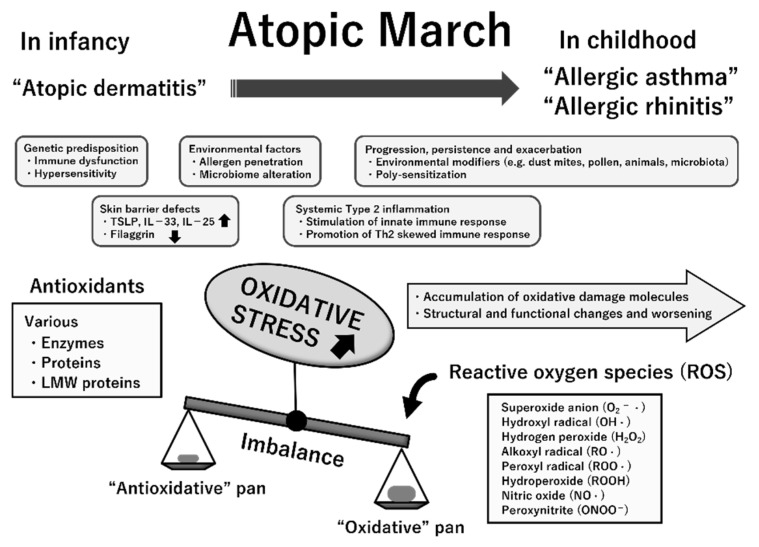
Multifactorial etiopathogenesis and possible involvement of increased oxidative stress status in atopic march. The temporal pattern of atopic march is generally from atopic dermatitis in infancy to gradual development into allergic asthma and allergic rhinitis in childhood. While its pathogenesis is complex, several essential mechanisms likely underlie atopic march. Oxidative stress is an imbalance between reactive oxygen species (ROS) generation and antioxidative defense mechanisms with any excess of the former, resulting in macromolecular damage and dysfunction. Chronically increased oxidative stress may contribute to the progression, persistence, and exacerbation of allergic inflammation, thereby resulting in atopic march. This suggestion is mostly based on previous clinical studies that have indicated the linkage of oxidative damage attributable to ROS (quantified by measurement of specific biomarkers) to the pathogenesis and progression of these atopic diseases. Abbreviations: TSLP, thymic stromal lymphopoietin; IL, interleukin; LMW, low-molecular-weight.
Figure 6
Figure 6
Schematic representation of the complex phenotypes and trajectories of each allergic disease. Small circles within red circle, each phenotype of AD; small circles within blue circle, each phenotype of AA; small circles within yellow circle, each phenotype of AR.

References

    1. Spergel J.M., Paller A.S. Atopic dermatitis and the atopic march. J. Allergy Clin. Immunol. 2003;112:S118–S127. doi: 10.1016/j.jaci.2003.09.033. - DOI - PubMed
    1. Czarnowicki T., Krueger J.G., Guttman-Yassky E. Novel concepts of prevention and treatment of atopic dermatitis through barrier and immune manipulations with implications for the atopic march. J. Allergy Clin. Immunol. 2017;139:1723–1734. doi: 10.1016/j.jaci.2017.04.004. - DOI - PubMed
    1. Lack G., Fox D., Northstone K., Golding J. Factors associated with the development of peanut allergy in childhood. N. Engl. J. Med. 2003;348:977–985. doi: 10.1056/NEJMoa013536. - DOI - PubMed
    1. Zheng T., Yu J., Oh M.H., Zhu Z. The atopic march: Progression from atopic dermatitis to allergic rhinitis and asthma. Allergy Asthma Immunol. Res. 2011;3:67–73. doi: 10.4168/aair.2011.3.2.67. - DOI - PMC - PubMed
    1. Tsakok T., Marrs T., Mohsin M., Baron S., du Toit G., Till S., Flohr C. Does atopic dermatitis cause food allergy? A systematic review. J. Allergy Clin. Immunol. 2016;137:1071–1078. doi: 10.1016/j.jaci.2015.10.049. - DOI - PubMed

LinkOut - more resources