


Evolution of Food Fermentation Processes and the Use of Multi-Omics in Deciphering the Roles of the Microbiota
- PMID: 34829140
- PMCID: PMC8618017
- DOI: 10.3390/foods10112861
Evolution of Food Fermentation Processes and the Use of Multi-Omics in Deciphering the Roles of the Microbiota
Abstract
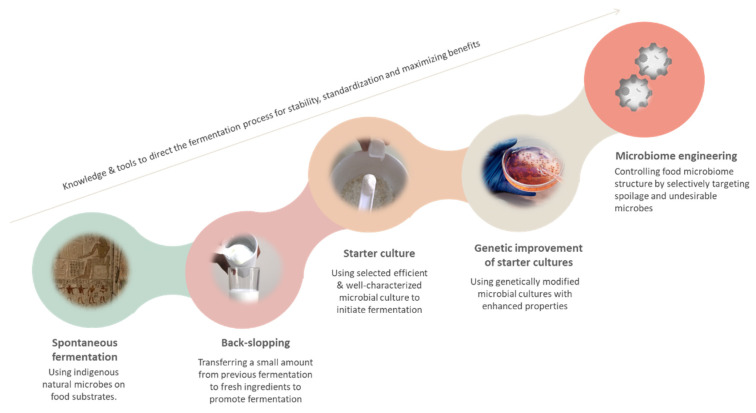
Food fermentation has been practised since ancient times to improve sensory properties and food preservation. This review discusses the process of fermentation, which has undergone remarkable improvement over the years, from relying on natural microbes and spontaneous fermentation to back-slopping and the use of starter cultures. Modern biotechnological approaches, including genome editing using CRISPR/Cas9, have been investigated and hold promise for improving the fermentation process. The invention of next-generation sequencing techniques and the rise of meta-omics tools have advanced our knowledge on the characterisation of microbiomes involved in food fermentation and their functional roles. The contribution and potential advantages of meta-omics technologies in understanding the process of fermentation and examples of recent studies utilising multi-omics approaches for studying food-fermentation microbiomes are reviewed. Recent technological advances in studying food fermentation have provided insights into the ancient wisdom in the practice of food fermentation, such as the choice of substrates and fermentation conditions leading to desirable properties. This review aims to stimulate research on the process of fermentation and the associated microbiomes to produce fermented food efficiently and sustainably. Prospects and the usefulness of recent advances in molecular tools and integrated multi-omics approaches are highlighted.
Keywords: fermented food; microbiome; multi-omics.
Conflict of interest statement
The authors declare no conflict of interest.
Figures
References
-
- Marsh A.J., Hill C., Ross R.P., Cotter P.D. Fermented beverages with health-promoting potential: Past and future perspectives. Trends. Food Sci. Technol. 2014;38:113–124. doi: 10.1016/j.tifs.2014.05.002. - DOI
-
- Liu L., Wang J., Rosenberg D., Zhao H., Lengyel G., Nadel D. Fermented beverage and food storage in 13,000 y-old stone mortars at Raqefet Cave, Israel: Investigating Natufian ritual feasting. J. Archaeol. Sci. 2018;21:783–793. doi: 10.1016/j.jasrep.2018.08.008. - DOI
-
- Chojnacka K. Fermentation products. Chem. Eng. Chem. Process Technol. 2010;5:1–12.
Publication types
Grants and funding
LinkOut - more resources
Full Text Sources
