


Agrobacterium tumefaciens-Mediated Transformation of NHEJ Mutant Aspergillus nidulans Conidia: An Efficient Tool for Targeted Gene Recombination Using Selectable Nutritional Markers
- PMID: 34829246
- PMCID: PMC8623315
- DOI: 10.3390/jof7110961
Agrobacterium tumefaciens-Mediated Transformation of NHEJ Mutant Aspergillus nidulans Conidia: An Efficient Tool for Targeted Gene Recombination Using Selectable Nutritional Markers
Abstract
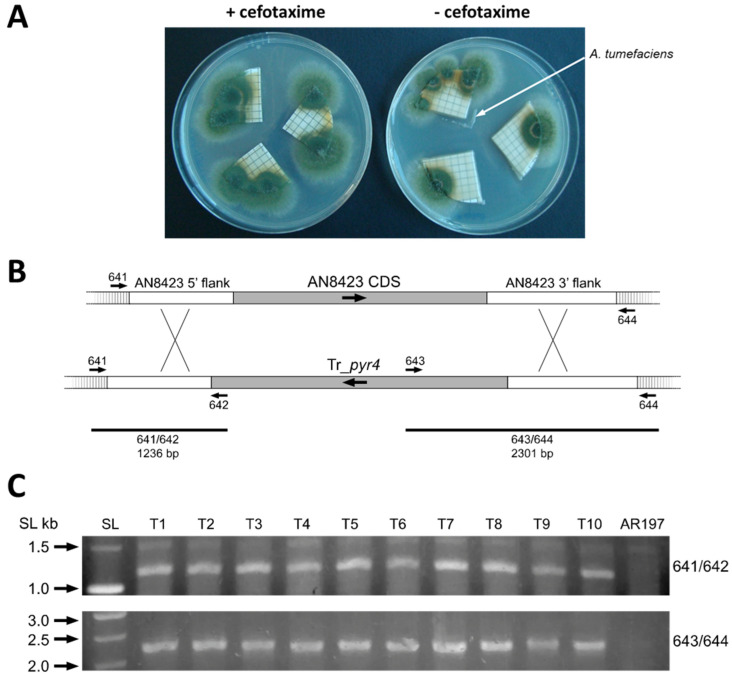
Protoplast transformation for the introduction of recombinant DNA into Aspergillus nidulans is technically demanding and dependant on the availability and batch variability of commercial enzyme preparations. Given the success of Agrobacterium tumefaciens-mediated transformation (ATMT) in diverse pathogenic fungi, we have adapted this method to facilitate transformation of A. nidulans. Using suitably engineered binary vectors, gene-targeted ATMT of A. nidulans non-homologous end-joining (NHEJ) mutant conidia has been carried out for the first time by complementation of a nutritional requirement (uridine/uracil auxotrophy). Site-specific integration in the ΔnkuA host genome occurred at high efficiency. Unlike other transformation techniques, however, cross-feeding of certain nutritional requirements from the bacterium to the fungus was found to occur, thus limiting the choice of auxotrophies available for ATMT. In complementation tests and also for comparative purposes, integration of recombinant cassettes at a specific locus could provide a means to reduce the influence of position effects (chromatin structure) on transgene expression. In this regard, targeted disruption of the wA locus permitted visual identification of transformants carrying site-specific integration events by conidial colour (white), even when auxotrophy selection was compromised due to cross-feeding. The protocol described offers an attractive alternative to the protoplast procedure for obtaining locus-targeted A. nidulans transformants.
Keywords: ATMT; Aspergillus nidulans; NHEJ; conidia; fungal transformation; mutagenesis; nutritional (pyrG/pyr4) and colour (wA) selectable markers; pCAMBIA-derived vectors; targeted gene deletion/disruption; ΔnkuA mutants.
Conflict of interest statement
The authors declare no conflict of interest. The funders had no role in the design of the study; in the collection, analyses, or interpretation of data; in the writing of the manuscript, or in the decision to publish the results.
Figures




References
-
- Jung M.K., Ovechkina Y., Prigozhina N., Oakley C.E., Oakley B.R. The use of beta-D-glucanase as a substitute for Novozyme 234 in immunofluorescence and protoplasting. Fungal Genet. Rep. 2000;47:8. doi: 10.4148/1941-4765.1204. - DOI
Grants and funding
LinkOut - more resources
Full Text Sources
