. 2021 Oct 30;10(11):1739.
doi: 10.3390/antiox10111739.

The Impact of N-Acetyl Cysteine and Coenzyme Q10 Supplementation on Skeletal Muscle Antioxidants and Proteome in Fit Thoroughbred Horses

Affiliations

The Impact of N-Acetyl Cysteine and Coenzyme Q10 Supplementation on Skeletal Muscle Antioxidants and Proteome in Fit Thoroughbred Horses

Marisa L Henry et al. Antioxidants (Basel). .

Abstract

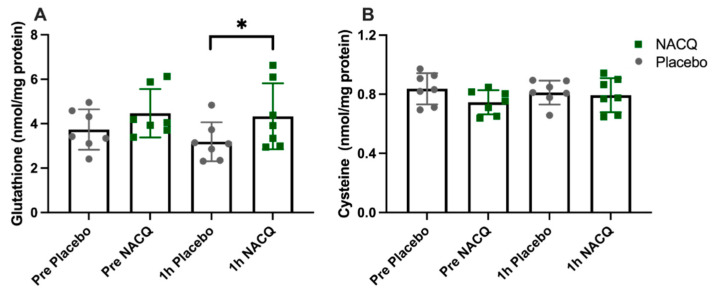
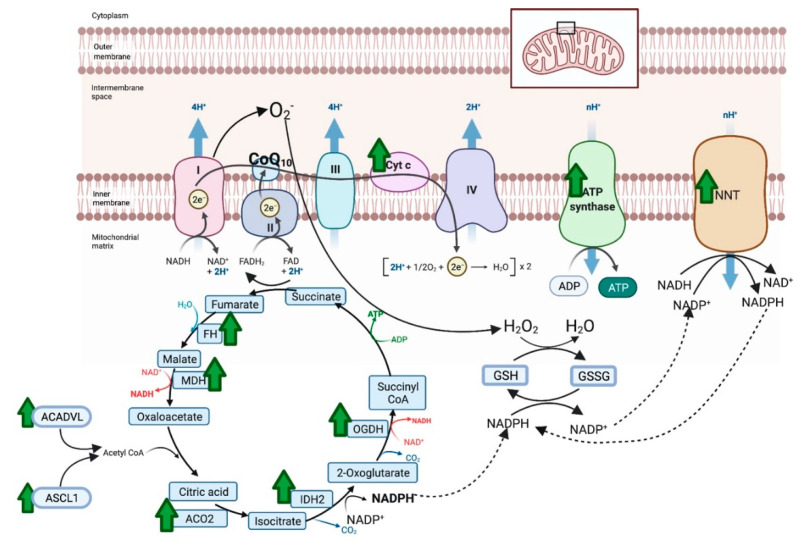
Horses have one of the highest skeletal muscle oxidative capacities amongst mammals, which, combined with a high glycolytic capacity, could perturb redox status during maximal exercise. We determined the effect of 30 d of oral coenzyme Q10 and N-acetyl-cysteine supplementation (NACQ) on muscle glutathione (GSH), cysteine, ROS, and coenzyme Q10 concentrations, and the muscle proteome, in seven maximally exercising Thoroughbred horses using a placebo and randomized cross-over design. Gluteal muscle biopsies were obtained the day before and 1 h after maximal exercise. Concentrations of GSH, cysteine, coenzyme Q10, and ROS were measured, and citrate synthase, glutathione peroxidase, and superoxide dismutase activities analyzed. GSH increased significantly 1 h post-exercise in the NACQ group (p = 0.022), whereas other antioxidant concentrations/activities were unchanged. TMT proteomic analysis revealed 40 differentially expressed proteins with NACQ out of 387 identified, including upregulation of 13 mitochondrial proteins (TCA cycle and NADPH production), 4 Z-disc proteins, and down regulation of 9 glycolytic proteins. NACQ supplementation significantly impacted muscle redox capacity after intense exercise by enhancing muscle glutathione concentrations and increasing expression of proteins involved in the uptake of glutathione into mitochondria and the NAPDH-associated reduction of oxidized glutathione, without any evident detrimental effects on performance.

Keywords: antioxidants; glycolysis; mitochondria; mitochondrial proteins; reactive oxygen species; redox.


Conflict of interest statement

Joe Pagan, a co-author, is the president of KER. He was involved in randomized design, owned horses used in the study, and provided all the product supplementation and funding for care and feeding of the subjects, as well as partially funded some of the analyses. Pagan had no role in skeletal muscle data analysis and interpretation. He did review the manuscript prior to submission. KER commercially offers CoQ10 for sale to horse owners.

Figures
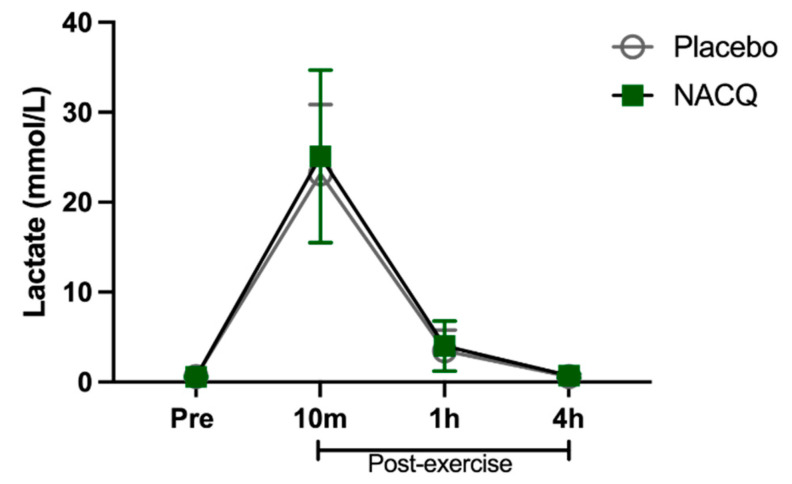
Figure 1
Figure 1
The concentration of plasma lactate in horses supplemented with NACQ compared to placebo before, during, and after an exercise test at a maximal gallop. Lactate concentrations were significantly higher 10 min post-exercise than all other timepoints (p < 0.0001) and were not significantly different between placebo and NACQ.
Figure 2
Figure 2
(A) Gluteal muscle glutathione concentrations in horses at rest and 1 h after exercise with NACQ (green) or placebo (grey) supplementation. The 1 h-post-exercise glutathione concentrations were significantly higher in NACQ horses than placebo (p = 0.022). (B) Muscle cysteine concentrations at rest and 1 h after exercise in horses supplemented with NACQ or placebo. Concentrations were not significantly different (p = 0.40). * p < 0.05 when compared with placebo group.
Figure 3
Figure 3
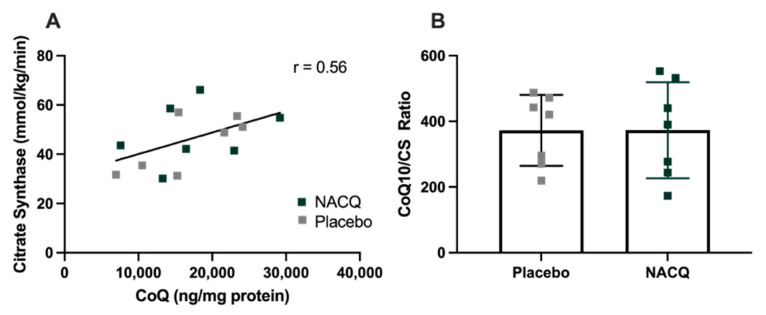
(A) Correlation between muscle coenzyme Q10 concentrations and CS activity in resting gluteal muscle samples (R = 0.56, p = 0.003). (B) The ratio of COQ10/CS in horses supplemented with NACQ or placebo. No significant differences were apparent (p = 0.99).
Figure 4
Figure 4
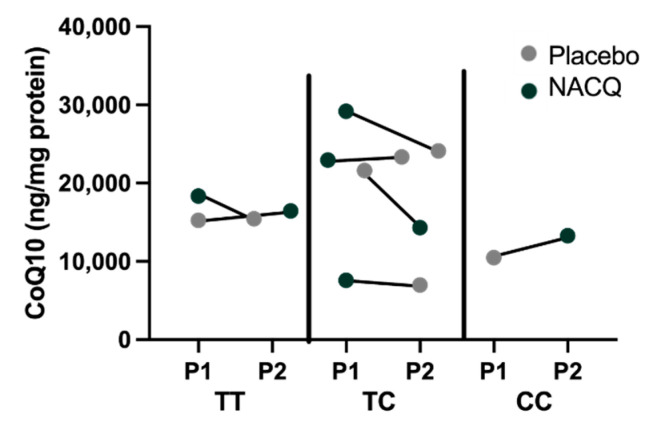
Myostatin genotypes and CoQ10 concentrations in horses on the placebo (grey) and on NACQ (green). The order of the points represents the order in which horses were fed the placebo or NACQ in the randomized block design.
Figure 5
Figure 5
Proteins with significantly increased expression (green arrow) in the mitochondria of horses on NACQ compared to placebo. Horses with NACQ supplementation had upregulation of two cytochrome C subunits, one subunit of ATP synthase, reduced glutathione (GSH), oxidized glutathione (GSSG), NAD(P) transhydrogenase (NNT), fumarate hydratase (FH), malate dehydrogenase (MDH), 2-oxoglutarate dehydrogenase (OGDH), NADP-dependent isocitrate dehydrogenase (IDH2), aconitase (ACO2), Very Long-Chain Specific Acyl-CoA Dehydrogenase Mitochondrial (ACADVL), and Long-Chain-Fatty-Acid–CoA Ligase 1 Isoform X2 (ASCL1). Created with BioRender.com (accessed on 26 October 2021).

References

    1. Essen-Gustavsson E. Activity and inactivity related muscle adaptations in the animal kingdom. Biochem. Exerc. 1986;6:435–454.
    1. Shadel G.S., Horvath T.L. Mitochondrial ROS signaling in organismal homeostasis. Cell. 2015;163:560–569. doi: 10.1016/j.cell.2015.10.001. - DOI - PMC - PubMed
    1. Ribas V., Garcia-Ruiz C., Fernandez-Checa J.C. Glutathione and mitochondria. Front. Pharm. 2014;5:151. doi: 10.3389/fphar.2014.00151. - DOI - PMC - PubMed
    1. Ferreira L.F., Reid M.B. Muscle-derived ROS and thiol regulation in muscle fatigue. J. Appl. Physiol. 2008;104:853–860. doi: 10.1152/japplphysiol.00953.2007. - DOI - PubMed
    1. Kwon Y.H., Stipanuk M.H. Cysteine regulates expression of cysteine dioxygenase and gamma-glutamylcysteine synthetase in cultured rat hepatocytes. Am. J. Physiol. Endocrinol. Metab. 2001;280:E804–E815. doi: 10.1152/ajpendo.2001.280.5.E804. - DOI - PubMed

LinkOut - more resources