Review
. 2021 Nov 20;10(11):1845.
doi: 10.3390/antiox10111845.

The Emerging Scenario of the Gut-Brain Axis: The Therapeutic Actions of the New Actor Kefir against Neurodegenerative Diseases

Affiliations
Review

The Emerging Scenario of the Gut-Brain Axis: The Therapeutic Actions of the New Actor Kefir against Neurodegenerative Diseases

Thiago M C Pereira et al. Antioxidants (Basel). .

Abstract

The fact that millions of people worldwide suffer from Alzheimer's disease (AD) or Parkinson's disease (PD), the two most prevalent neurodegenerative diseases (NDs), has been a permanent challenge to science. New tools were developed over the past two decades and were immediately incorporated into routines in many laboratories, but the most valuable scientific contribution was the "waking up" of the gut microbiota. Disturbances in the gut microbiota, such as an imbalance in the beneficial/pathogenic effects and a decrease in diversity, can result in the passage of undesired chemicals and cells to the systemic circulation. Recently, the potential effect of probiotics on restoring/preserving the microbiota was also evaluated regarding important metabolite and vitamin production, pathogen exclusion, immune system maturation, and intestinal mucosal barrier integrity. Therefore, the focus of the present review is to discuss the available data and conclude what has been accomplished over the past two decades. This perspective fosters program development of the next steps that are necessary to obtain confirmation through clinical trials on the magnitude of the effects of kefir in large samples.

Keywords: angiotensin II; autonomic nervous system; chronic focal encephalitis; gut microbiota; inflammation; kefir; neurodegenerative diseases; oxidative stress.


Conflict of interest statement

The authors declare no conflict of interest.

Figures
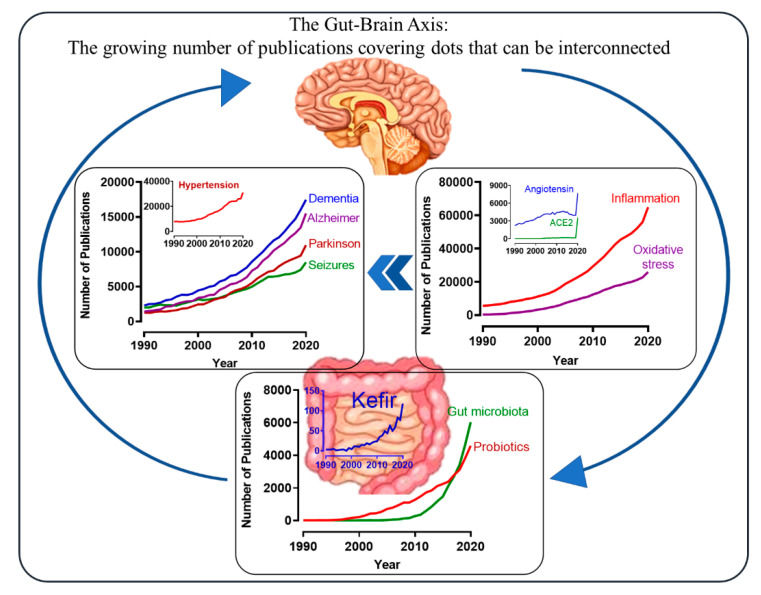
Figure 1
Figure 1
Schematic illustration and graphs constructed by plotting the number of papers published per year in indexed journals listed on the PubMed platform. The arrows indicate the multifactorial and interactive connections, including inflammation, oxidative stress, hypertension and angiotensin/ACE2. We interpreted the sharp increase in the number of published papers relating to angiotensin/ACE2 in 2020 as being due to its role in COVID-19. The bottom panel shows a large jump in the number of papers in “microbiota” (~26,000), demonstrating the current relevance of therapies based on the use of probiotics and that kefir shows a similar profile. ACE2: Angiotensin-Converting Enzyme type 2. The above diagram was created by one of the coauthors of this review, a 76-year-old researcher suffering from PD for 12 years.
Figure 2
Figure 2
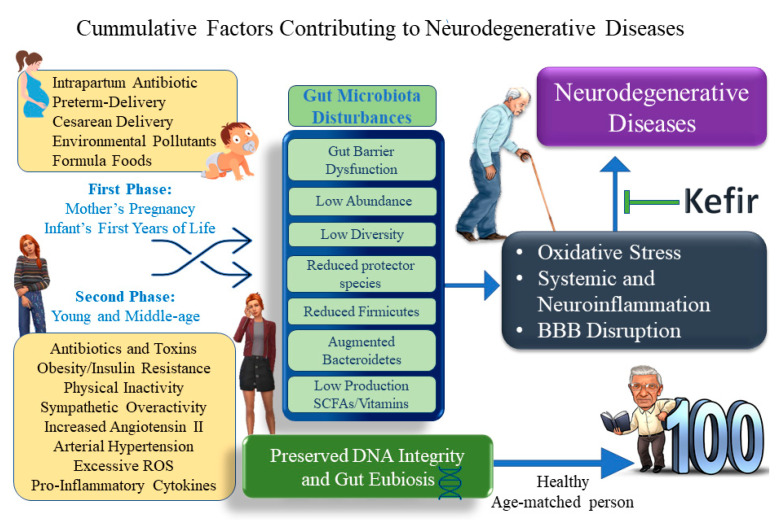
Schematic diagram suggesting several negative factors (conventional and nonconventional) that influence the seeding of the gut microbiota (as identified by “omics” approaches) in the early days of life of the infant and that can anticipate the onset of AD and PD. In addition to searching for the negative factors influencing ND, in our opinion, we suggest that the search in this field should also be expanded to the features (biomarkers, epigenetic influence) that could explain those that are centenarian life spans. This diagram was also created by one of the coauthors of this review, a 76-year-old researcher suffering from PD for 12 years.
Figure 3
Figure 3
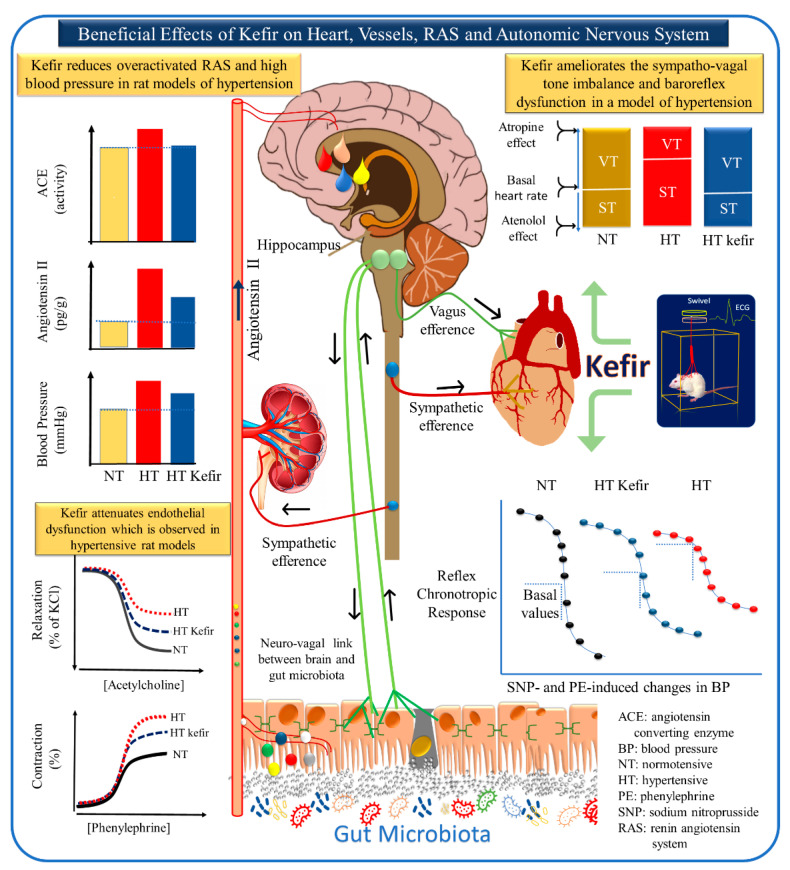
Gut microbiota and some relevant molecular pathways linking gut dysbiosis to cardiovascular diseases through the bloodstream and via the autonomic nervous system. The main mechanisms of the modulators include the neuroendocrine, afferent, and efferent pathways of the autonomic nervous system (vagus and sympathetic components), reactive oxygen species (ROS, represented by red circles), inflammatory markers (white and blue circles), and dietary metabolic products (short-chain fatty acids: SCFAs; lipopolysaccharide: LPS, green circles), which are delivered into the circulatory system and reach the brain, connecting integrative areas related to ND. Distinct areas (kidney, gut, heart, and brain) are represented to emphasize the protective effects of kefir based on our recent publications [14,63,64,65]. All images were modified and reconstructed from our previous publications. This diagram was also created by one of the coauthors of this review, a 76-year-old researcher suffering from PD for 12 years.
Figure 4
Figure 4
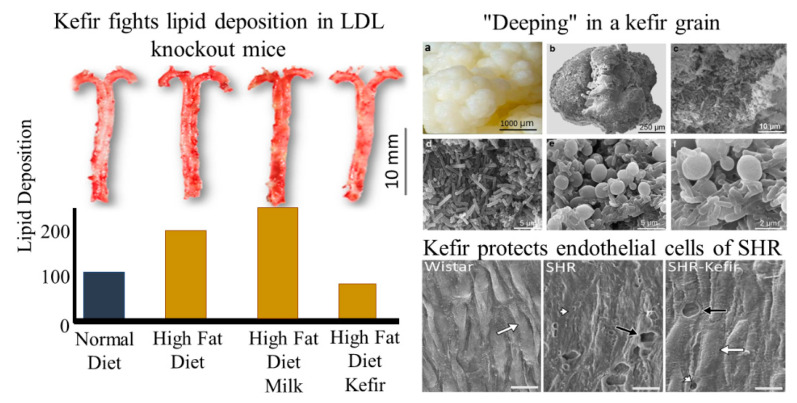
Illustrative images from our laboratory demonstrating the vascular protective role of kefir in both lipid deposition (in LDLr knockout mice) and in the endothelial layer (in SHR model). The images were reconstructed and modified from previous publications [7,80]. In addition, we demonstrate the “inside world” of a single grain, which was pictured at increasing magnifications (from “b” to “f”) and symbiotically inhabited by millions of microorganisms that our laboratory has used to demonstrate the effect of kefir experimental and clinical studies [7].
Figure 5
Figure 5
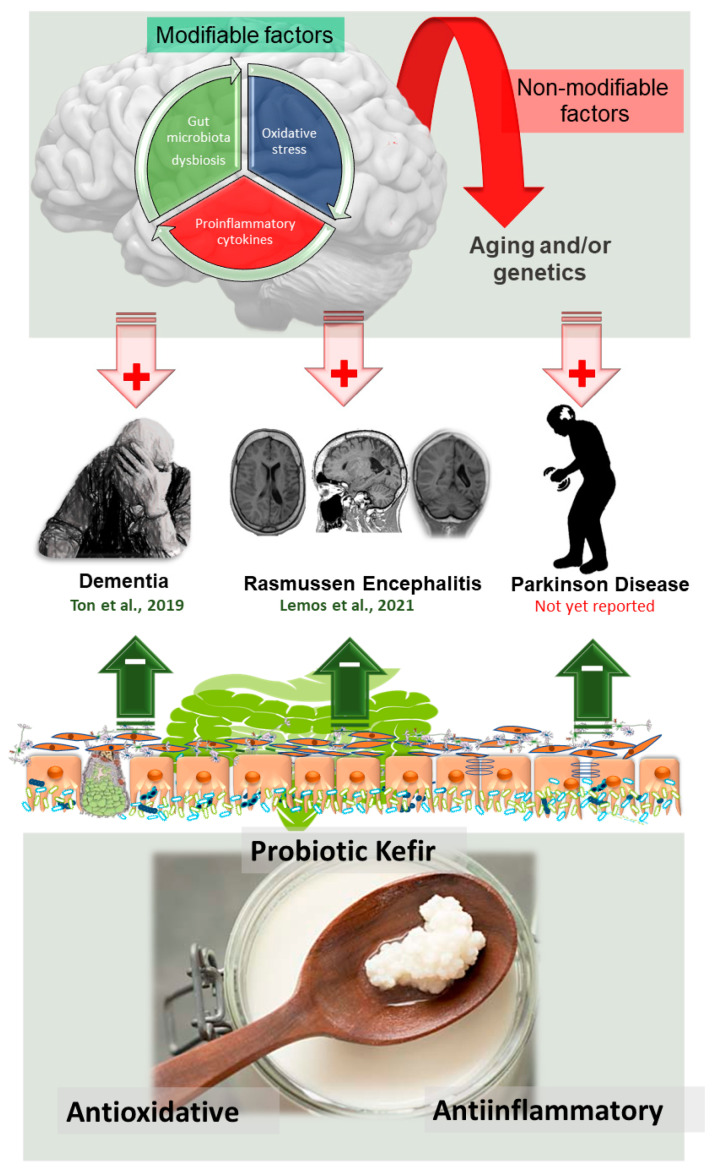
Graphical scheme demonstrating the state-of-the-art and our conclusive opinion based on our clinical studies performed in patients suffering from aging-related dementia and AD and in young patients exhibiting repeated and intense episodes of seizures. It should be noted that the role of kefir in PD progression has not yet been reported in the literature.

References

    1. Singh A., Kukreti R., Saso L., Kukreti S. Oxidative Stress: A Key Modulator in Neurodegenerative Diseases. Molecules. 2019;24:1583. doi: 10.3390/molecules24081583. - DOI - PMC - PubMed
    1. Stephenson J., Nutma E., van der Valk P., Amor S. Inflammation in CNS neurodegenerative diseases. Immunology. 2018;154:204–219. doi: 10.1111/imm.12922. - DOI - PMC - PubMed
    1. Salman M.M., Al-Obaidi Z., Kitchen P., Loreto A., Bill R.M., Wade-Martins R. Advances in Applying Computer-Aided Drug Design for Neurodegenerative Diseases. Int. J. Mol. Sci. 2021;22:4688. doi: 10.3390/ijms22094688. - DOI - PMC - PubMed
    1. Aldewachi H., Al-Zidan R.N., Conner M.T., Salman M.M. High-Throughput Screening Platforms in the Discovery of Novel Drugs for Neurodegenerative Diseases. Bioengineering. 2021;8:30. doi: 10.3390/bioengineering8020030. - DOI - PMC - PubMed
    1. Livingston G., Huntley J., Sommerlad A., Ames D., Ballard C., Banerjee S., Brayne C., Burns A., Cohen-Mansfield J., Cooper C., et al. Dementia prevention, intervention, and care: 2020 report of the Lancet Commission. Lancet. 2020;396:413–446. doi: 10.1016/S0140-6736(20)30367-6. - DOI - PMC - PubMed

LinkOut - more resources