Review
. 2021 Nov 1;9(11):1591.
doi: 10.3390/biomedicines9111591.

Targeted Therapies in Cancer: To Be or Not to Be, Selective

Affiliations
Review

Targeted Therapies in Cancer: To Be or Not to Be, Selective

Skye Montoya et al. Biomedicines. .

Abstract

Development of targeted therapies in recent years revealed several nonchemotherapeutic options for patients. Chief among targeted therapies is small molecule kinase inhibitors targeting key oncogenic signaling proteins. Through competitive and noncompetitive inhibition of these kinases, and therefore the pathways they activate, cancers can be slowed or completely eradicated, leading to partial or complete remissions for many cancer types. Unfortunately, for many patients, resistance to targeted therapies, such as kinase inhibitors, ultimately develops and can necessitate multiple lines of treatment. Drug resistance can either be de novo or acquired after months or years of drug exposure. Since resistance can be due to several unique mechanisms, there is no one-size-fits-all solution to this problem. However, combinations that target complimentary pathways or potential escape mechanisms appear to be more effective than sequential therapy. Combinations of single kinase inhibitors or alternately multikinase inhibitor drugs could be used to achieve this goal. Understanding how to efficiently target cancer cells and overcome resistance to prior lines of therapy became imperative to the success of cancer treatment. Due to the complexity of cancer, effective treatment options in the future will likely require mixing and matching these approaches in different cancer types and different disease stages.

Keywords: cancer; clinical trial inhibitors; combination drug therapies; multikinase inhibitors; receptor tyrosine kinases; resistance mechanisms; single kinase inhibitors; targeted therapies.


Conflict of interest statement

The authors declare no conflict of interest.

Figures
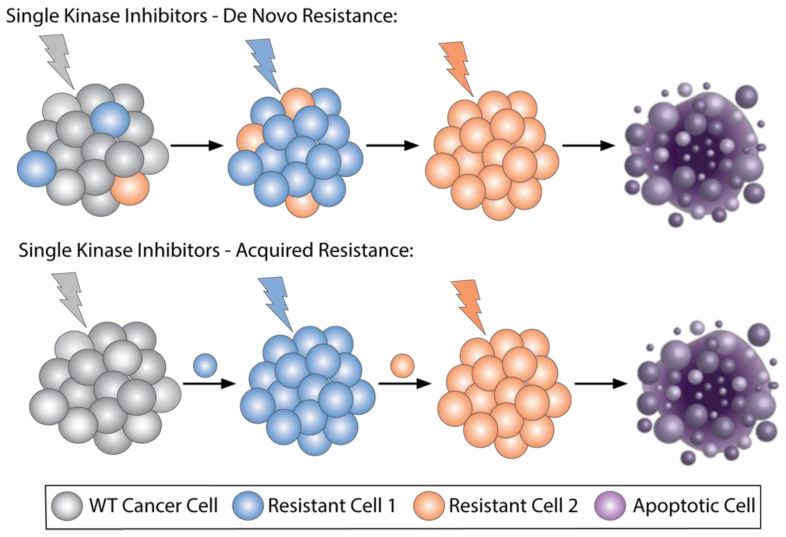
Figure 1
Figure 1
Types of resistance mechanisms occurring in patients. Resistance to targeted therapies can be broadly classified as either de novo or acquired resistance. In case of de novo resistance (top), pre-existing mutations exist in tumor cells that are selected for after treatment (blue colored cells). This could potentially be overcome by treating with sequential selective kinase inhibitors that target escape mechanisms of resistance (orange-colored cells). In acquired resistance (bottom), cells with resistance arise during treatment and cause relapse. Sequential treatments may overcome resistance if given in correct order.
Figure 2
Figure 2
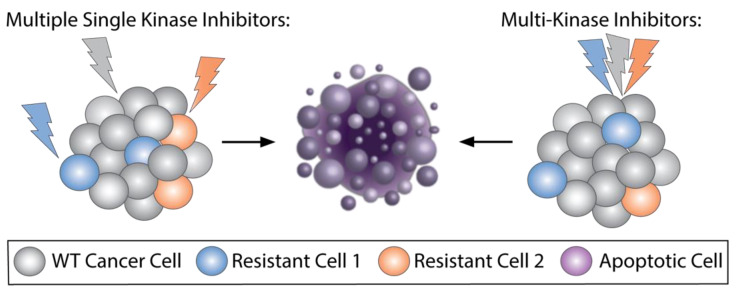
Hitting multiple targets at once to overcome resistance. Since resistance to targeted therapies can occur from residual tumor cells that are not eradicated selective single kinase inhibitors, multiple kinase targeted therapies can be utilized to overcome resistance. Using two or more single kinase selective agents (left) or multikinase inhibitor single agents (right) can target driver mutations and potential escape mechanisms simultaneously and obviate need for multiple sequential therapies.

References

    1. Zhong L., Li Y., Xiong L., Wang W., Wu M., Yuan T., Yang W., Tian C., Miao Z., Wang T., et al. Small molecules in targeted cancer therapy: Advances, challenges, and future perspectives. Signal Transduct. Target. Ther. 2021;6:1–48. doi: 10.1038/s41392-021-00572-w. - DOI - PMC - PubMed
    1. Cohen P., Cross D., Jänne P.A. Kinase drug discovery 20 years after imatinib: Progress and future directions. Nat. Rev. Drug Discov. 2021;20:551–569. doi: 10.1038/s41573-021-00195-4. - DOI - PMC - PubMed
    1. Kannaiyan R., Mahadevan D. A comprehensive review of protein kinase inhibitors for cancer therapy. Expert Rev. Anticancer. Ther. 2018;18:1249–1270. doi: 10.1080/14737140.2018.1527688. - DOI - PMC - PubMed
    1. Papaccio F., Paino F., Regad T., Papaccio G., Desiderio V., Tirino V. Concise Review: Cancer Cells, Cancer Stem Cells, and Mesenchymal Stem Cells: Influence in Cancer Development. Stem Cells Transl. Med. 2017;6:2115–2125. doi: 10.1002/sctm.17-0138. - DOI - PMC - PubMed
    1. Bhullar K.S., Lagarón N.O., McGowan E.M., Parmar I., Jha A., Hubbard B.P., Rupasinghe H.P.V. Kinase-targeted cancer therapies: Progress, challenges and future directions. Mol. Cancer. 2018;17:1–20. doi: 10.1186/s12943-018-0804-2. - DOI - PMC - PubMed

LinkOut - more resources