Review
. 2021 Nov 9;22(22):12126.
doi: 10.3390/ijms222212126.

Emerging Approaches for Solid Tumor Treatment Using CAR-T Cell Therapy

Affiliations
Review

Emerging Approaches for Solid Tumor Treatment Using CAR-T Cell Therapy

Hyunmin Chung et al. Int J Mol Sci. .

Abstract

Cancer immunotherapy is becoming more important in the clinical setting, especially for cancers resistant to conventional chemotherapy, including targeted therapy. Chimeric antigen receptor (CAR)-T cell therapy, which uses patient's autologous T cells, combined with engineered T cell receptors, has shown remarkable results, with five US Food and Drug Administration (FDA) approvals to date. CAR-T cells have been very effective in hematologic malignancies, such as diffuse large B cell lymphoma (DLBCL), B cell acute lymphoblastic leukemia (B-ALL), and multiple myeloma (MM); however, its effectiveness in treating solid tumors has not been evaluated clearly. Therefore, many studies and clinical investigations are emerging to improve the CAR-T cell efficacy in solid tumors. The novel therapeutic approaches include modifying CARs in multiple ways or developing a combination therapy with immune checkpoint inhibitors and chemotherapies. In this review, we focus on the challenges and recent advancements in CAR-T cell therapy for solid tumors.

Keywords: CAR-T cell; challenge; combination therapy; solid tumor.


Conflict of interest statement

The authors declare no conflict of interest.

Figures
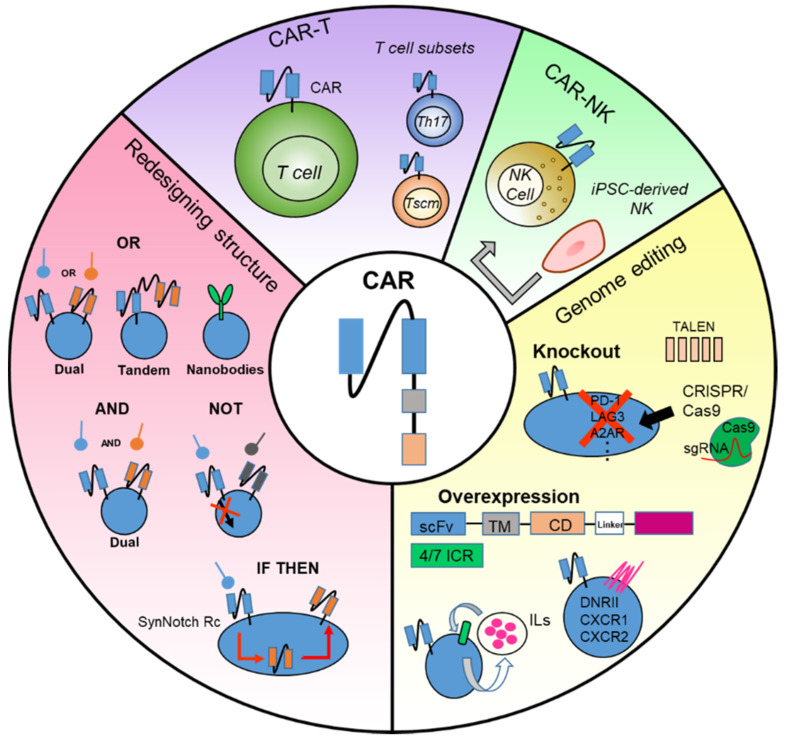
Figure 1
Figure 1
Summary of novel approaches for employing chimeric antigen receptors (CARs). CAR construct has been advanced and redesigned to express a variety of combinations, including diverse scFvs and intracellular signaling domains. CARs can be expressed in either T cells, T cell subsets, or NK cells to develop anti-tumor immune cell and gene therapies. Additional gene engineering has been conducted in immune cells to enhance the CAR-T cell persistence and anti-tumor efficacy. Th17—T helper 17; Tscm—stem cell-like memory T cell; iPSC—induced Pluripotent stem cell; NK—natural killer; TALEN—transcription activator-like effector nucleases; CRISPR—clustered regularly interspaced short palindromic repeats; sgRNA—single guide RNA; PD-1—programmed cell death-1; LAG3—lymphocyte activation gene 3; A2AR—A2A adenosine receptor; DNRII—TGF-β dominant negative receptor II; scFv—single chain variable fragment; TM—transmembrane; CD—cytoplasmic domain; ICR—inverted cytokine receptor; ILs—interleukins.
Figure 2
Figure 2
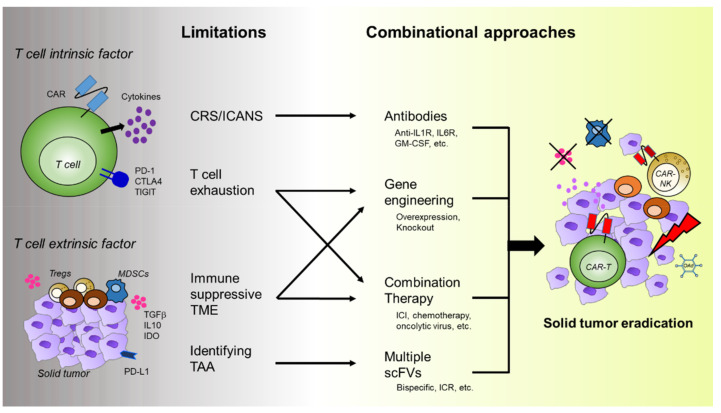
Therapeutic strategies to overcome current limitations and improve CAR-T cell efficacy in solid tumors. The current problems of CAR-T cell therapies in solid tumors can be categorized into T cell intrinsic factor and T cell extrinsic factor, which is described in Section 3. The conventional CAR-T cells can be further modified genetically to express more CARs, impair inhibitory immune checkpoints (such as PD-1 and CTLA-4), or retain activation genes, such as chemokine receptors and interleukins. In addition, a variety of drugs including immune checkpoint inhibitors are currently being tested in combination with CAR-T cell preclinically and clinically. Alternatively, cancer vaccine or CAR-NK cells are also being developed for the next generation cancer immunotherapy. CAR—chimeric antigen receptor; ICI—immune checkpoint inhibitor; PD-1—programmed cell death-1; CTLA4—cytotoxic T lymphocyte-associated protein 4; TIGIT—T cell immunoreceptor with Ig and ITIM domains; CRS—cytokine release syndrome; ICANS—immune effector cell-associated neurotoxicity syndrome; GM-CSF—granuolocyte-macrophage colony-stimulating factor; Treg—regulatory T cell; MDSC—myeloid-derived suppressor cell; TGF-β —transforming growth factor beta; IDO—indoleamine 2,3-dioxygenase; TME—tumor microenvironment; TAA—tumor-associated antigen; ICI—immune checkpoint inhibitor; ICR—inverted cytokine receptor; OAd—oncolytic adenovirus.

References

    1. Carbone D.P., Gandara D.R., Antonia S.J., Zielinski C., Paz-Ares L. Non–small-cell lung cancer: Role of the immune system and potential for immunotherapy. J. Thorac. Oncol. 2015;10:974–984. doi: 10.1097/JTO.0000000000000551. - DOI - PMC - PubMed
    1. Liu Y., Zeng G. Cancer and innate immune system interactions: Translational potentials for cancer immunotherapy. J. Immunother. 2012;35:299–308. doi: 10.1097/CJI.0b013e3182518e83. - DOI - PMC - PubMed
    1. Hanahan D., Weinberg R.A. Hallmarks of cancer: The next generation. Cell. 2011;144:646–674. doi: 10.1016/j.cell.2011.02.013. - DOI - PubMed
    1. Wagner J., Wickman E., DeRenzo C., Gottschalk S. CAR T-cell Therapy for Solid Tumors: Bright Future or Dark Reality? Mol. Ther. 2020;28:2230–2239. doi: 10.1016/j.ymthe.2020.09.015. - DOI - PMC - PubMed
    1. Noh J.-Y., Seo H., Lee J., Jung H. Immunotherapy in Hematologic Malignancies: Emerging Therapies and Novel Approaches. Int. J. Mol. Sci. 2020;21:8000. doi: 10.3390/ijms21218000. - DOI - PMC - PubMed

MeSH terms

Substances

LinkOut - more resources