Review
. 2021 Nov 11;22(22):12204.
doi: 10.3390/ijms222212204.

The Role of Exosomes and Their Applications in Cancer

Affiliations
Review

The Role of Exosomes and Their Applications in Cancer

Yuju Zhou et al. Int J Mol Sci. .

Abstract

Exosomes are very small extracellular vesicles secreted by multiple cell types and are extensively distributed in various biological fluids. Recent research indicated that exosomes can participate in regulating the tumor microenvironment and impacting tumor proliferation and progression. Due to the extensive enrollment in cancer development, exosomes have become a focus of the search for a new therapeutic method for cancer. Exosomes can be utilized for the therapeutic delivery of small molecules, proteins and RNAs to target cancer cells with a high efficiency. Exosome-carried proteins, lipids and nucleic acids are being tested as promising biomarkers for cancer diagnosis and prognosis, even as potential treatment targets for cancer. Moreover, different sources of exosomes exhibit multiple performances in cancer applications. In this review, we elaborate on the specific mechanism by which exosomes affect the communication between tumors and the microenvironment and state the therapeutic and diagnostic applications of exosomes in cancers.

Keywords: applications; cancers; exosomes; tumor microenvironment.


Conflict of interest statement

The authors declare no conflict of interest.

Figures
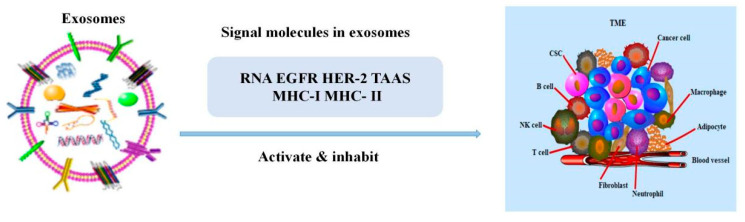
Figure 1
Figure 1
The relationship between exosomes and the TME. The signal molecules carried by exosomes could activate or inhibit immune cells to mediate the growth of tumor cells.
Figure 2
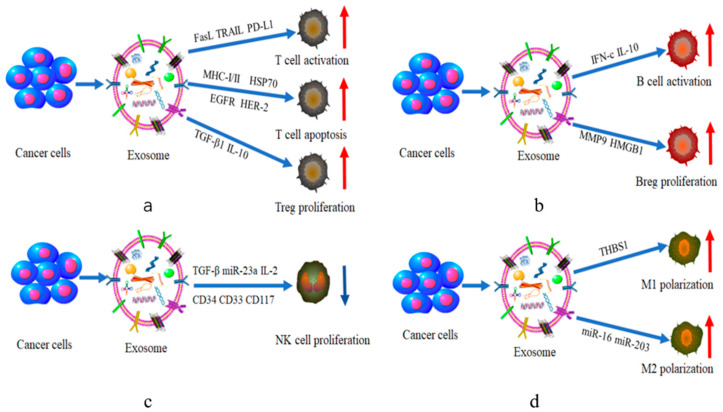
Figure 2
The effect of tumor-derived exosomes on immune cells. (ad) respectively show the regulatory effects of various signal molecules of tumor-derived exosomes on the proliferation and differentiation of T cells, B cells, NK cells and macrophages. (MHC-I(II), major histocompatibility complexes; HSP70, heat shock protein70; EGFR HER-2, growth factor receptors; FasL TRAIL PD-L1, tumor necrosis factor–related apoptosis-inducing ligand; TGF-β, transforming growth factor β; IL-10, Interleukin-10TGF-β, transforming growth factor β; CD34 CD33 CD117, NK cells receptors; IFN-c, pro-inflammatory factors; IL-10, anti-inflammatory factors; MMP9, matrix metalloproteinase 9; HMGB1, an evolutionarily conserved DNA-binding nuclear protein; THBS 1, a protein with strong anti-inflammatory properties).
Figure 3
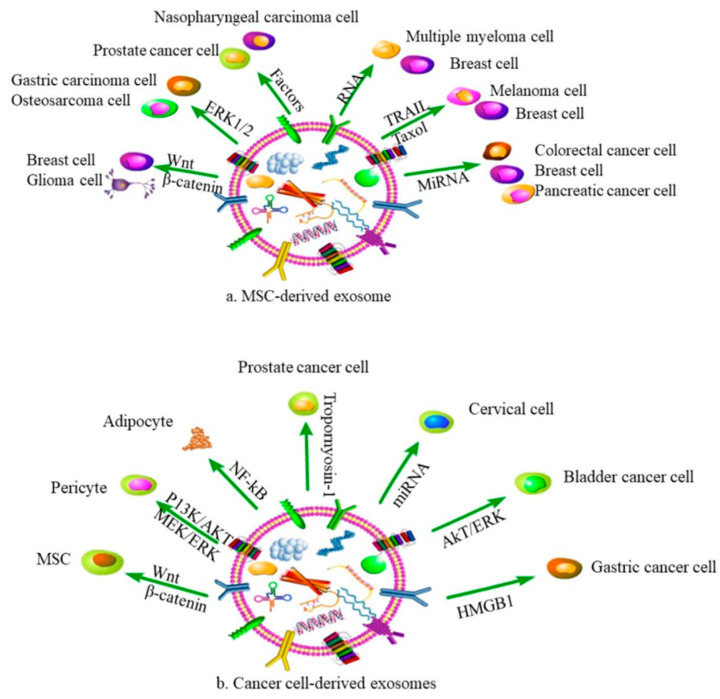
Figure 3
Effects of exosomes from different sources on cancers. (a,b) respectively show that exosomes from MSCs and cancer cells affect various cancers processes through different inclusions.
Figure 4
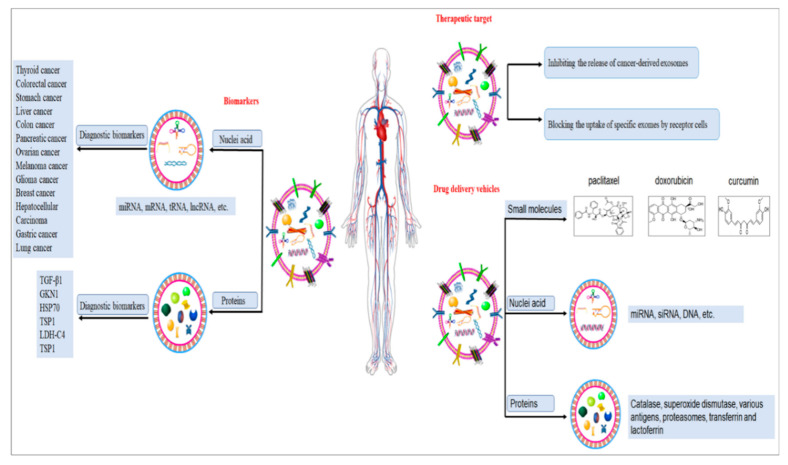
Figure 4
The applications of exosomes in cancers.

References

    1. Zhao W., Shan B., He D., Cheng Y., Li B., Zhang C., Duan C. Recent Progress in Characterizing Long Noncoding RNAs in Cancer Drug Resistance. J. Cancer. 2019;10:6693–6702. doi: 10.7150/jca.30877. - DOI - PMC - PubMed
    1. Ragusa M., Barbagallo C., Cirnigliaro M., Battaglia R., Brex D., Caponnetto A., Barbagallo D., Di Pietro C., Purrello M. Asymmetric RNA Distribution among Cells and Their Secreted Exosomes: Biomedical Meaning and Considerations on Diagnostic Applications. Front. Mol. Biosci. 2017;4:66–80. doi: 10.3389/fmolb.2017.00066. - DOI - PMC - PubMed
    1. Wang S., Wang J., Wei W., Ma G. Exosomes: The Indispensable Messenger in Tumor Pathogenesis and the Rising Star in Antitumor Applications. Adv. Biosyst. 2019;3:e1900008. doi: 10.1002/adbi.201900008. - DOI - PubMed
    1. Darband S.G., Mirza-Aghazadeh-Attari M., Kaviani M., Mihanfar A., Sadighparvar S., Yousefi B., Majidinia M. Exosomes: Natural nanoparticles as bio shuttles for RNAi delivery. J. Control. Release. 2018;289:158–170. doi: 10.1016/j.jconrel.2018.10.001. - DOI - PubMed
    1. De Visser K.E., Eichten A., Coussens L.M. Paradoxical roles of the immune system during cancer development. Nat. Rev. Cancer. 2006;6:24–37. doi: 10.1038/nrc1782. - DOI - PubMed