Review
. 2021 Nov 12;22(22):12217.
doi: 10.3390/ijms222212217.

Kinase-Inhibitors in Iodine-Refractory Differentiated Thyroid Cancer-Focus on Occurrence, Mechanisms, and Management of Treatment-Related Hypertension

Affiliations
Review

Kinase-Inhibitors in Iodine-Refractory Differentiated Thyroid Cancer-Focus on Occurrence, Mechanisms, and Management of Treatment-Related Hypertension

Anne Christine Kaae et al. Int J Mol Sci. .

Abstract

Differentiated thyroid cancer (DTC) usually has a good prognosis when treated conventionally with thyroidectomy, radioactive iodine (RAI) and thyroid-stimulating hormone suppression, but some tumors develop a resistance to RAI therapy, requiring alternative treatments. Sorafenib, lenvatinib and cabozantinib are multikinase inhibitors (MKIs) approved for the treatment of RAI-refractory DTC. The drugs have been shown to improve progression-free survival (PFS) and overall survival (OS) via the inhibition of different receptor tyrosine kinases (RTKs) that are involved in tumorigenesis and angiogenesis. Both sorafenib and lenvatinib have been approved irrespective of the line of therapy for the treatment of RAI-refractory DTC, whereas cabozantinib has only been approved as a second-line treatment. Adverse effects (AEs) such as hypertension are often seen with MKI treatment, but are generally well manageable. In this review, current clinical studies will be discussed, and the toxicity and safety of sorafenib, lenvatinib and cabozantinib treatment will be evaluated, with a focus on AE hypertension and its treatment options. In short, treatment-emergent hypertension (TE-HTN) occurs with all three drugs, but is usually well manageable and leads only to a few dose modifications or even discontinuations. This is emphasized by the fact that lenvatinib is widely considered the first-line drug of choice, despite its higher rate of TE-HTN.

Keywords: adverse effects; cabozantinib; hypertension; lenvatinib; multikinase inhibitors; sorafenib; thyroid cancer.


Conflict of interest statement

The authors declare no conflict of interest.

Figures
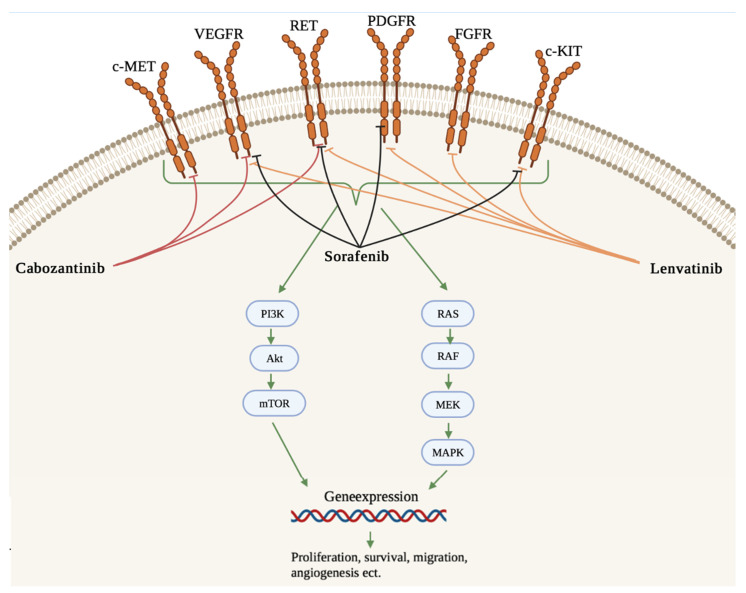
Figure 1
Figure 1
Targets of sorafenib, lenvatinib and cabozantinib. The intracellular signaling pathway MAPK and the PI3K/AKT/mTOR pathway are involved in the development of TC. VEGFR (vascular endothelial growth factor receptor), PDGFR (platelet-derived growth factor receptor), FGFR (fibroblast growth factor receptor), RET (rearranged during transfection), c-KIT (stem cell factor receptor), RAS (rat sarcoma protein), MET (Hepatocyte growth factor receptor), RAF (rapidly accelerated fibrosarcoma kinase), MEK (mitogen-activated protein kinase kinase), MAPK (mitogen-activated protein kinase), PI3K (phosphoinositide 3-kinase), AKT (protein kinase B), mTOR (mammalian target of rapamycin) [9,18,45]. Adapted from [9,18,49]. The figure was drawn using Biorender.com (accessed on 21 October 2021).
Figure 2
Figure 2
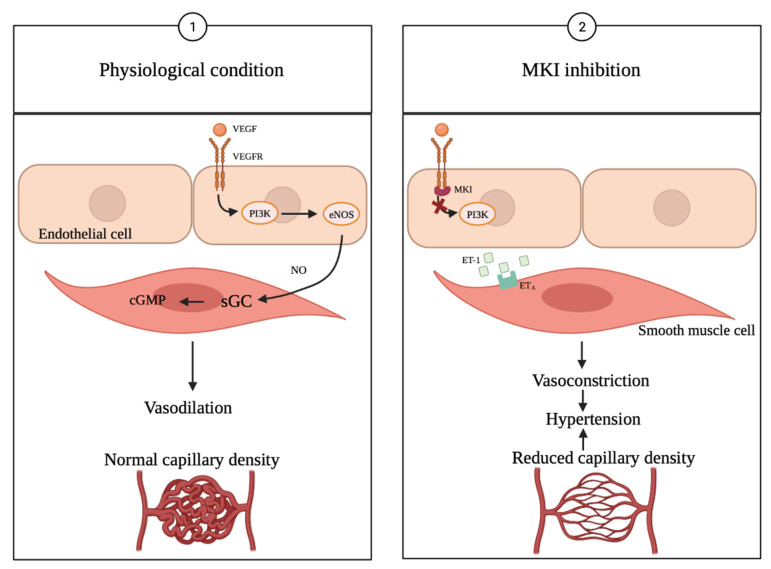
MKI treatment induced hypertension. Inhibition of VEFGR causes hypertension, as VEGFR receptors are present on both healthy vascular endothelial cells and in cancer cells, causing the MKI treatment to also affect healthy endothelial cells [18] (adapted from [18,75]). NO production is inhibited, and the endothelin-1 pathway is activated leading to vasoconstriction. VEGF is important for the integrity of the capillary network and inhibition of the VEGFR leads to reduction in capillary density [75]. VEGF (vascular endothelial growth factor), VEGFR (vascular endothelial growth factor receptor), PI3K (phosphatidylinositol-3-kinase), eNOS (endothelial nitric oxide), sGC (soluble guanylate cyclase), cGMP (cyclic guanosine monophosphate), ET-1 (endothelin-1), ETA (endothelin receptor type A) [18,75]. The figure was drawn using Biorender.com.

References

    1. Sung H., Ferlay J., Siegel R.L., Laversanne M., Soerjomataram I., Jemal A., Bray F. Global Cancer Statistics 2020: GLOBOCAN Estimates of Incidence and Mortality Worldwide for 36 Cancers in 185 Countries. CA Cancer J. Clin. 2021;71:209–249. doi: 10.3322/caac.21660. - DOI - PubMed
    1. Lim H., Devesa S.S., Sosa J.A., Check D., Kitahara C.M. Trends in Thyroid Cancer Incidence and Mortality in the United States, 1974–2013. JAMA. 2017;317:1338–1348. doi: 10.1001/jama.2017.2719. - DOI - PMC - PubMed
    1. Takahashi S., Kiyota N., Yamazaki T., Chayahara N., Nakano K., Inagaki L., Toda K., Enokida T., Minami H., Imamura Y., et al. A Phase II study of the safety and efficacy of lenvatinib in patients with advanced thyroid cancer. Future Oncol. 2019;15:717–726. doi: 10.2217/fon-2018-0557. - DOI - PubMed
    1. Carling T., Udelsman R. Thyroid cancer. Annu. Rev. Med. 2014;65:125–137. doi: 10.1146/annurev-med-061512-105739. - DOI - PubMed
    1. Cabanillas M.E., McFadden D.G., Durante C. Thyroid cancer. Lancet. 2016;388:2783–2795. doi: 10.1016/S0140-6736(16)30172-6. - DOI - PubMed

MeSH terms