Review
. 2021 Nov 19;22(22):12496.
doi: 10.3390/ijms222212496.

Cell Behavior of Non-Small Cell Lung Cancer Is at EGFR and MicroRNAs Hands

Affiliations
Review

Cell Behavior of Non-Small Cell Lung Cancer Is at EGFR and MicroRNAs Hands

Sarah Sayed Hassanein et al. Int J Mol Sci. .

Abstract

Lung cancer is a complex disease associated with gene mutations, particularly mutations of Kirsten Rat Sarcoma Viral Oncogene Homolog (KRAS) and epidermal growth factor receptor (EGFR). Non-small cell lung cancer (NSCLC) and small cell lung cancer (SCLC) are the two major types of lung cancer. The former includes most lung cancers (85%) and are commonly associated with EGFR mutations. Several EGFR-tyrosine kinase inhibitors (EGFR-TKIs), including erlotinib, gefitinib, and osimertinib, are effective therapeutic agents in EGFR-mutated NSCLC. However, their effectiveness is limited by the development (acquired) or presence of intrinsic drug resistance. MicroRNAs (miRNAs) are key gene regulators that play a profound role in the development and outcomes for NSCLC via their role as oncogenes or oncosuppressors. The regulatory role of miRNA-dependent EGFR crosstalk depends on EGFR signaling pathway, including Rat Sarcoma/Rapidly Accelerated Fibrosarcoma/Mitogen-Activated Protein Kinase/Extracellular Signal-Regulated Kinase 1/2 (Ras/Raf/MEK/ERK1/2), Signal Transducer and Activator of Transcription (STAT), Nuclear Factor Kappa-Light-Chain-Enhancer of Activated B Cells (NF-kB), phosphoinositide 3-kinase/protein kinase B (PI3K/AKT), Janus kinase 1 (JAK1), and growth factor receptor-bound protein 2 (GRB2). Dysregulated expression of miRNAs affects sensitivity to treatment with EGFR-TKIs. Thus, abnormalities in miRNA-dependent EGFR crosstalk can be used as diagnostic and prognostic markers, as well as therapeutic targets in NSCLC. In this review, we present an overview of miRNA-dependent EGFR expression regulation, which modulates the behavior and progression of NSCLC.

Keywords: chemoresistance; diagnostic markers; epidermal growth factor receptor (EGFR); microRNA (miRNA); non-small cell lung cancer (NSCLC); oncogenes; oncosuppressors; signaling pathways; therapeutic targets; tyrosine kinase inhibitors (TKIs).


Conflict of interest statement

The authors declare that no conflict of interest (neither financial nor personal) exists.

Figures
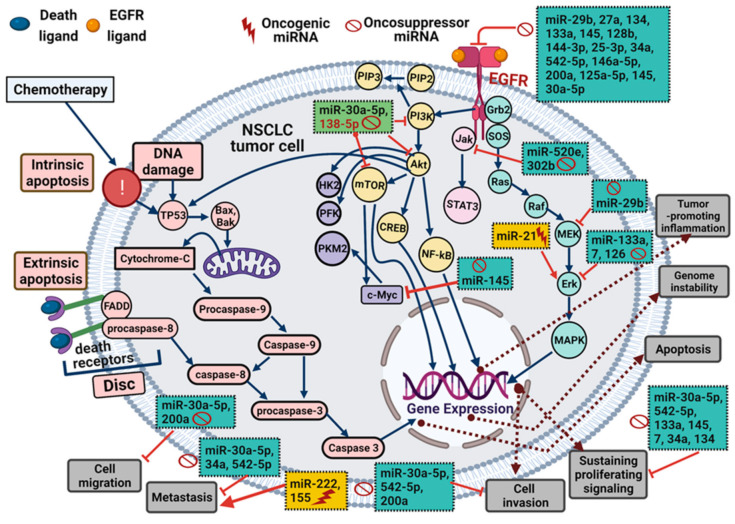
Figure 1
Figure 1
EGFR signaling components are affected by various miRNAs (oncogenic or tumor suppressors) in non-small cell lung cancer. Activation of the EGFR signaling pathway, including PI3K/Akt, Ras/Raf/MAPK, and Jak/STAT, stimulates inflammation, proliferative signaling, migration, angiogenesis, and invasion. These signaling pathways are controlled by different miRNAs. Binding of death ligand (e.g., TRAIL) to death receptor leads to FADD (adaptor molecule). Pro-caspase-8 activation takes place upon its binding to FADD and DISC formation (extrinsic apoptosis). Chemotherapeutic drugs, such as cisplatin, cause DNA damage and results in p53 activation (intrinsic apoptosis). Activated caspase-8 directly activates other caspases that translocate to the mitochondria promoting the Bax-Bak assembly, thus changing mitochondrial membrane permeability. Cytochrome c is then released into cytosol resulting in caspases activation leading to apoptosis. Several oncogenic and tumor suppressor miRNAs control EGFR signaling components and subsequently affect tumor growth and progression. Blue and red arrows for stimulation, dashed brown arrows for cellular effect, and red “T” for inhibition.
Figure 2
Figure 2
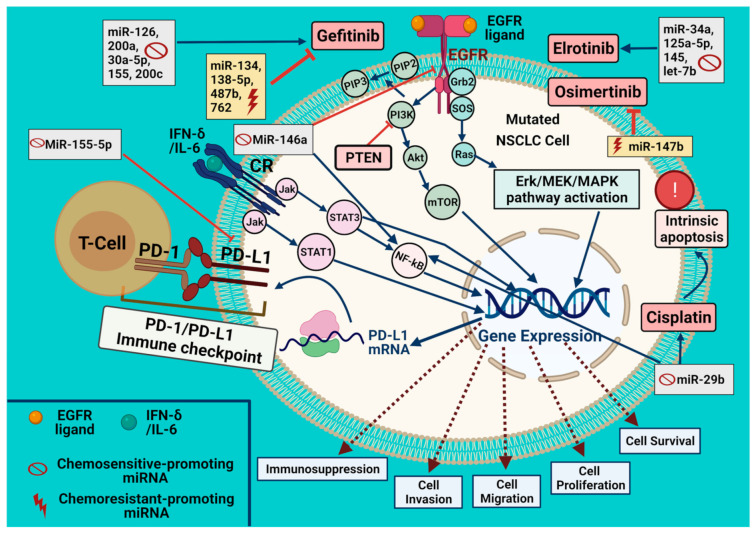
Role of miRNAs in modulating chemosensitivity to EGFR-TKIs and cisplatin in mutated NSCLC cells. In NSCLC tumor cells, EGFR activation results in activating Erk/MEK/MAPK, Akt/mTOR, and Jak/STAT signaling pathways. Cytokines (e.g., IFN-gamma and IL-6) bind to their respective cytokine receptors (CRs), leading to its activation. The NSCLC cell chemoresistance to gefitinib increases by miR-134, miR-138-5p, miR-487b, and miR-762 but decreases by miR-126, miR-200a, miR-30a-5p, miR-155, and miR-200c. The cell chemosensitivity to erlotinib was enhanced by miR-34a, miR-125a-5p, miR-145, and let-7b, yet it decreased to osimertinib by miR-147b. PD-L1 expression can be induced by aberrations in signal transduction components (constitutive expression) and/or many inflammatory cytokines (inducible expression); its expression results in its recruitment at the cell surface and binds to PD-1 on T-cell to avoid immune destruction. MiR-155-5p suppresses mRNA expression, membrane protein, and total protein levels of PD-L1. MiR-146a targets EGFR and NF-κB signaling and significantly suppresses cell proliferation via EGFR-TKI (erlotinib, gefitinib, and afatinib). MiR-29b restored NF-κB and extrinsic apoptosis. Cisplatin induces intrinsic apoptosis and can be repressed by miR-29b. Blue and red arrows denote for stimulation; dashed brown arrows for cellular effect and red “T” sign for inhibition.

References

    1. Zhen Q., Liu J., Gao L., Liu J., Wang R., Chu W., Zhang Y., Tan G., Zhao X., Lv B. MicroRNA-200a Targets EGFR and c-Met to Inhibit Migration, Invasion, and Gefitinib Resistance in Non-Small Cell Lung Cancer. Cytogenet. Genome Res. 2015;146:1–8. doi: 10.1159/000434741. - DOI - PubMed
    1. MacDonagh L., Gray S.G., Finn S.P., Cuffe S., O’Byrne K.J., Barr M.P. The emerging role of microRNAs in resistance to lung cancer treatments. Cancer Treat. Rev. 2015;41:160–169. doi: 10.1016/j.ctrv.2014.12.009. - DOI - PubMed
    1. Garinet S., Laurent-Puig P., Blons H., Oudart J.-B. Current and Future Molecular Testing in NSCLC, What Can We Expect from New Sequencing Technologies? J. Clin. Med. 2018;7:144. doi: 10.3390/jcm7060144. - DOI - PMC - PubMed
    1. Wang F., Chan L.W.C., Law H.K.W., Cho W.C.S., Tang P., Yu J., Shyu C.R., Wong S.C.C., Yip S.P., Yung B.Y.M. Exploring microRNA-mediated alteration of EGFR signaling pathway in non-small cell lung cancer using an mRNA: MiRNA regression model supported by target prediction databases. Genomics. 2014;104:504–511. doi: 10.1016/j.ygeno.2014.09.004. - DOI - PubMed
    1. Zhang Y., Yang Q., Wang S. MicroRNAs: A new key in lung cancer. Cancer Chemother. Pharmacol. 2014;74:1105–1111. doi: 10.1007/s00280-014-2559-9. - DOI - PubMed

MeSH terms