. 2021 Nov 19;22(22):12502.
doi: 10.3390/ijms222212502.

A Phenylfurocoumarin Derivative Reverses ABCG2-Mediated Multidrug Resistance In Vitro and In Vivo

Affiliations

A Phenylfurocoumarin Derivative Reverses ABCG2-Mediated Multidrug Resistance In Vitro and In Vivo

Shoji Kokubo et al. Int J Mol Sci. .

Abstract

The ATP-binding cassette subfamily G member 2 (ABCG2) transporter is involved in the development of multidrug resistance in cancer patients. Many inhibitors of ABCG2 have been reported to enhance the chemosensitivity of cancer cells. However, none of these inhibitors are being used clinically. The aim of this study was to identify novel ABCG2 inhibitors by high-throughput screening of a chemical library. Among the 5812 compounds in the library, 23 compounds were selected in the first screening, using a fluorescent plate reader-based pheophorbide a (PhA) efflux assay. Thereafter, to validate these compounds, a flow cytometry-based PhA efflux assay was performed and 16 compounds were identified as potential inhibitors. A cytotoxic assay was then performed to assess the effect these 16 compounds had on ABCG2-mediated chemosensitivity. We found that the phenylfurocoumarin derivative (R)-9-(3,4-dimethoxyphenyl)-4-((3,3-dimethyloxiran-2-yl)methoxy)-7H-furo [3,2-g]chromen-7-one (PFC) significantly decreased the IC50 of SN-38 in HCT-116/BCRP colon cancer cells. In addition, PFC stimulated ABCG2-mediated ATP hydrolysis, suggesting that this compound interacts with the substrate-binding site of ABCG2. Furthermore, PFC reversed the resistance to irinotecan without causing toxicity in the ABCG2-overexpressing HCT-116/BCRP cell xenograft mouse model. In conclusion, PFC is a novel inhibitor of ABCG2 and has promise as a therapeutic to overcome ABCG2-mediated MDR, to improve the efficiency of cancer chemotherapy.

Keywords: ABC transporter; ABCG2 inhibitor; chemosensitivity; multidrug resistance; phenylfurocoumarin.


Conflict of interest statement

The authors declare no conflict of interest.

Figures
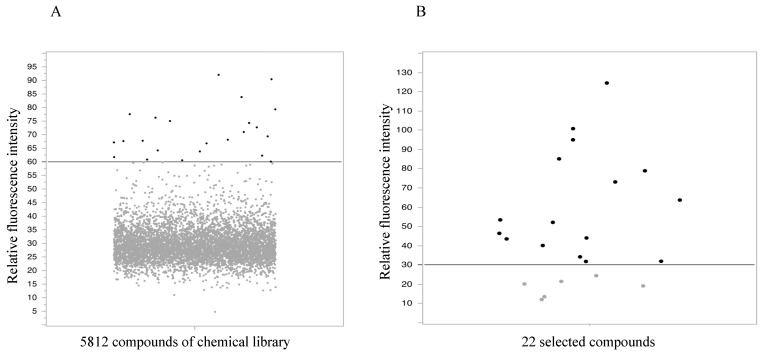
Figure 1
Figure 1
High-throughput screening and validation assay identifying 16 candidate ABCG2 inhibitors. (A) Dot plot of PhA efflux data from high-throughput screening. Of 5812 compounds, 23 exhibited higher fluorescence intensities than Ko143. (B) Dot plot of PhA efflux data for validation by flow cytometry. Of 22 compounds (there was an overlap for one of the compounds, the number of candidates was reduced to 22), 16 showed higher fluorescence intensities than Ko143.
Figure 2
Figure 2
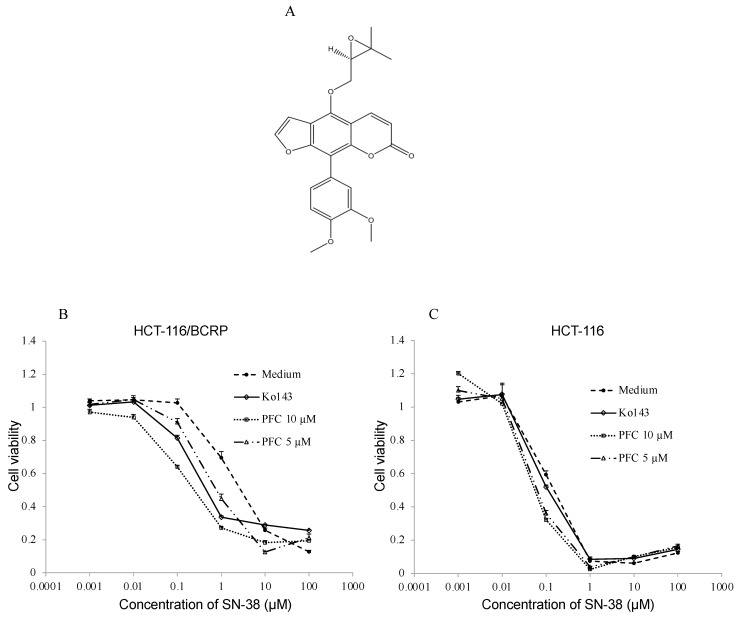
(A) Structure of a phenylfurocoumarin derivative (PFC). (B,C) Effect of PFC on SN-38 cytotoxicity in HCT-116/BCRP (B) and HCT-116 (C) cell lines. Cells were incubated in the presence of multiple concentrations of SN-38 with 5 or 10 µM of PFC, or 1 µM of Ko143, or medium only (control). Viability was determined by triplicate MTS assays. These figures show the result of one representative experiment of three independent experiments. Points, mean (n = 5); bars, SD.
Figure 3
Figure 3
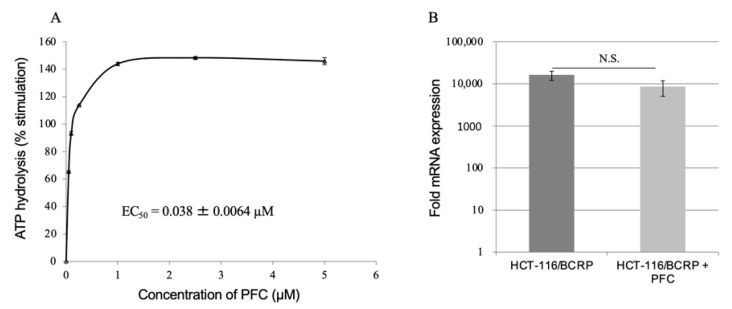
Effect of the phenylfurocoumarin derivative PFC on ATPase activity of ABCG2 and mRNA expression of ABCG2. (A) Representative data from four independent experiments. Each point represents a mean (n = 4). The concentration of PFC required for 50% stimulation (EC50) is shown as mean ± SE. (B) ABCG2 mRNA expression in HCT-116/BCRP and HCT-116/BCRP with PFC was measured by qPCR, relative to that of HCT-116. Data are shown as mean ± standard error (SE) (n = 3). N.S. not significant.
Figure 4
Figure 4
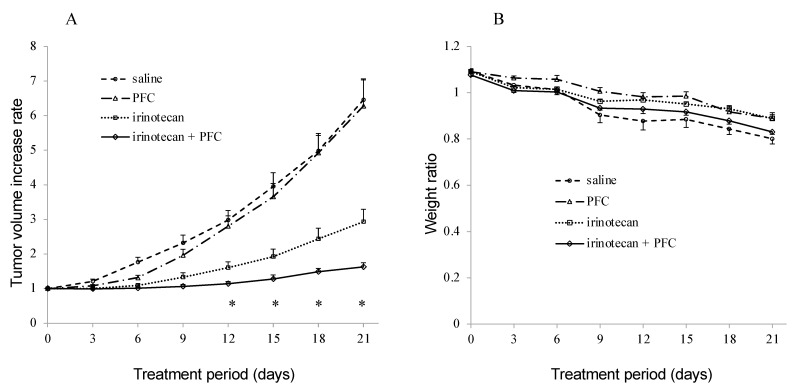
The phenylfurocoumarin derivative PFC reverses resistance to irinotecan in HCT-116/BCRP cell xenografts in nude mice. Tumor volume increase rate (A) and body weight rate (B) were measured every 3 days. Each point represents a mean (n = 5). Bars show standard error (SE). p values were determined with the two-tailed Student’s t-test (* p < 0.05: irinotecan versus irinotecan + PFC).
Figure 5
Figure 5
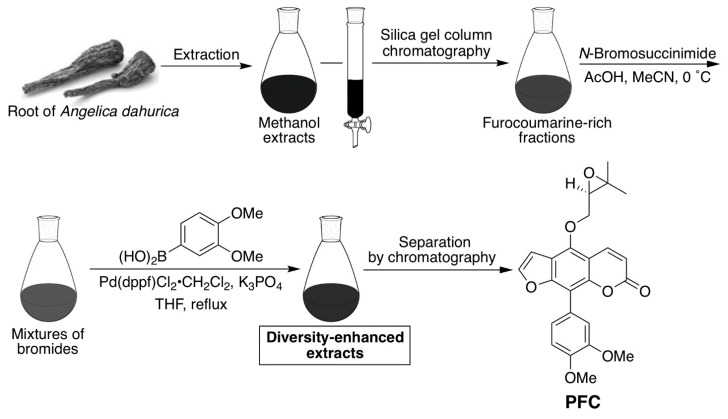
PFC synthesis scheme.

References

    1. Gottesman M.M. Mechanisms of cancer drug resistance. Annu. Rev. Med. 2002;53:615–627. doi: 10.1146/annurev.med.53.082901.103929. - DOI - PubMed
    1. Gottesman M.M., Fojo T., Bates S.E. Multidrug resistance in cancer: Role of ATP-dependent transporters. Nat. Rev. Cancer. 2002;2:48–58. doi: 10.1038/nrc706. - DOI - PubMed
    1. Shukla S., Ohnuma S., Ambudkar S.V. Improving cancer chemotherapy with modulators of ABC drug transporters. Curr. Drug Targets. 2011;12:621–630. doi: 10.2174/138945011795378540. - DOI - PMC - PubMed
    1. Dean M., Rzhetsky A., Allikmets R. The human ATP-binding cassette (ABC) transporter superfamily. Genome Res. 2001;11:1156–1166. doi: 10.1101/gr.184901. - DOI - PubMed
    1. Allikmets R., Schriml L., Hutchinson A., Romano-Spica V., Dean M. A human placenta-specific ATP-binding cassette gene (ABCP) on chromosome 4q22 that is involved in multidrug resistance. Cancer Res. 1998;58:5337–5339. - PubMed

MeSH terms

LinkOut - more resources