. 2021 Nov 12;10(22):5266.
doi: 10.3390/jcm10225266.

Phantosmia, Parosmia, and Dysgeusia Are Prolonged and Late-Onset Symptoms of COVID-19

Affiliations

Phantosmia, Parosmia, and Dysgeusia Are Prolonged and Late-Onset Symptoms of COVID-19

Sophia E Schambeck et al. J Clin Med. .

Abstract

Deficiencies in smell and taste are common symptoms of COVID-19. Quantitative losses are well surveyed. This study focuses on qualitative changes such as phantosmia (hallucination of smell), parosmia (alteration of smell), and dysgeusia (alteration of taste) and possible connections with the adaptive immune system. Subjective experience of deficiency in taste and smell was assessed by two different questionnaires after a median of 100 and 244 days after first positive RT-PCR test. SARS-CoV-2-specific antibody levels were measured with the iFlash-SARS-CoV-2 assay. After 100 days a psychophysical screening test for olfactory and gustatory dysfunction was administered. 30 of 44 (68.2%) participants reported a chemosensory dysfunction (14 quantitative, 6 qualitative, 10 quantitative, and qualitative) during COVID-19, eleven (25.0%) participants (1 quantitative, 7 qualitative, 3 quantitative, and quantity) after 100 days, and 14 (31.8%) participants (1 quantitative, 10 qualitative, 3 quantitative and qualitative) after 244 days. Four (9.1%) participants, who were symptom-free after 100 days reported now recently arisen qualitative changes. Serological and T-cell analysis showed no correlation with impairment of taste and smell. In conclusion, qualitative changes can persist for several months and occur as late-onset symptoms months after full recovery from COVID-19-induced quantitative losses in taste and smell.

Keywords: COVID-19; coronavirus; dysgeusia; long-COVID; parosmia; phantosmia; smell; taste.


Conflict of interest statement

The authors declare no conflict of interest.

Figures
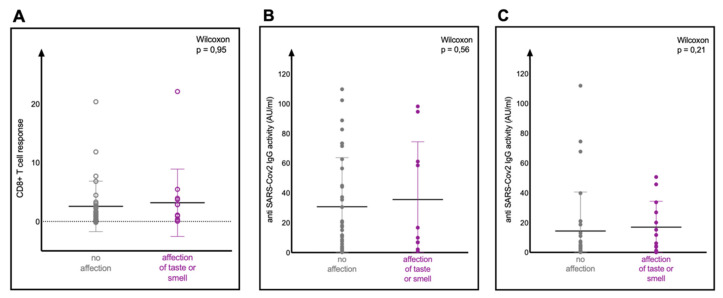
Figure A1
Figure A1
(A) CD8+ T-cell response (mean 63 days after positive RT-PCR test) of the participants with or without alteration of taste and smell ongoing after a median of 244 days after positive RT-PCR test. (B,C) Anti SARS-Cov2 IgG levels of the participants with or without alteration of taste and smell ongoing at 100 days (A1B) and 244 days (A1C) after positive RT-PCR test. Data analysis with the Wilcoxon test showed no significant difference between both groups.
Figure A2
Figure A2
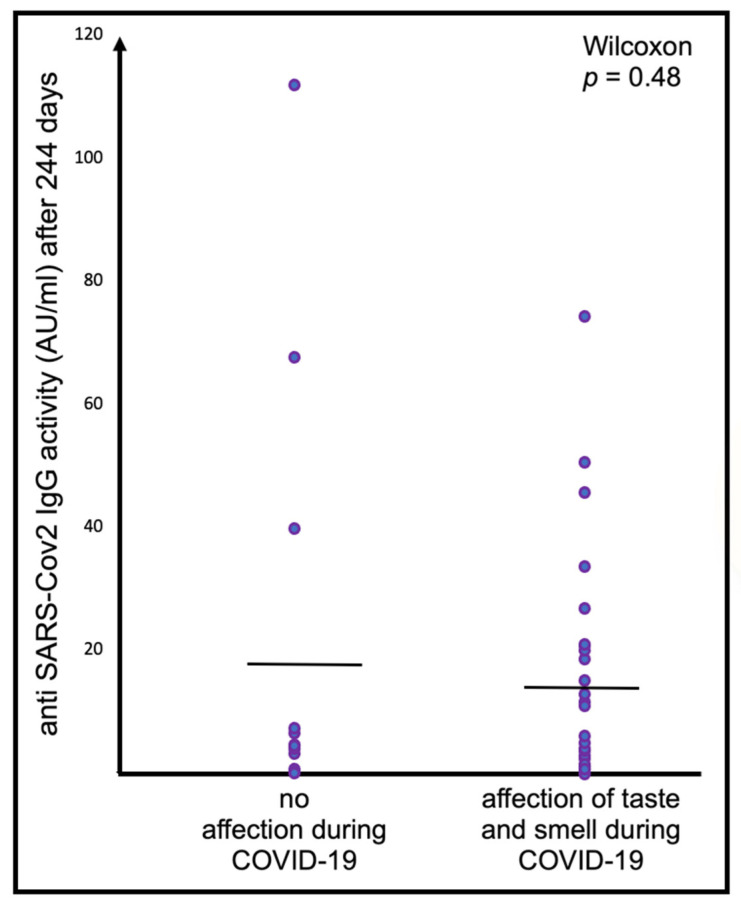
Anti SARS-Cov2 IgG levels after a median of 244 days after positive RT-PCR test of the participants with or without alteration of taste and smell during the illness. Data analysis with the Wilcoxon test showed no significant difference between both groups.
Figure 1
Figure 1
Flow chart showing the structure and links between the parental study (EPI-SARS study) and the substudy on smell and taste. RT-PCR positive tested individuals were included in the study and followed over the course of 6 months, with repeat blood sampling and questionnaires (V1–V6). The smell and taste substudy was part of the EPI-SARS study protocol. Part A, including Q1 and psychophysical screening test, and part B with Q2 were conducted at V2–4 and V6 respectively.
Figure 2
Figure 2
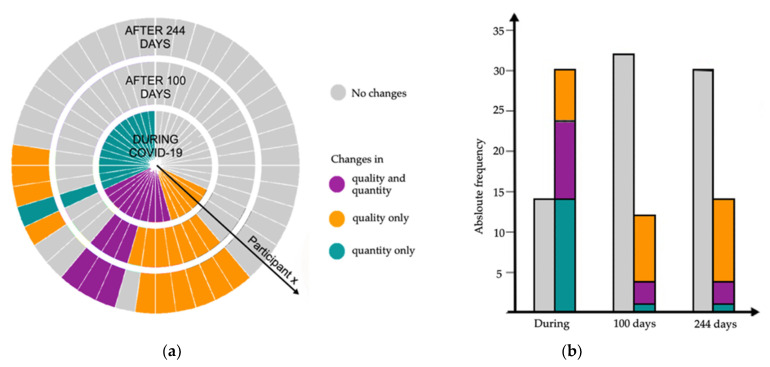
Quantitative and qualitative alterations in taste and smell of all 44 participants over the course of the study. Data on chemosensory dysfunction during the disease were collected in retrospectively, whereas information concerning 100 and 244 days were collected prospectively. (a) Development of quantitative and qualitative alterations of taste and smell of each participant. Each slice symbolizes one participant and the respective alteration of taste and smell during COVID-19 infection, as well as 100 and 244 days later. (b) Absolute frequencies and distribution of alterations in taste and smell over the course of study.
Figure 3
Figure 3
Scores odor identification test of the 44 participants (red: women, black: men).

References

    1. Lee Y., Min P., Lee S., Kim S.-W. Prevalence and Duration of Acute Loss of Smell or Taste in COVID-19 Patients. J. Korean Med. Sci. 2020;35:e174. doi: 10.3346/jkms.2020.35.e174. - DOI - PMC - PubMed
    1. Reinhard A., Ikonomidis C., Broome M., Gorostidi F. Anosmia and COVID-19. Rev. Med. Suisse. 2020;16:849–851. - PubMed
    1. Kain P. Loss of Smell and Taste: Potential of Using Them as Markers for Early Detection of COVID-19. Adv. Neurol. Neurosci. 2020;3:49–50. - PMC - PubMed
    1. Huart C., Philpott C., Konstantinidis I., Altundag A., Whitcroft K., Trecca E., Cassano M., Rombaux P., Hummel T. Comparison of COVID-19 and common cold chemosensory dysfunction. Rhinology. 2020;58:623–625. doi: 10.4193/Rhin20.251. - DOI - PubMed
    1. Glezer I., Bruni-Cardoso A., Schechtman D., Malnic B. Viral infection and smell loss: The case of COVID-19. J. Neurochem. 2021;157:930–943. doi: 10.1111/jnc.15197. - DOI - PMC - PubMed

LinkOut - more resources