Review
. 2021 Oct 22;10(11):2844.
doi: 10.3390/cells10112844.

CFTR Protein: Not Just a Chloride Channel?

Affiliations
Review

CFTR Protein: Not Just a Chloride Channel?

Laurence S Hanssens et al. Cells. .

Abstract

Cystic fibrosis (CF) is a recessive genetic disease caused by mutations in a gene encoding a protein called Cystic Fibrosis Transmembrane Conductance Regulator (CFTR). The CFTR protein is known to acts as a chloride (Cl-) channel expressed in the exocrine glands of several body systems where it also regulates other ion channels, including the epithelial sodium (Na+) channel (ENaC) that plays a key role in salt absorption. This function is crucial to the osmotic balance of the mucus and its viscosity. However, the pathophysiology of CF is more challenging than a mere dysregulation of epithelial ion transport, mainly resulting in impaired mucociliary clearance (MCC) with consecutive bronchiectasis and in exocrine pancreatic insufficiency. This review shows that the CFTR protein is not just a chloride channel. For a long time, research in CF has focused on abnormal Cl- and Na+ transport. Yet, the CFTR protein also regulates numerous other pathways, such as the transport of HCO3-, glutathione and thiocyanate, immune cells, and the metabolism of lipids. It influences the pH homeostasis of airway surface liquid and thus the MCC as well as innate immunity leading to chronic infection and inflammation, all of which are considered as key pathophysiological characteristics of CF.

Keywords: CFTR protein; bicarbonate; channel; chloride; cystic fibrosis; glutathione; lipids; macrophages; neutrophils; thiocyanate.


Conflict of interest statement

The authors declare no conflict of interest.

Figures
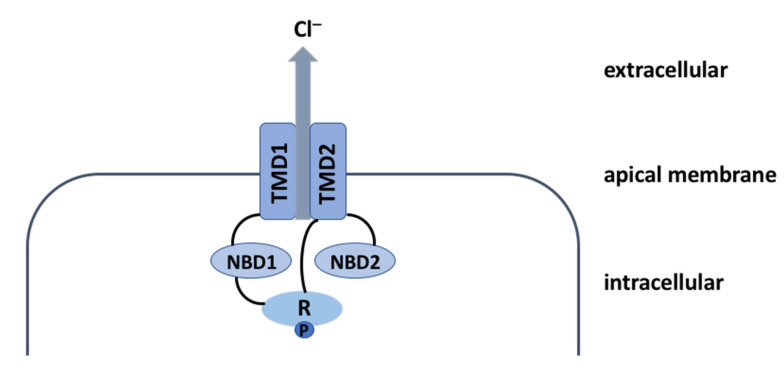
Figure 1
Figure 1
Schematic representation of CFTR protein. CFTR protein includes several domains: two transmembrane domains (TMD1 and TMD2), two cytosolic nucleotide-binding domains (NBD1 and NBD2), and a single regulatory R-domain. TMD1 is linked to NBD1 and TMD2 is linked to NBD2, thereby forming two TMD-NBD complexes united by the R-domain. The TMDs form the channel of the CFTR protein, while the NBDs regulate its opening and closure. As the CFTR channel is an ATP-dependent ion channel, its opening requires R-domain phosphorylation (P) by the protein kinase A (PKA) and ATP binding at the NBDs leading to their dimerization, which in turn allows the chloride (Cl) ions to exit the epithelial cells. Channel closure is triggered by ATP hydrolysis, which results in the separation of the NBD dimer and restoration of the TMD conformation [3]. Abbreviations: Cl = chloride; TMD = transmembrane domain; NBD = nucleotide-binding domain; R = regulatory domain; P = phosphorylation site.
Figure 2
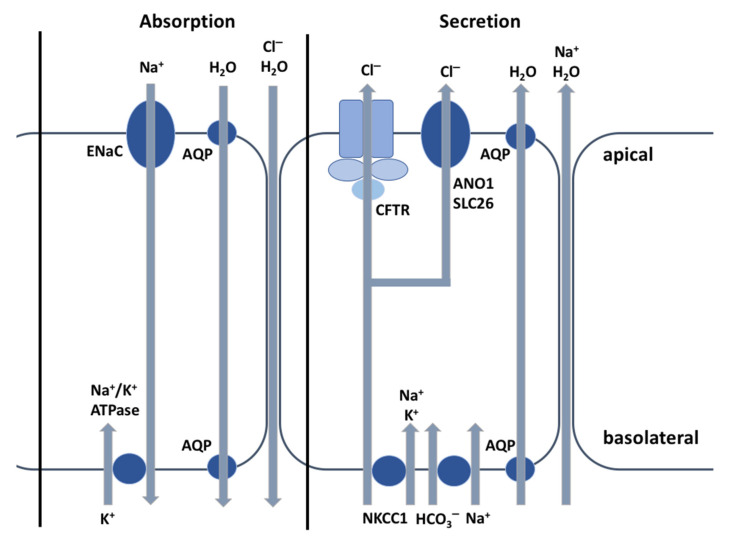
Figure 2
Schematic representation of ion transport in airway epithelia. Modified from Saint-Criq [12]. Epithelial tissues are made of one or more layers of cells that cover their surface and are joined to one another by junctional proteins. Epithelial cells are composed of two membranes with distinct functions depending on the tissue and on their ion channels, exchangers, cotransporters, or pumps. While the basolateral membrane is in contact with the interstitial tissue, the apical membrane is in contact with the external environment and thus also acts as a barrier to prevent potential pathogens or toxic compounds from reaching the bloodstream. Salt and water are absorbed or secreted via paracellular or transcellular pathways (respectively, ENaC and AQP). Cl secretion across the epithelial cell apical membrane usually occurs via CFTR, depending on the CFTR channel opening and number, and creates the driving force for Na+ secretion across the epithelial cells through the paracellular pathway, with water following osmotically via aquaporins or the paracellular pathway [12]. Abbreviations: CFTR = cystic fibrosis transmembrane conductance regulator; ENaC = epithelial sodium channel; ANO1 = anoctamin-1; AQP = aquaporins; NKCC1 = Na-K-Cl cotransporter; Cl = chloride; HCO3 = bicarbonate; H2O = water; K+ = potassium.
Figure 3
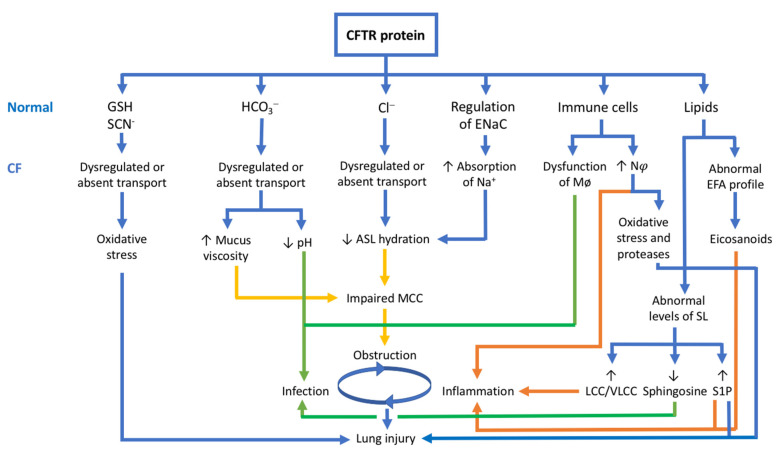
Figure 3
Relationship between CFTR protein and lung pathophysiology of CF. Modified from Elborn [1]. The CFTR protein is not just a chloride channel. It is also involved in HCO3, GSH and SCN transport, regulation of ENaC, immune cells, and metabolism of lipids. In CF, the loss of functional CFTR results in bronchial obstruction (in yellow), inflammation (in orange), and infection (in green), leading to lung injury. Abbreviations: CFTR = cystic fibrosis transmembrane conductance regulator; Cl = chloride; HCO3 = bicarbonate; GSH = glutathione; SCN = thiocyanate; Na+ = sodium; ENaC = epithelial sodium channel; ASL = airway surface liquid; Mø = macrophages; Nφ = neutrophils; SL = sphingolipids; S1P = sphingosine-1-phosphate; LCC/VLCC = long-chain ceramides/very long-chain ceramides.

References

    1. Elborn J.S. Cystic fibrosis. Lancet. 2016;388:2519–2531. doi: 10.1016/S0140-6736(16)00576-6. - DOI - PubMed
    1. Naehrlich L. The changing face of cystic fibrosis and its implications for screening. Int. J. Neonatal Screen. 2020;6:54. doi: 10.3390/ijns6030054. - DOI - PMC - PubMed
    1. Fonseca C., Bicker J., Alves G., Falcão A., Fortuna A. Cystic fibrosis: Physiopathology and the latest pharmacological treatments. Pharmacol. Res. 2020;162:105267. doi: 10.1016/j.phrs.2020.105267. - DOI - PubMed
    1. Andersen D.H. Cystic fibrosis of the pancreas and its relation to celiac diseasea clinical and pathologic study. Am. J. Dis. Child. 1938;56:344–399. doi: 10.1001/archpedi.1938.01980140114013. - DOI
    1. Fanconi G., Uehlinger E., Knauer C. Das Coeliakie-syndrom bei angeborener zystischer Pankreasfibromatose und Bronchiektasien. Wien. Med. Wchnschr. 1936;86:753–756.

MeSH terms

Substances

LinkOut - more resources