Review
. 2021 Oct 30;10(11):2963.
doi: 10.3390/cells10112963.

Dynamic Role of Phospholipases A2 in Health and Diseases in the Central Nervous System

Affiliations
Review

Dynamic Role of Phospholipases A2 in Health and Diseases in the Central Nervous System

Grace Y Sun et al. Cells. .

Abstract

Phospholipids are major components in the lipid bilayer of cell membranes. These molecules are comprised of two acyl or alkyl groups and different phospho-base groups linked to the glycerol backbone. Over the years, substantial interest has focused on metabolism of phospholipids by phospholipases and the role of their metabolic products in mediating cell functions. The high levels of polyunsaturated fatty acids (PUFA) in the central nervous system (CNS) have led to studies centered on phospholipases A2 (PLA2s), enzymes responsible for cleaving the acyl groups at the sn-2 position of the phospholipids and resulting in production of PUFA and lysophospholipids. Among the many subtypes of PLA2s, studies have centered on three major types of PLA2s, namely, the calcium-dependent cytosolic cPLA2, the calcium-independent iPLA2 and the secretory sPLA2. These PLA2s are different in their molecular structures, cellular localization and, thus, production of lipid mediators with diverse functions. In the past, studies on specific role of PLA2 on cells in the CNS are limited, partly because of the complex cellular make-up of the nervous tissue. However, understanding of the molecular actions of these PLA2s have improved with recent advances in techniques for separation and isolation of specific cell types in the brain tissue as well as development of sensitive molecular tools for analyses of proteins and lipids. A major goal here is to summarize recent studies on the characteristics and dynamic roles of the three major types of PLA2s and their oxidative products towards brain health and neurological disorders.

Keywords: Alzheimer’s disease; central nervous system; lysophospholipids; oxidized fatty acids; oxylipins; phospholipases A2; stroke.


Conflict of interest statement

The authors declare no conflict of interest.

Figures
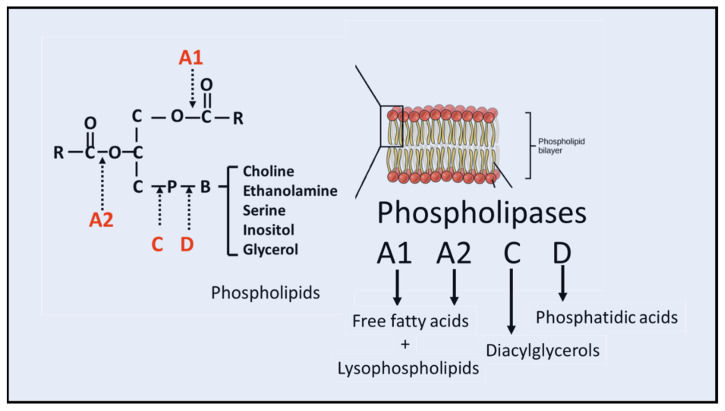
Figure 1
Figure 1
Phospholipases acting on phospholipids. Action of phospholipases A1, A2, C and D on phospholipids resulting in free fatty acids and lysophospholipids, diacylglycerol and phosphatidic acids, respectively.
Figure 2
Figure 2
Receptor- signaling pathways for iPLA2, sPLA2 and cPLA2 leading to production of docosahexaenoic acid (DHA) and arachidonic acid (ARE). In turn, DHA and ARA are metabolized by cyclooxygenases (COX) and lipoxygenases (LOX) to produce docosanoids and eicosanoids and undergo peroxidation to produce 4-hydroxyhexenal (4-HHE) and 4-hydroxynonenal (4-HNE), respectively. Abbreviations: AMPA, α-amino-3-hydroxy-5-methyl-4-isoxazole proprionic acid receptor, TLR, Toll-like receptors, NMDA, N-methyl-D-aspartate receptor.
Figure 3
Figure 3
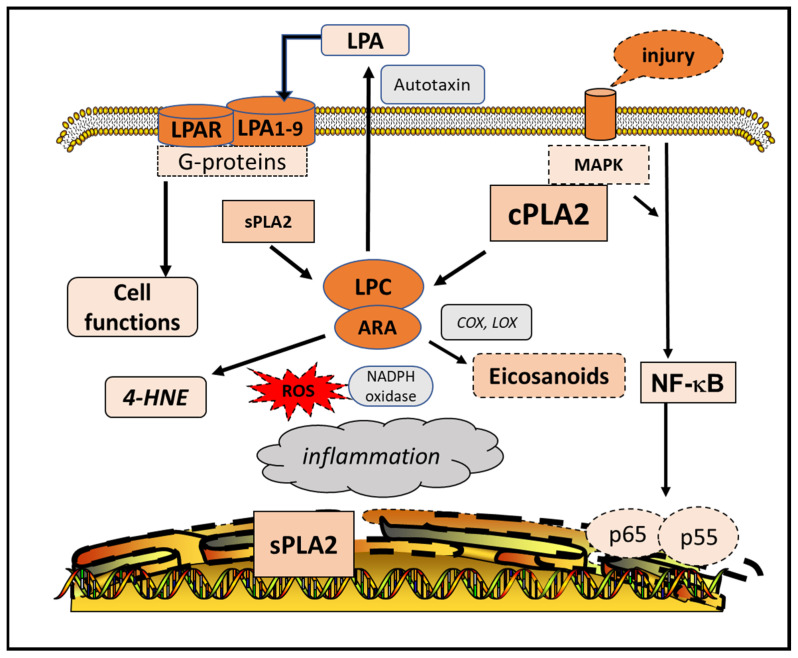
Role of lysophospholipids in metabolic pathways. Cell injury leads to activation of cPLA2 and NF-kB pathway and transcriptional increase in sPLA2. Activation of sPLA2 and cPLA2 result in the release of ARA and lysophosphatidylcholine (LPC). LPC is converted to lysophosphatidic acid (LPA) via the extracellular autotaxin. LPA interacts with G-protein receptors to regulate cell metabolism. Abbreviations: 4-hydroxynonenal (4-HNE), nuclear factor kappa-light-chain-enhancer of activated B cells (NF-kB), reactive oxygen species (ROS), mitogen-activated protein kinases (MAPK).

References

    1. Kita Y., Shindou H., Shimizu T. Cytosolic phospholipase A2 and lysophospholipid acyltransferases. Biochim. Biophys. Acta (BBA)—Mol. Cell Biol. Lipids. 2018;1864:838–845. doi: 10.1016/j.bbalip.2018.08.006. - DOI - PubMed
    1. Schaloske R.H., Dennis E.A. The phospholipase A2 superfamily and its group numbering system. Biochim. Biophys. Acta (BBA)—Mol. Cell Biol. Lipids. 2006;1761:1246–1259. doi: 10.1016/j.bbalip.2006.07.011. - DOI - PubMed
    1. Burke J., Dennis E.A. Phospholipase A2 structure/function, mechanism, and signaling. J. Lipid Res. 2009;50:S237–S242. doi: 10.1194/jlr.R800033-JLR200. - DOI - PMC - PubMed
    1. Ong W.-Y., Farooqui T., Kokotos G., Farooqui A.A. Synthetic and Natural Inhibitors of Phospholipases A2: Their Importance for Understanding and Treatment of Neurological Disorders. ACS Chem. Neurosci. 2015;6:814–831. doi: 10.1021/acschemneuro.5b00073. - DOI - PubMed
    1. Sun G.Y., Chuang D.Y., Zong Y., Jiang J., Lee J.C.M., Gu Z., Simonyi A. Role of Cytosolic Phospholipase A2 in Oxidative and Inflammatory Signaling Pathways in Different Cell Types in the Central Nervous System. Mol. Neurobiol. 2014;50:6–14. doi: 10.1007/s12035-014-8662-4. - DOI - PMC - PubMed

Publication types

MeSH terms

Substances

LinkOut - more resources