Review
. 2021 Nov 3;10(11):2999.
doi: 10.3390/cells10112999.

Molecular Characterization of Membrane Steroid Receptors in Hormone-Sensitive Cancers

Affiliations
Review

Molecular Characterization of Membrane Steroid Receptors in Hormone-Sensitive Cancers

Mirco Masi et al. Cells. .

Abstract

Cancer is one of the most common causes of death worldwide, and its development is a result of the complex interaction of genetic factors, environmental cues, and aging. Hormone-sensitive cancers depend on the action of one or more hormones for their development and progression. Sex steroids and corticosteroids can regulate different physiological functions, including metabolism, growth, and proliferation, through their interaction with specific nuclear receptors, that can transcriptionally regulate target genes via their genomic actions. Therefore, interference with hormones' activities, e.g., deregulation of their production and downstream pathways or the exposition to exogenous hormone-active substances such as endocrine-disrupting chemicals (EDCs), can affect the regulation of their correlated pathways and trigger the neoplastic transformation. Although nuclear receptors account for most hormone-related biologic effects and their slow genomic responses are well-studied, less-known membrane receptors are emerging for their ability to mediate steroid hormones effects through the activation of rapid non-genomic responses also involved in the development of hormone-sensitive cancers. This review aims to collect pre-clinical and clinical data on these extranuclear receptors not only to draw attention to their emerging role in cancer development and progression but also to highlight their dual role as tumor microenvironment players and potential candidate drug targets.

Keywords: GPER; GPRC6A; OXER1; PGRMC; TRPM8; ZIP9; breast cancer; endometrial cancer; mPR; ovarian cancer; prostate cancer.


Conflict of interest statement

The authors declare no conflict of interests.

Figures
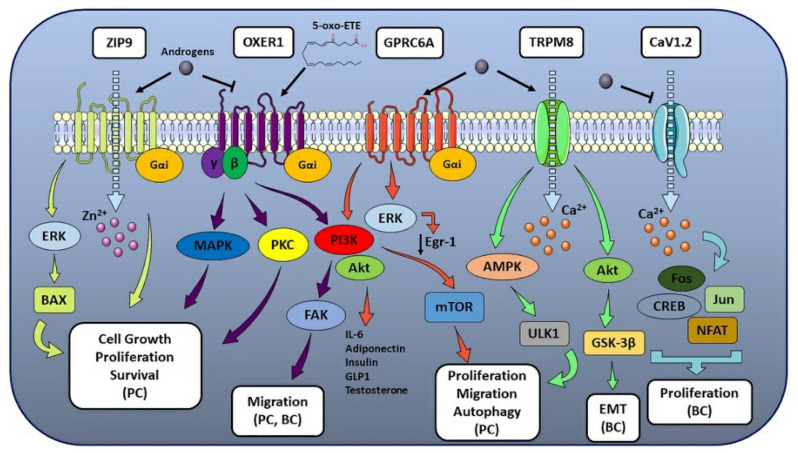
Figure 1
Figure 1
mAR-associated pathways and their effect on hormone-sensitive cancer progression. The figure illustrates the molecular pathways correlated to the different mARs and their biological effects on multiple hormone-sensitive cancer types. When one or more tumor-related processes were reported only for a specific cancer type, the latter was made explicit in the figure and put in parentheses (e.g., breast cancer as BC, prostate cancer as PC) (see text for details).
Figure 2
Figure 2
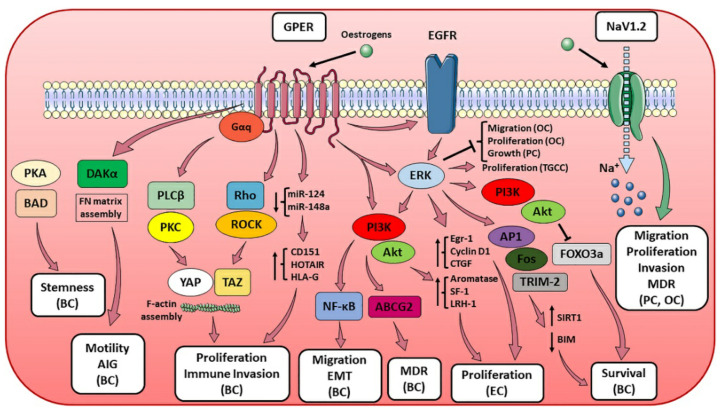
mER-associated pathways and their effect on hormone-sensitive cancer progression. The figure illustrates the molecular pathways correlated to the different mERs and their biological effects on multiple hormone-sensitive cancer types. When one or more tumor-related processes were reported only for a specific cancer type, the latter was made explicit in the figure and put in parentheses (e.g., breast cancer as BC, prostate cancer as PC, endometrial cancer as EC, ovarian cancer as OC and testicular germ cell cancer as TGCC). Other abbreviations: multi-drug resistance (MDR), anchorage-independent growth (AIG) (see text for details).
Figure 3
Figure 3
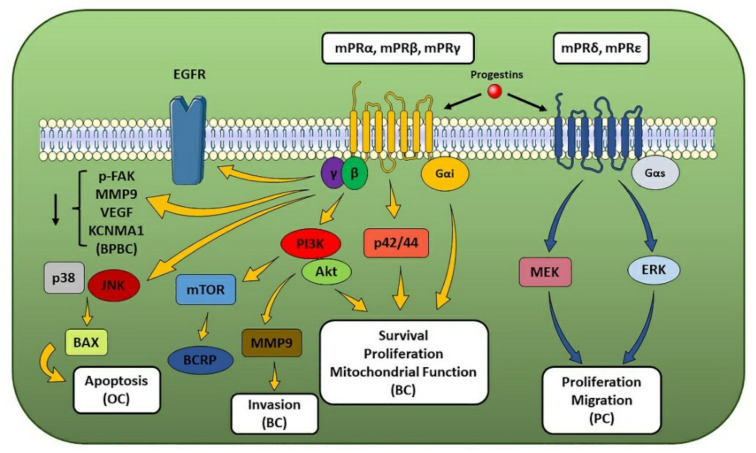
mPR-associated pathways and their effect on hormone-sensitive cancer progression. The figure illustrates the molecular pathways correlated to the different mPRs and their biological effects on multiple hormone-sensitive cancer types. When one or more tumor-related processes were reported only for a specific cancer type, the latter has been made explicit in the figure and put in parentheses (e.g., breast cancer as BC, prostate cancer as PC, ovarian cancer as OC, and basal phenotype breast cancer as BPBC) (see text for details).
Figure 4
Figure 4
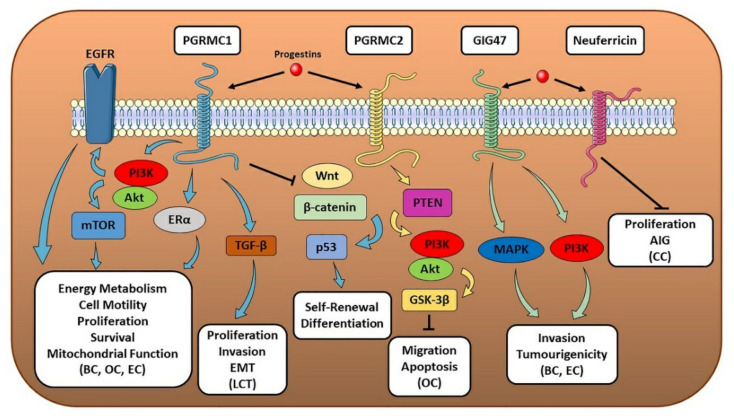
MAPR-associated pathways and their effect on hormone-sensitive cancer progression. The figure illustrates the molecular pathways correlated to the different MAPRs and their biological effects on multiple hormone-sensitive cancer types. When one or more tumor-related processes were reported only for a specific cancer type, the latter has been made explicit in the figure and put in parentheses (e.g., breast cancer as BC, endometrial cancer as EC, ovarian cancer as OC, Leydig cell tumor as LCT and cervical cancer as CC). Other abbreviations: anchorage-independent growth (AIG) (see text for details).

References

    1. Ferlay J., Colombet M., Soerjomataram I., Parkin D.M., Piñeros M., Znaor A., Bray F. Cancer statistics for the year 2020: An overview. Int. J. Cancer. 2021;149:778–789. doi: 10.1002/ijc.33588. - DOI - PubMed
    1. Henderson B.E., Feigelson H.S. Hormonal carcinogenesis. Carcinogenesis. 2000;21:427–433. doi: 10.1093/carcin/21.3.427. - DOI - PubMed
    1. Buoso E., Masi M., Racchi M., Corsini E. Endocrine-Disrupting Chemicals’ (EDCs) Effects on Tumour Microenvironment and Cancer Progression: Emerging Contribution of RACK1. Int. J. Mol. Sci. 2020;21:9229. doi: 10.3390/ijms21239229. - DOI - PMC - PubMed
    1. Kravchenko J., Corsini E., Williams M.A., Decker W., Manjili M.H., Otsuki T., Singh N., Al-Mulla F., Altemaimi R., Amedei A., et al. Chemical compounds from anthropogenic environment and immune evasion mechanisms: Potential interactions. Carcinogenesis. 2015;36:S111–S127. doi: 10.1093/carcin/bgv033. - DOI - PMC - PubMed
    1. Whirledge S., Cidlowski J.A. Chapter 5-Steroid Hormone Action. In: Strauss J., Barbieri R., editors. Yen and Jaffe’s Reproductive Endocrinology: Physiology, Pathophysiology, and Clinical Management. 8th ed. Elsevier; Amsterdam, The Netherlands: 2018. pp. 115–131.

Publication types