Review
. 2021 Nov 4;10(11):3017.
doi: 10.3390/cells10113017.

Recent Advances in Understanding the Pathogenesis of Rheumatoid Arthritis: New Treatment Strategies

Affiliations
Review

Recent Advances in Understanding the Pathogenesis of Rheumatoid Arthritis: New Treatment Strategies

Anna-Lena Mueller et al. Cells. .

Abstract

Rheumatoid arthritis (RA) is considered a chronic systemic, multi-factorial, inflammatory, and progressive autoimmune disease affecting many people worldwide. While patients show very individual courses of disease, with RA focusing on the musculoskeletal system, joints are often severely affected, leading to local inflammation, cartilage destruction, and bone erosion. To prevent joint damage and physical disability as one of many symptoms of RA, early diagnosis is critical. Auto-antibodies play a pivotal clinical role in patients with systemic RA. As biomarkers, they could help to make a more efficient diagnosis, prognosis, and treatment decision. Besides auto-antibodies, several other factors are involved in the progression of RA, such as epigenetic alterations, post-translational modifications, glycosylation, autophagy, and T-cells. Understanding the interplay between these factors would contribute to a deeper insight into the causes, mechanisms, progression, and treatment of the disease. In this review, the latest RA research findings are discussed to better understand the pathogenesis, and finally, treatment strategies for RA therapy are presented, including both conventional approaches and new methods that have been developed in recent years or are currently under investigation.

Keywords: auto-antibodies; autophagy; biological agents; citrullination; epigenetic; inflammation; phytochemical; rheumatoid arthritis; treatment.


Conflict of interest statement

The authors declare no conflict of interest. Figures were created with BioRender software (https://biorender.com/ (accessed on 15 May 2021).

Figures

Figure 1
Figure 1
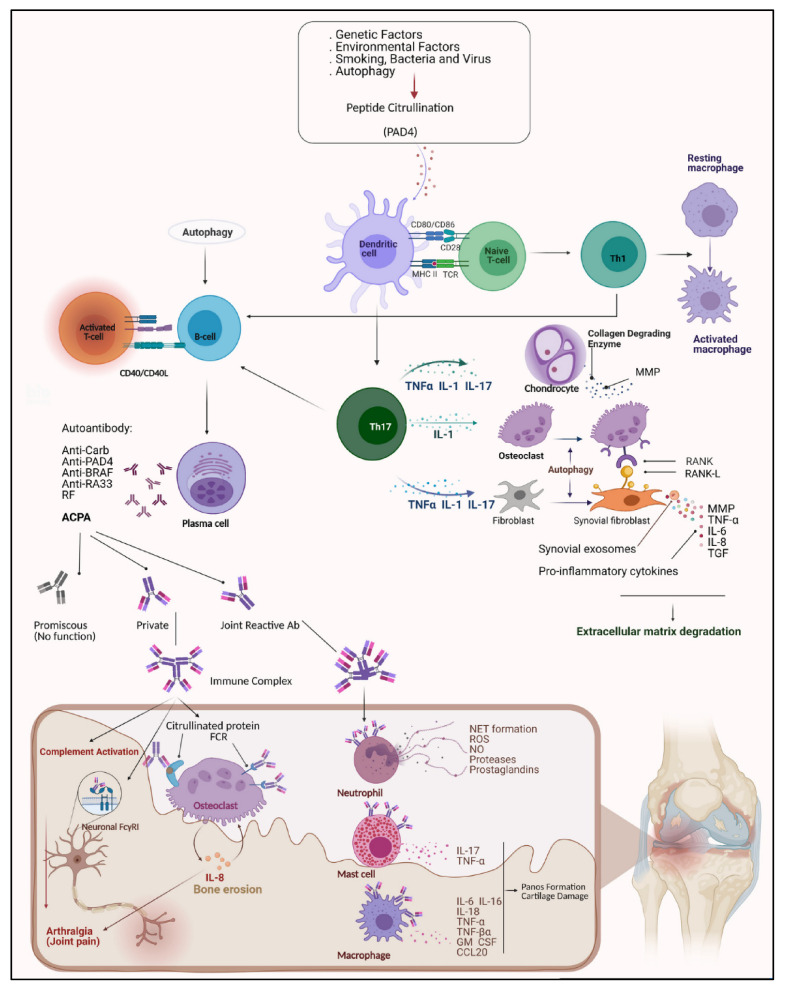
The etiology of rheumatoid arthritis. Multiple factors such as genetic background, smoking, bacterial infections, viral infections, and autophagy are involved in catalyzing the process of converting arginine to citrulline by PADI4 enzyme. Antigen presentation by the antigen presenting cells (APC) activates the naive T-cell, Th1, Th17, and Th2 cells. Th1 cells cause macrophage activation in the synovial joint by an elevated capability to secrete pro-inflammatory TNF. Th17 produces IL-17, IL1, and TNF-α, which effect chondrocytes, osteoclasts, and fibroblasts. Chondrocytes release collagen-releasing enzymes and Matrix-Metalloproteinase (MMP). Fibroblasts transform into FLS, which produce pro-inflammatory cytokines leading to destruction of the extracellular matrix. T-cells activate B-cells and plasma cells that secrete a variety of auto-antibodies. Auto-antibodies can attach to neutrophils and macrophages and lead to pannus formation and cartilage damage. They also can form an immune complex leading to joint pain and bone destruction.
Figure 2
Figure 2
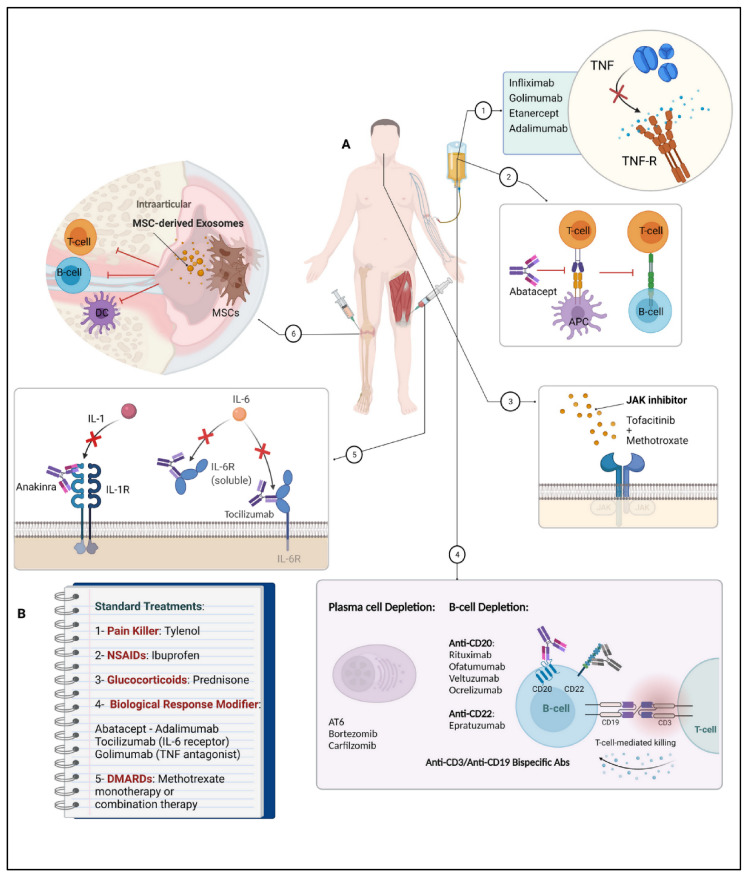
Treatment strategies for RA therapy. (A) New approaches in RA treatment. (1) TNF-inhibitors, (2) co-stimulation blockers (Abatacept), (3) Janus-Activated-Kinase (JAK) inhibitors (Tofacitinib + Baricitinib), (4) CD20 (Rituximab, Ofatumumab) and CD22 (Epratuzumab) targeting on B-cell surfaces and plasma cell targeting therapies (ATG), (5) IL-1 and IL-6 targeting mAbs (Anakinra and Tocilizumab), (6) intraarticular administration of mesenchymal stem cells. (B) Common standard treatments for RA patients (NSAIDs, GCs, biological response modifiers, and DMARDs).

References

    1. Firestein G.S. Evolving concepts of rheumatoid arthritis. Nature. 2003;423:356–361. doi: 10.1038/nature01661. - DOI - PubMed
    1. De Brito Rocha S., Baldo D.C., Andrade L.E.C. Clinical and pathophysiologic relevance of autoantibodies in rheumatoid arthritis. Adv. Rheumatol. 2019;59:1–13. doi: 10.1186/s42358-018-0042-8. - DOI - PubMed
    1. Farid S.S., Azizi G., Mirshafiey A. Anti-citrullinated protein antibodies and their clinical utility in rheumatoid arthritis. Int. J. Rheum. Dis. 2013;16:379–386. doi: 10.1111/1756-185X.12129. - DOI - PubMed
    1. Sieghart D., Platzer A., Studenic P., Alasti F., Grundhuber M., Swiniarski S., Horn T., Haslacher H., Blüml S., Smolen J. Determination of autoantibody isotypes increases the sensitivity of serodiagnostics in rheumatoid arthritis. Front. Immunol. 2018;9:876. doi: 10.3389/fimmu.2018.00876. - DOI - PMC - PubMed
    1. Stahl E.A., Raychaudhuri S., Remmers E.F., Xie G., Eyre S., Thomson B.P., Li Y., Kurreeman F.A., Zhernakova A., Hinks A. Genome-wide association study meta-analysis identifies seven new rheumatoid arthritis risk loci. Nat. Genet. 2010;42:508. doi: 10.1038/ng.582. - DOI - PMC - PubMed

Publication types