. 2021 Nov 5;10(11):3042.
doi: 10.3390/cells10113042.

Abnormal Calcium Handling in Atrial Fibrillation Is Linked to Changes in Cyclic AMP Dependent Signaling

Affiliations

Abnormal Calcium Handling in Atrial Fibrillation Is Linked to Changes in Cyclic AMP Dependent Signaling

Franziska Reinhardt et al. Cells. .

Abstract

Both, the decreased L-type Ca2+ current (ICa,L) density and increased spontaneous Ca2+ release from the sarcoplasmic reticulum (SR), have been associated with atrial fibrillation (AF). In this study, we tested the hypothesis that remodeling of 3',5'-cyclic adenosine monophosphate (cAMP)-dependent protein kinase A (PKA) signaling is linked to these compartment-specific changes (up- or down-regulation) in Ca2+-handling. Perforated patch-clamp experiments were performed in atrial myocytes from 53 patients with AF and 104 patients in sinus rhythm (Ctl). A significantly higher frequency of transient inward currents (ITI) activated by spontaneous Ca2+ release was confirmed in myocytes from AF patients. Next, inhibition of PKA by H-89 promoted a stronger effect on the ITI frequency in these myocytes compared to myocytes from Ctl patients (7.6-fold vs. 2.5-fold reduction), while the β-agonist isoproterenol (ISO) caused a greater increase in Ctl patients (5.5-fold vs. 2.1-fold). ICa,L density was larger in myocytes from Ctl patients at baseline (p < 0.05). However, the effect of ISO on ICa,L density was only slightly stronger in AF than in Ctl myocytes (3.6-fold vs. 2.7-fold). Interestingly, a significant reduction of ICa,L and Ca2+ sparks was observed upon Ca2+/Calmodulin-dependent protein kinase II inhibition by KN-93, but this inhibition had no effect on ITI. Fluorescence resonance energy transfer (FRET) experiments showed that although AF promoted cytosolic desensitization to β-adrenergic stimulation, ISO increased cAMP to similar levels in both groups of patients in the L-type Ca2+ channel and ryanodine receptor compartments. Basal cAMP signaling also showed compartment-specific regulation by phosphodiesterases in atrial myocytes from 44 Ctl and 43 AF patients. Our results suggest that AF is associated with opposite changes in compartmentalized PKA/cAMP-dependent regulation of ICa,L (down-regulation) and ITI (up-regulation).

Keywords: L-type calcium current (ICa,L); atrial fibrillation (AF); cAMP-dependent regulation; patch-clamp; protein kinase A (PKA); transient inward current (ITI).


Conflict of interest statement

The authors declare no conflict of interest.

Figures
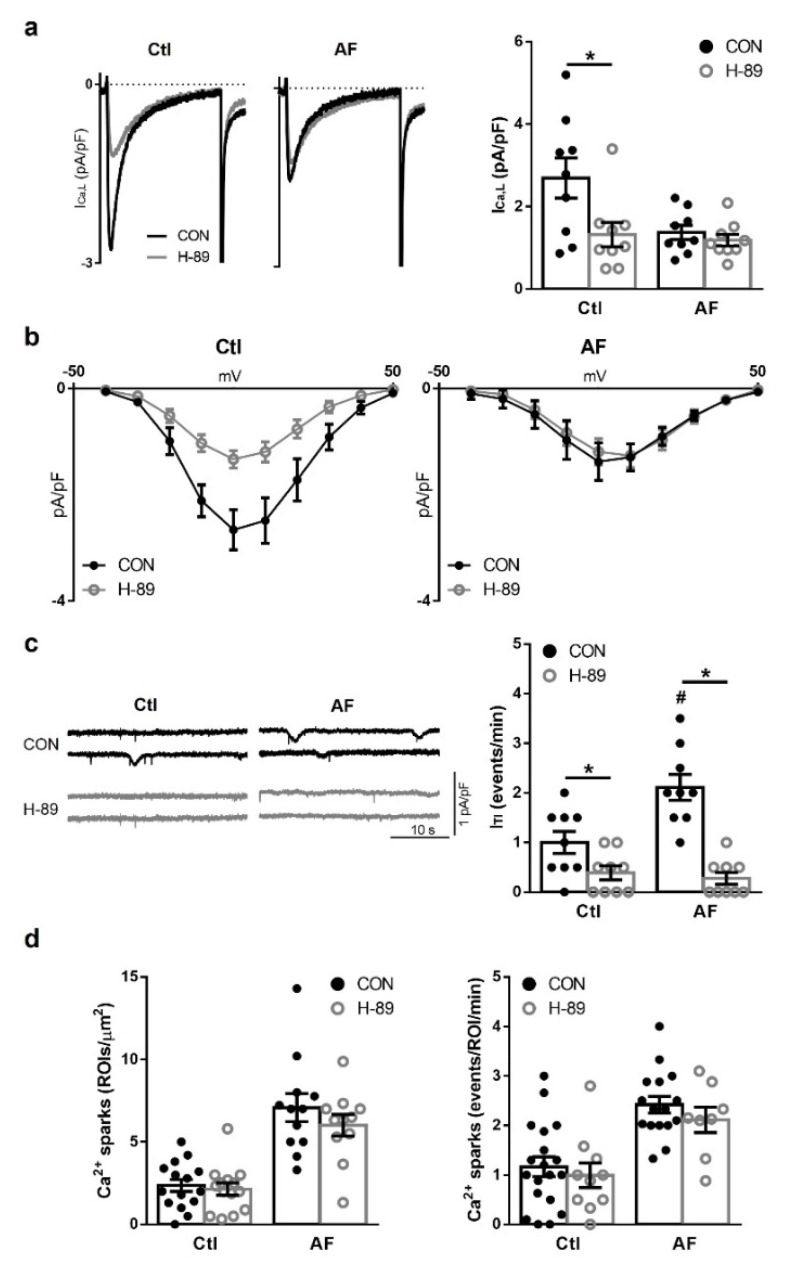
Figure 1
Figure 1
Effect of protein kinase A (PKA) inhibition on ICa,L, ITI and sarcoplasmic reticulum (SR) Ca2+ load. (a) (left): Representative ICa,L recordings in myocytes from a patient in sinus rhythm (Ctl) and a patient with atrial fibrillation (AF) before (CON, black trace) and after exposure to the selective PKA inhibitor (H-89, 10 μM, grey trace). (right): Average effect of H-89 in Ctl and AF patients. (b) Mean effect of H-89 on the current-voltage relationship in Ctl and AF patients. (c) (left): Representative traces of spontaneous ITI recorded in Ctl and AF myocytes before and after exposure to H-89. (right): Mean effects of H-89 on the spontaneous ITI frequency in Ctl and AF patients. (d) Average effects of H-89 on Ca2+ sparks density (left) and frequency (right) before and after exposure to H-89. ROI: region of interest. Significant differences between treatments are indicated with * and between groups with #.
Figure 2
Figure 2
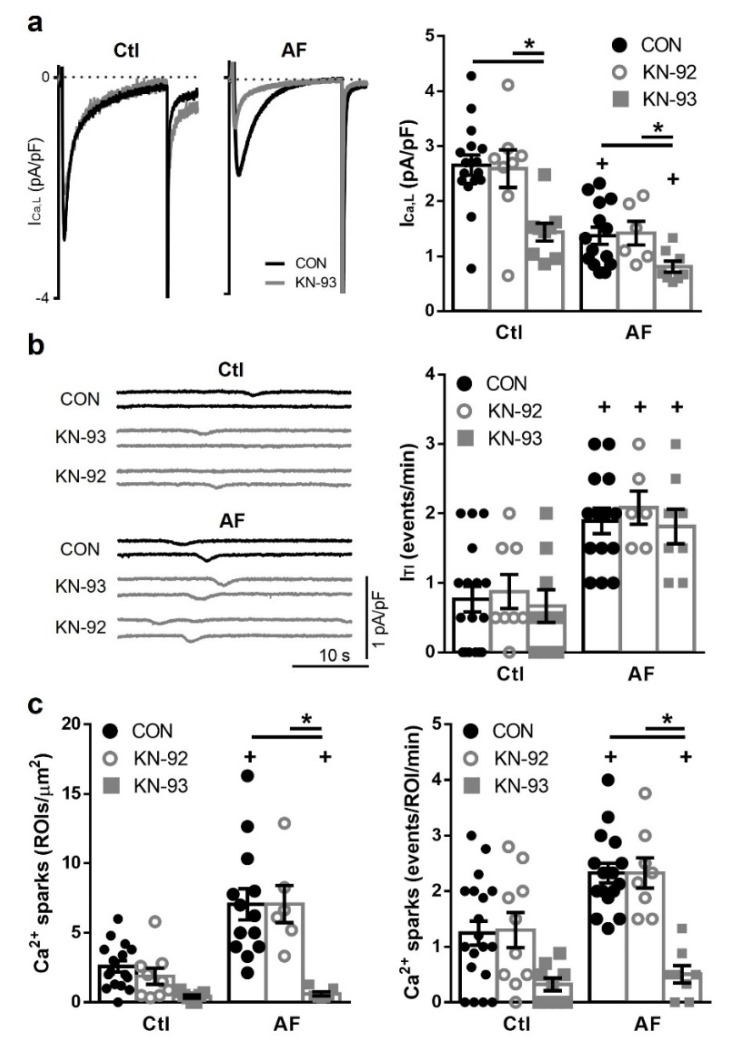
Effects of Ca2+/Calmodulin-dependent protein kinase II (CaMKII) inhibition on ICa,L, ITI and Ca2+ sparks. (a) (left): Representative ICa,L recordings in myocytes from a patient in sinus rhythm (Ctl) and a patient with atrial fibrillation (AF) before (CON, black trace) and after exposure to a selective CaMKII inhibitor (KN-93, 1 μM, grey trace). (right): Average effects of KN-92 (1 μM, the inactive CaMKII inhibitor) and KN-93 in Ctl and AF patients. (b) (left): Representative recordings of spontaneous ITI before and after exposure to KN-92 and KN-93 in myocytes from in Ctl and AF patients. (right): Average effects of KN-92 and KN-93 on the spontaneous ITI frequency in AF and Ctl myocytes. (c) Average effects of KN-92 and KN-93 on Ca2+ sparks density (left) and frequency (right) before and after exposure to KN-92 and KN-93. Significant differences between treatments are indicated with * and between groups with +.
Figure 3
Figure 3
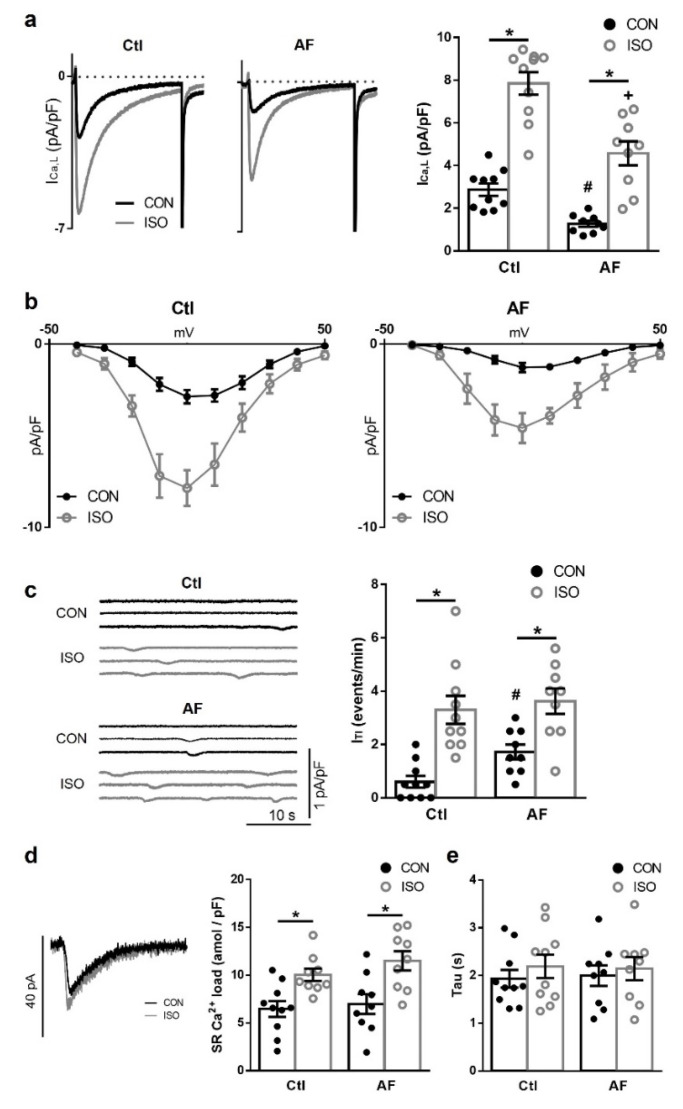
Effect of β-adrenergic stimulation on ICa,L, ITI and sarcoplasmic reticulum (SR) Ca2+ load. (a) (left): Representative ICa,L recordings in myocytes from a sinus rhythm (Ctl) patient and a patient with atrial fibrillation (AF), before (CON, black trace) and after exposure of the myocyte to 30 nM isoproterenol (ISO, grey trace). (right): Average effects of ISO in Ctl and AF patients. (b) Mean current-voltage relationship for ICa,L in Ctl and AF myocytes before and after exposure to ISO. (c) (left): Representative recordings of ITI before and after ISO in Ctl and AF. (right): Average effects of ISO on ITI in Ctl and AF myocytes. (d) (right): Representative recordings of caffeine-induced NCX-currents before and after ISO. (left): Average ISO effect on SR Ca2+ load in Ctl and AF. (e) Average ISO effect on time constant (Tau) in Ctl and AF. Significant differences between treatments are indicated with *, between groups with #.
Figure 4
Figure 4
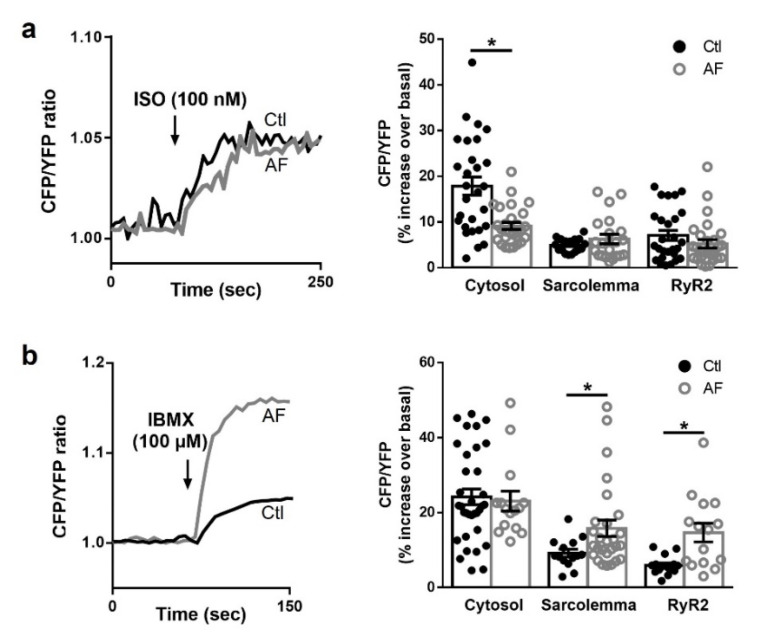
Cytosolic and local cAMP dynamics. (left): representative kinetics of fluorescence resonance energy transfer (FRET) changes (expressed as CFP/YFP ratio) in the ryanodine receptor (RyR2) microdomain recorded in human atrial myocytes from patients in sinus rhythm (Ctl) and with atrial fibrillation (AF), transduced with Epac1-camps-JNC sensor and treated with (a) isoproterenol (ISO, 100 nM) and (b) the non-selective phosphodiesterase inhibitor (IBMX, 100 μM) and the phosphodiesterase type 8 selective inhibitor PF-04957325 (100 nM). (right): average increases in cAMP levels in the cytosol and in different compartments (sarcolemma and RyR2) of living human atrial myocytes, measured as total cAMP produced after exposure (a) to ISO and (b) to the inhibitor IBMX. Significant differences between treatments are indicated with *.
Figure 5
Figure 5
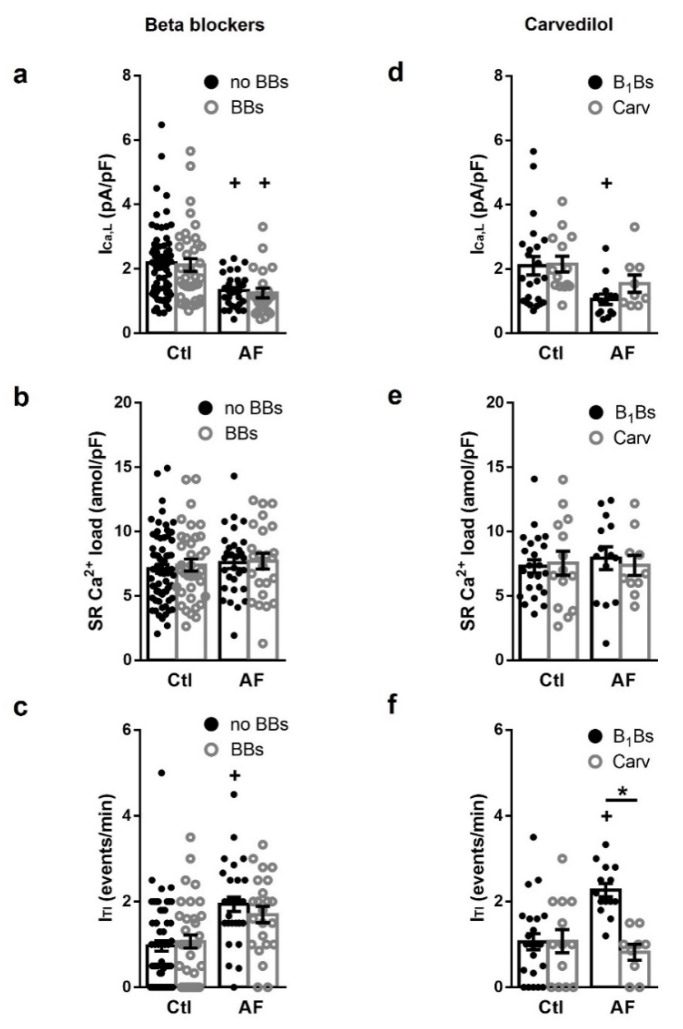
Effect of β-blocker treatment of patients on Ca2+-handling. (left): average effects of the treatment of patients with β-blockers (BBs) or without BBs (no BBs) on (a) ICa,L, (b) sarcoplasmic reticulum (SR) Ca2+ load and (c) ITI, in patients in sinus rhythm (Ctl) and with atrial fibrillation (AF). (right): Carvediol effects on (d) ICa,L, (e) SR Ca2+ load and (f) ITI, in Ctl and AF. Statistical significance was evaluated using a multivariate linear regression model adjusted for the confounding effects of common clinical factors showing a bias between BBs treatment as well as factors suspected to affect Ca2+-handling. Significant differences between treatments are indicated with * and between groups with +. Each point represents a patient mean value recorded in myocytes from a total of 53 patients with AF and 104 patients without AF. 23 of the AF patients and 37 of the no AF patients were treated with BBs.

References

    1. Hove-Madsen L., Llach A., Bayes-Genís A., Roura S., Font E.R., Arís A., Cinca J. Atrial Fibrillation Is Associated with Increased Spontaneous Calcium Release From the Sarcoplasmic Reticulum in Human Atrial Myocytes. Circulation. 2004;110:1358–1363. doi: 10.1161/01.CIR.0000141296.59876.87. - DOI - PubMed
    1. van Wagoner D.R., Pond A.L., Lamorgese M., Rossie S.S., McCarthy P.M., Nerbonne J.M. Atrial L-Type Ca2+ Currents and Human Atrial Fibrillation. Circ. Res. 1999;85:428–436. doi: 10.1161/01.RES.85.5.428. - DOI - PubMed
    1. Vest J.A., Wehrens X.H.T., Reiken S.R., Lehnart S.E., Dobrev D., Chandra P., Danilo P., Ravens U., Rosen M.R., Marks A.R. Defective Cardiac Ryanodine Receptor Regulation during Atrial Fibrillation. Circulation. 2005;111:2025–2032. doi: 10.1161/01.CIR.0000162461.67140.4C. - DOI - PubMed
    1. Beneke K., Molina C.E. Molecular Basis of Atrial Fibrillation Initiation and Maintenance. Hearts. 2021;2:14. doi: 10.3390/hearts2010014. - DOI
    1. Llach A., Molina C.E., Prat-Vidal C., Fernandes J., Casado V., Ciruela F., Lluis C., Franco R., Cinca J., Hove-Madsen L. Abnormal Calcium Handling in Atrial Fibrillation Is Linked to Up-Regulation of Adenosine A2A Receptors. Eur. Heart J. 2011;32:721–729. doi: 10.1093/eurheartj/ehq464. - DOI - PubMed

Publication types

MeSH terms