


DNA Methylation in Genetic and Sporadic Forms of Neurodegeneration: Lessons from Alzheimer's, Related Tauopathies and Genetic Tauopathies
- PMID: 34831288
- PMCID: PMC8624300
- DOI: 10.3390/cells10113064
DNA Methylation in Genetic and Sporadic Forms of Neurodegeneration: Lessons from Alzheimer's, Related Tauopathies and Genetic Tauopathies
Abstract
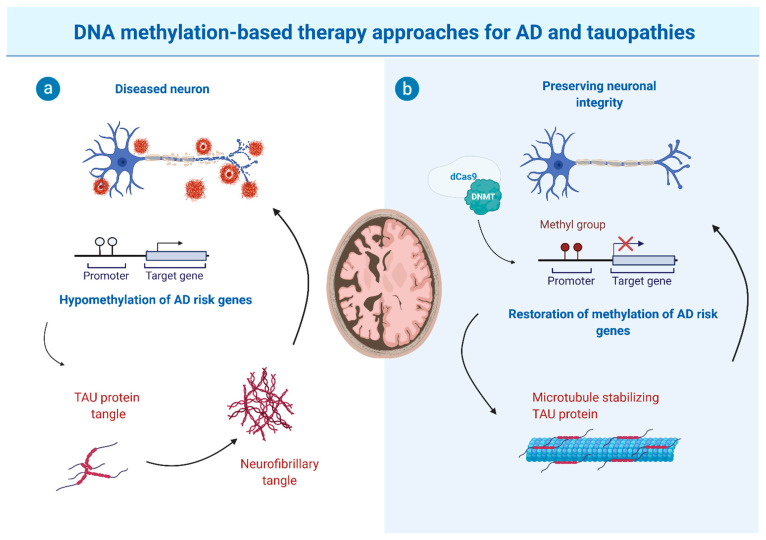
Genetic and sporadic forms of tauopathies, the most prevalent of which is Alzheimer's Disease, are a scourge of the aging society, and in the case of genetic forms, can also affect children and young adults. All tauopathies share ectopic expression, mislocalization, or aggregation of the microtubule associated protein TAU, encoded by the MAPT gene. As TAU is a neuronal protein widely expressed in the CNS, the overwhelming majority of tauopathies are neurological disorders. They are characterized by cognitive dysfunction often leading to dementia, and are frequently accompanied by movement abnormalities such as parkinsonism. Tauopathies can lead to severe neurological deficits and premature death. For some tauopathies there is a clear genetic cause and/or an epigenetic contribution. However, for several others the disease etiology is unclear, with few tauopathies being environmentally triggered. Here, we review current knowledge of tauopathies listing known genetic and important sporadic forms of these disease. Further, we discuss how DNA methylation as a major epigenetic mechanism emerges to be involved in the disease pathophysiology of Alzheimer's, and related genetic and non-genetic tauopathies. Finally, we debate the application of epigenetic signatures in peripheral blood samples as diagnostic tools and usages of epigenetic therapy strategies for these diseases.
Keywords: Alzheimer; DNA methylation; MAPT; TAU; epigenetics; neurodegeneration; neurogenetic disease; tauopathy.
Conflict of interest statement
The authors declare no conflict of interest.
Figures
References
-
- Barker W.W., Luis C.A., Kashuba A., Luis M., Harwood D.G., Loewenstein D., Waters C., Jimison P., Shepherd E., Sevush S., et al. Relative Frequencies of Alzheimer Disease, Lewy Body, Vascular and Frontotemporal Dementia, and Hippocampal Sclerosis in the State of Florida Brain Bank. Alzheimer Dis. Assoc. Disord. 2016;16:203–212. doi: 10.1097/00002093-200210000-00001. - DOI - PubMed
-
- Höglinger G.U., Respondek G., Stamelou M., Kurz C., Josephs K.A., Lang A.E., Mollenhauer B., Müller U., Nilsson C., Whitwell J.L., et al. Clinical diagnosis of progressive supranuclear palsy: The movement disorder society criteria. Mov. Disord. 2017;32:853–864. doi: 10.1002/mds.26987. - DOI - PMC - PubMed
Publication types
MeSH terms
Substances
Grants and funding
LinkOut - more resources
Full Text Sources
Medical
