


Trends of Hospital Admissions Due to Congenital Anomalies in England and Wales between 1999 and 2019: An Ecological Study
- PMID: 34831564
- PMCID: PMC8617891
- DOI: 10.3390/ijerph182211808
Trends of Hospital Admissions Due to Congenital Anomalies in England and Wales between 1999 and 2019: An Ecological Study
Abstract
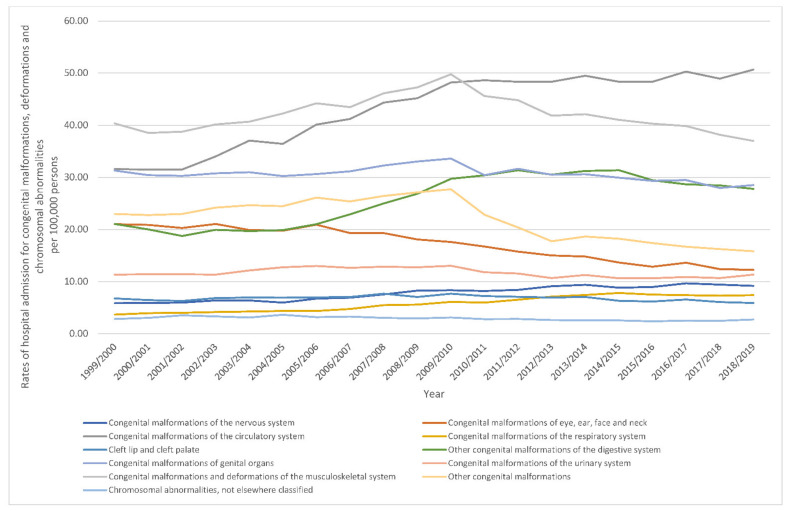
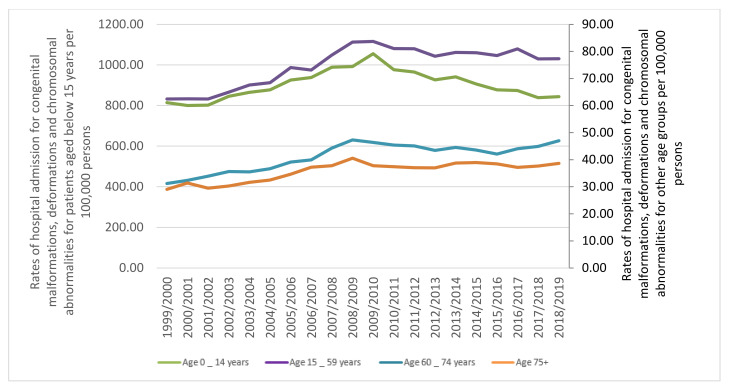
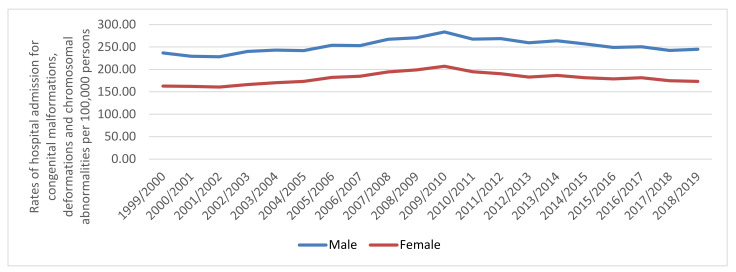
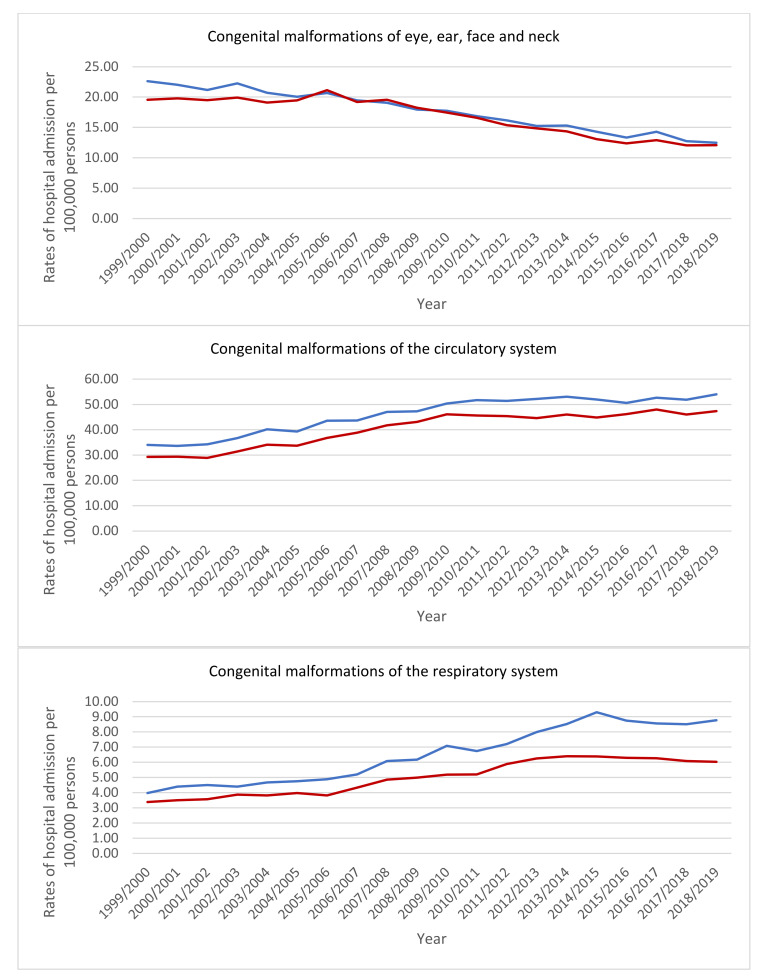
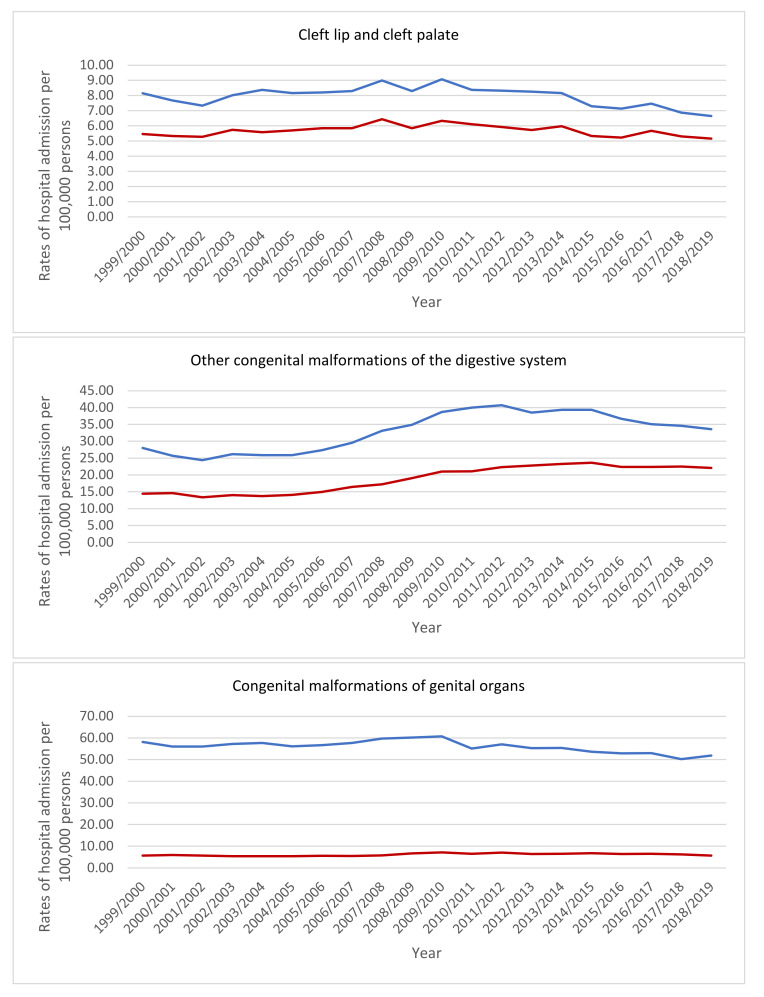
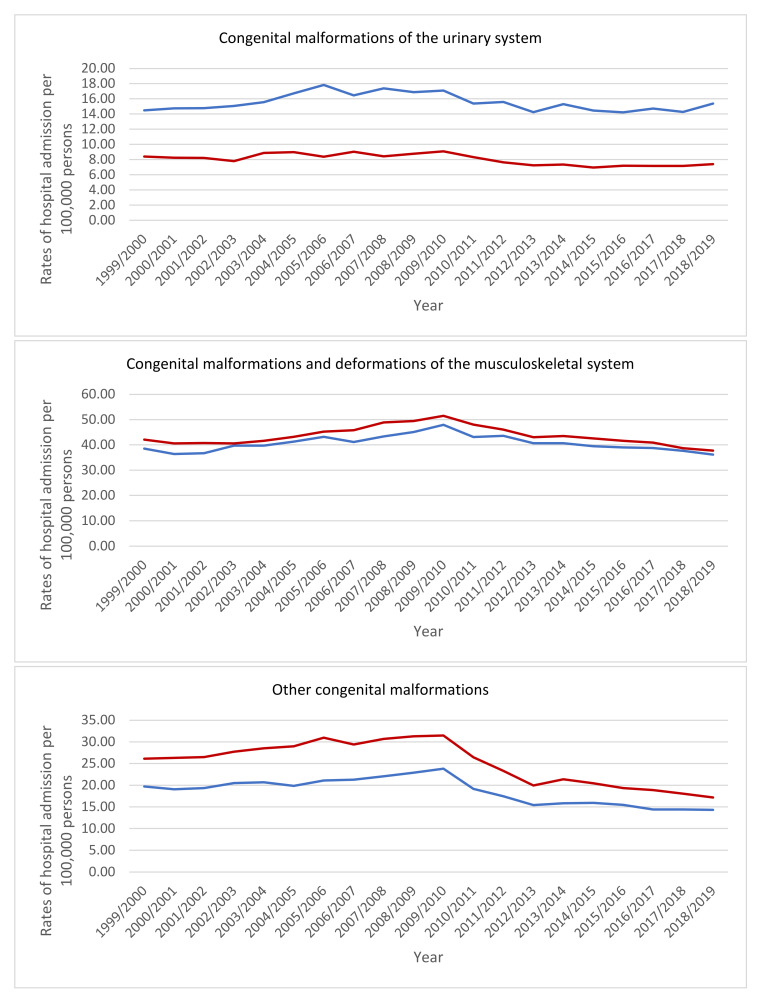
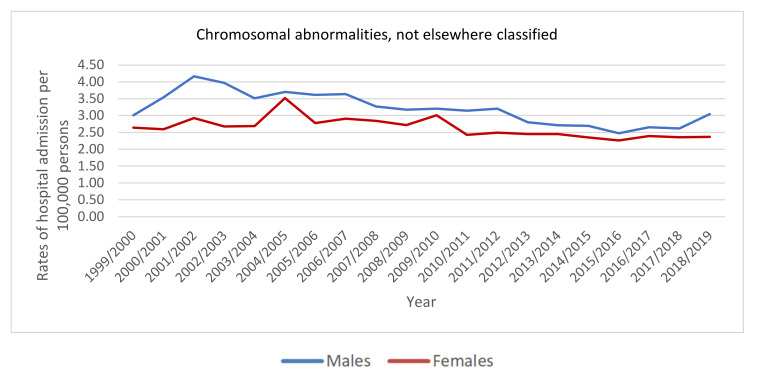
Objectives: To investigate the trends in congenital anomalies-related hospital admissions in England and Wales. Methods: This was an ecological study that was conducted using hospital admission data taken from the Hospital Episode Statistics database in England and the Patient Episode Database for Wales. Congenital malformations, deformations and chromosomal abnormalities hospital admissions data were extracted for the period between April 1999 and March 2019. Results: Hospital admission rate increased by 4.9% [from 198.74 (95% CI 197.53-199.94) in 1999 to 208.55 (95% CI 207.39-209.71) in 2019 per 100,000 persons, trend test, p < 0.01]. The most common hospital admissions causes were congenital malformations of the circulatory system, the musculoskeletal system, genital organs, and the digestive system. The most notable increase in hospital admissions rate was observed in congenital malformations of the respiratory system (1.01-fold). The age group below 15 years accounted for 75.1% of the total number of hospital admissions. Males contributed to 57.5% of the whole number of hospital admission. Hospital admission rate between females was increased by 6.4% [from 162.63 (95% CI 161.10-164.16) in 1999 to 173.05 (95% CI 171.57-174.54) in 2019 per 100,000 persons]. Hospital admission rate between males was increased by 3.4% [from 236.61 (95% CI 234.72-238.50) in 1999 to 244.70 (95% CI 242.92-246.49) in 2019 per 100,000 persons]. Conclusions: Males had a higher percentage of hospitalisation compared to females. Further studies to investigate the factors associated with higher hospitalisation rate among males are needed.
Keywords: England; United Kingdom; Wales; congenital; hospitalisation.
Conflict of interest statement
The authors declare no conflict of interest.
Figures
References
-
- World Health Organization Congenital Anomalies. 2020. [(accessed on 25 April 2021)]. Available online: https://www.who.int/news-room/fact-sheets/detail/congenital-anomalies.
-
- Sadler T. Langman’s Medical Embryology. Wolters Kluwer; Philadelphia, PA, USA: 2015. Birth defects and prenatal diagnosis; pp. 126–140.
-
- World Health Organization Birth Defects. Report by the Secretariat. Sixty-Third World Health Assembly. 2009. [(accessed on 1 July 2021)]. Available online: https://apps.who.int/iris/handle/10665/2271.
-
- Naghavi M., Wang H., Allen C., GBD 2015 Mortality and Causes of Death Collaborators Global, regional, and national life expectancy, all-cause mortality, and cause-specific mortality for 249 causes of death, 1980–2015: A systematic analysis for the Global Burden of Disease Study 2015. Lancet. 2016;388:1459–1544. - PMC - PubMed
MeSH terms
LinkOut - more resources
Full Text Sources
Medical
Miscellaneous
