. 2021 Oct 31;14(11):1115.
doi: 10.3390/ph14111115.

HIV-1 Protease and Reverse Transcriptase Inhibitory Activities of Curcuma aeruginosa Roxb. Rhizome Extracts and the Phytochemical Profile Analysis: In Vitro and In Silico Screening

Affiliations

HIV-1 Protease and Reverse Transcriptase Inhibitory Activities of Curcuma aeruginosa Roxb. Rhizome Extracts and the Phytochemical Profile Analysis: In Vitro and In Silico Screening

Chanin Sillapachaiyaporn et al. Pharmaceuticals (Basel). .

Abstract

Human immunodeficiency virus type-1 (HIV-1) infection causes acquired immunodeficiency syndrome (AIDS). Currently, several anti-retroviral drugs are available, but adverse effects of these drugs have been reported. Herein, we focused on the anti-HIV-1 activity of Curcuma aeruginosa Roxb. (CA) extracted by hexane (CA-H), ethyl acetate (CA-EA), and methanol (CA-M). The in vitro HIV-1 protease (PR) and HIV-1 reverse transcriptase (RT) inhibitory activities of CA extracts were screened. CA-M potentially inhibited HIV-1 PR (82.44%) comparable to Pepstatin A (81.48%), followed by CA-EA (67.05%) and CA-H (47.6%), respectively. All extracts exhibited moderate inhibition of HIV-1 RT (64.97 to 76.93%). Besides, phytochemical constituents of CA extracts were identified by GC-MS and UPLC-HRMS. Fatty acids, amino acids, and terpenoids were the major compounds found in the extracts. Furthermore, drug-likeness parameters and the ability of CA-identified compounds on blocking of the HIV-1 PR and RT active sites were in silico investigated. Dihydroergocornine, 3β,6α,7α-trihydroxy-5β-cholan-24-oic acid, and 6β,11β,16α,17α,21-Pentahydroxypregna-1,4-diene-3,20-dione-16,17-acetonide showed strong binding affinities at the active residues of both HIV-1 PR and RT. Moreover, antioxidant activity of CA extracts was determined. CA-EA exhibited the highest antioxidant activity, which positively related to the amount of total phenolic content. This study provided beneficial data for anti-HIV-1 drug discovery from CA extracts.

Keywords: ADMET analysis; AIDS; Curcuma aeruginosa Roxb.; HIV-1 protease inhibitor; HIV-1 reverse transcriptase inhibitor; drug discovery; immunodeficiency virus; virtual screening.


Conflict of interest statement

The authors declare no conflict of interest.

Figures

Figure 1
Figure 1
Schematic of Curcuma aeruginosa Roxb. (CA) extraction and fractionation. Rhizomes of Curcuma aeruginosa Roxb. were extracted with methanol then sequentially fractionated with hexane (CA-H), ethyl acetate (CA-EA), and methanol (CA-M), respectively.
Figure 2
Figure 2
Inhibitory activities of CA extracts on HIV-1 PR (A) and HIV-1 RT (B). All extracts (1 mg/mL) significantly inhibited both HIV-1 PR and RT compared to DMSO control (One-way ANOVA, Dunnett’s test, * p < 0.05). Mean ± SD of at least three independent experiments is presented.
Figure 3
Figure 3
The Venn diagram shows numbers of compounds found in CA-H, CA-EA, and CA-M.
Figure 4
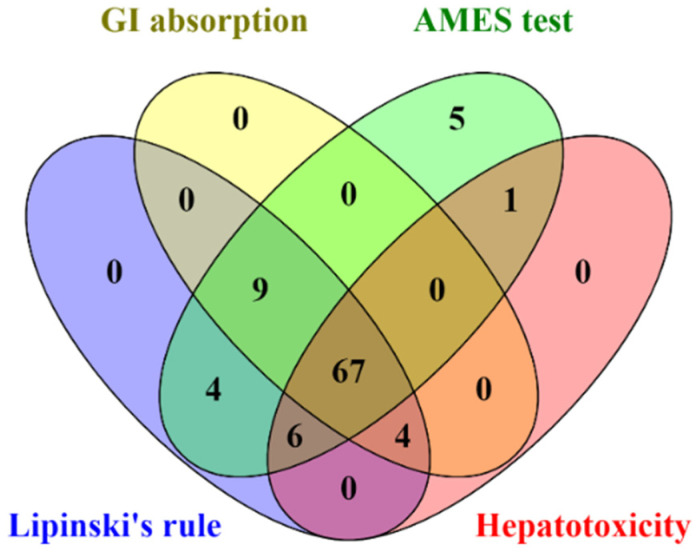
Figure 4
The Venn diagram presents the number of compounds predicted as high GI absorption, no AMES toxicity, no hepatotoxicity, and acceptable for Lipinski’s rule.
Figure 5
Figure 5
Three-dimensional schematic interaction between HIV-1 PR (PDB: 5KR0) and candidate ligands. Balls and sticks represent amino acid residues and ligands, respectively. Green dashed lines indicate hydrogen bonds. Pink and purple dashed lines indicate hydrophobic bonds.
Figure 6
Figure 6
Three-dimensional schematic interaction between HIV-1 RT (PDB: 3QIP) at the DNA polymerase active site and candidate ligands. Balls and sticks represent amino acid residues and ligands, respectively. Green dashed lines indicate hydrogen bonds. Pink and purple dashed lines indicate hydrophobic bonds.
Figure 7
Figure 7
Three-dimensional schematic interaction between HIV-1 RT (PDB: 3QIP) at the RNase H active site and candidate ligands. Balls and sticks represent amino acid residues and ligands, respectively. Green dashed lines indicate hydrogen bonds. Pink and purple dashed lines indicate hydrophobic bonds.
Figure 8
Figure 8
Analysis of antioxidant compounds and antioxidant capacity of CA extracts. (A) Total phenolic content of CA extract. (B) Antioxidant activity of CA extracts. Data are shown as mean ± SD of at least three independent experiments.

References

    1. Nyamweya S., Hegedus A., Jaye A., Rowland-Jones S., Flanagan K.L., Macallan D.C. Comparing HIV-1 and HIV-2 infection: Lessons for viral immunopathogenesis. Rev. Med. Virol. 2013;23:221–240. doi: 10.1002/rmv.1739. - DOI - PubMed
    1. Kwan C.K., Ernst J.D. HIV and tuberculosis: A deadly human syndemic. Clin. Microbiol. Rev. 2011;24:351–376. doi: 10.1128/CMR.00042-10. - DOI - PMC - PubMed
    1. Engelman A., Cherepanov P. The structural biology of HIV-1: Mechanistic and therapeutic insights. Nat. Rev. Microbiol. 2012;10:279–290. doi: 10.1038/nrmicro2747. - DOI - PMC - PubMed
    1. Lv Z., Chu Y., Wang Y. HIV protease inhibitors: A review of molecular selectivity and toxicity. HIV/AIDS. 2015;7:95–104. - PMC - PubMed
    1. Sarafianos S.G., Marchand B., Das K., Himmel D.M., Parniak M.A., Hughes S.H., Arnold E. Structure and function of HIV-1 reverse transcriptase: Molecular mechanisms of polymerization and inhibition. J. Mol. Biol. 2009;385:693–713. doi: 10.1016/j.jmb.2008.10.071. - DOI - PMC - PubMed