


Efficacy and Safety of Sugammadex for the Reversal of Rocuronium-Induced Neuromuscular Blockade in Patients with End-Stage Renal Disease: A Systematic Review and Meta-Analysis
- PMID: 34833477
- PMCID: PMC8622972
- DOI: 10.3390/medicina57111259
Efficacy and Safety of Sugammadex for the Reversal of Rocuronium-Induced Neuromuscular Blockade in Patients with End-Stage Renal Disease: A Systematic Review and Meta-Analysis
Abstract
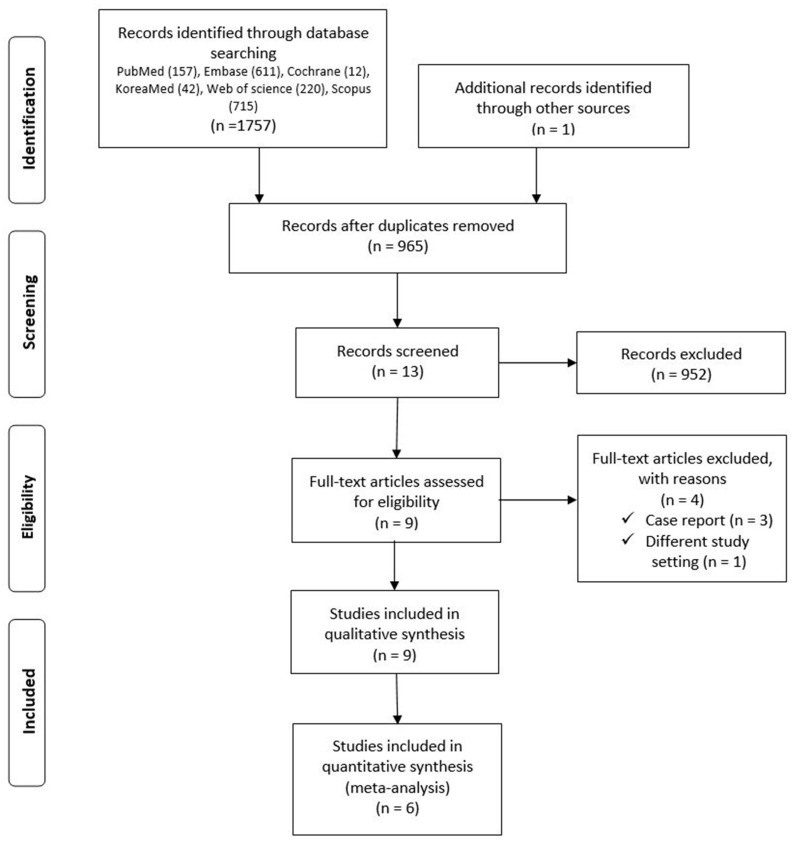
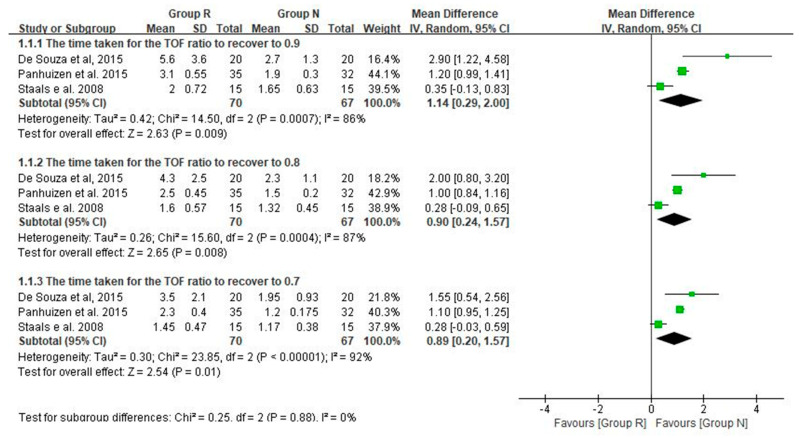
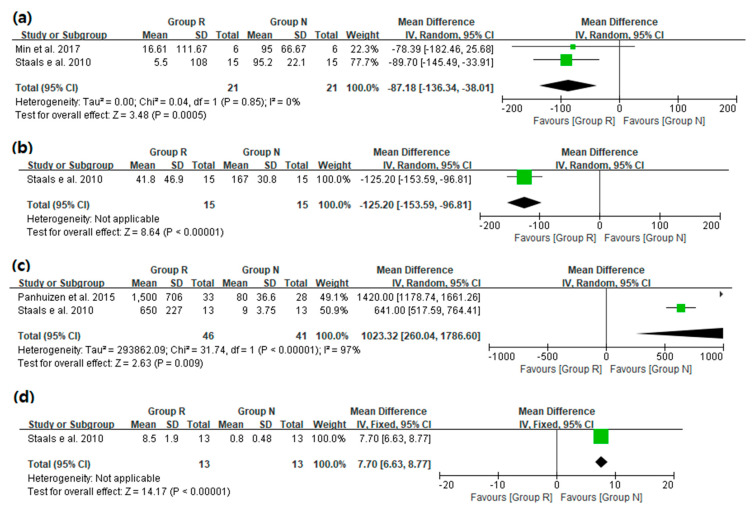
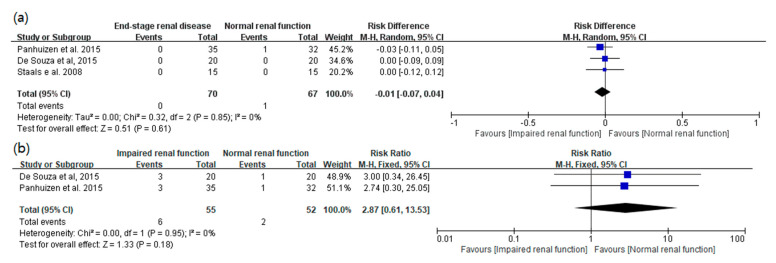
Background and Objectives: Sugammadex is widely used in anesthesia to reverse rocuronium-induced neuromuscular blockade (NMB). In patients with compromised kidney function, most drugs show alteration of their pharmacokinetic profile with reduced clearance. The purpose of this article is to examine the efficacy, pharmacokinetics, and safety of sugammadex in end-stage renal disease (ESRD) patients receiving general anesthesia, using a systematic review. Materials and Methods: The databases of PubMed, EMBASE, the Cochrane Library, Web of Science, Scopus, KoreaMed, and ClinicalTrials.gov were searched for studies comparing the efficacy or safety outcomes of sugammadex administration for the reversal of rocuronium-induced NMB, in ESRD patients (group R) or in those with normal renal function (group N) undergoing surgery under general anesthesia. Results: We identified nine studies with 655 patients-six prospective, case-control studies with 179 patients (89 and 90 in groups R and N) and three retrospective observational studies with 476 ESRD patients. In the six prospective studies, the times taken to reach a train-of-four ratio ≥0.9, 0.8, and 0.7 were significantly longer in group R than in group N (weighted mean difference [95% confidence interval] [min]: 1.14 [0.29 to 2.00], 0.9 [0.24 to 1.57], 0.89 [0.20 to 1.57], respectively). The total plasma clearance of sugammadex was significantly lower in group R than in group N. There was no significant difference in the incidence of NMB recurrence and prolonged time to recovery between the groups. In the three retrospective studies, the possibility of sugammadex-related adverse events appears to be insignificant. Conclusions: Sugammadex may effectively and safely reverse rocuronium-induced NMB in patients with ESRD, although the recovery to a TOF ratio of 0.9 may be prolonged compared to patients with normal renal function. Further studies are needed, considering the small number of studies included and the high heterogeneity of some of the results.
Keywords: chronic; kidney failure; neuromuscular blockade; renal insufficiency; rocuronium; sugammadex.
Conflict of interest statement
The authors declare no conflict of interest.
Figures
References
-
- Bom A., Bradley M., Cameron K., Clark J.K., Van Egmond J., Feilden H., MacLean E.J., Muir A.W., Palin R., Rees D.C., et al. A novel concept of reversing neuromuscular block: Chemical encapsulation of rocuronium bromide by a cyclodextrin-based synthetic host. Angew. Chem. Int. Ed. Engl. 2002;41:266–270. doi: 10.1002/1521-3757(20020118)114:2<275::AID-ANGE275>3.0.CO;2-A. - DOI - PubMed
-
- Staals L.M., Snoeck M.M., Driessen J.J., van Hamersvelt H.W., Flockton E.A., van den Heuvel M.W., Hunter J.M. Reduced clearance of rocuronium and sugammadex in patients with severe to end-stage renal failure: A pharmacokinetic study. Br. J. Anaesth. 2010;104:31–39. doi: 10.1093/bja/aep340. - DOI - PubMed
-
- U.S. Food and Drug Administration. Merck Sharp & Dohme Corp. BRIDION® (Sugammadex) Injection, for Intravenous Use. Initial U.S. Approval; Silver Spring, MD, USA: 2015. [(accessed on 5 December 2019)]. Available online: https://www.accessdata.fda.gov/drugsatfda_docs/label/2015/022225lbl.pdf.
Publication types
MeSH terms
Substances
LinkOut - more resources
Full Text Sources
Medical
