Review
. 2021 Nov 19;57(11):1272.
doi: 10.3390/medicina57111272.

The Lymphatic System in Breast Cancer: Anatomical and Molecular Approaches

Affiliations
Review

The Lymphatic System in Breast Cancer: Anatomical and Molecular Approaches

Gianfranco Natale et al. Medicina (Kaunas). .

Abstract

Breast cancer is one of the most important causes of premature mortality among women and it is one of the most frequently diagnosed tumours worldwide. For this reason, routine screening for prevention and early diagnosis is important for the quality of life of patients. Breast cancer cells can enter blood and lymphatic capillaries, then metastasizing to the regional lymph nodes in the axilla and to both visceral and non-visceral sites. Rather than at the primary site, they seem to enter the systemic circulation mainly through the sentinel lymph node and the biopsy of this indicator can influence the axillary dissection during the surgical approach to the pathology. Furthermore, secondary lymphoedema is another important issue for women following breast cancer surgical treatment or radiotherapy. Considering these fundamental aspects, the present article aims to describe new methodological approaches to assess the anatomy of the lymphatic network in the axillary region, as well as the molecular and physiological control of lymphatic vessel function, in order to understand how the lymphatic system contributes to breast cancer disease. Due to their clinical implications, the understanding of the molecular mechanisms governing lymph node metastasis in breast cancer are also examined. Beyond the investigation of breast lymphatic networks and lymphatic molecular mechanisms, the discovery of new effective anti-lymphangiogenic drugs for future clinical settings appears essential to support any future development in the treatment of breast cancer.

Keywords: anticancer drugs; breast cancer; lymphatic metastasis; lymphatic system; sentinel lymph node.


Conflict of interest statement

The authors declare no conflict of interest.

Figures
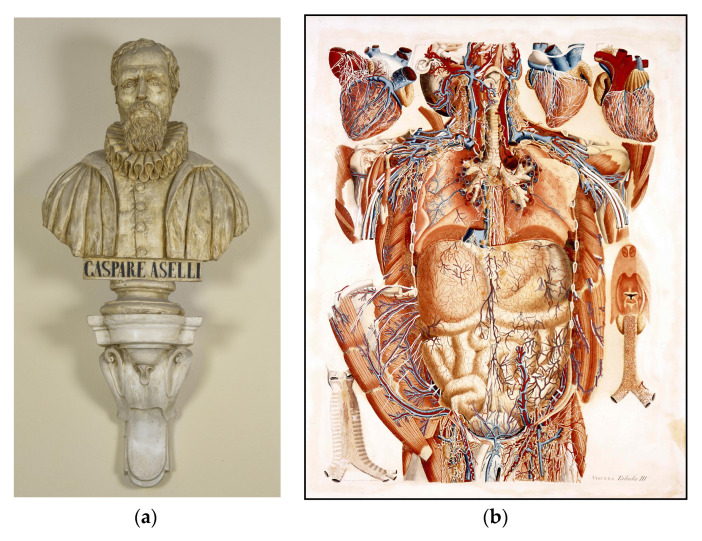
Figure 1
Figure 1
(A) Plaster bust of Gaspare Aselli. Museum of Human Anatomy “Filippo Civinini”. University of Pisa. (B) Tabula III-Viscera (Paolo Mascagni. Anatomiae universae icones) [14]. This plate illustrates the lymphatic network in thoracic, axillary and inguinal regions. Mascagni’s Gallery of the Museum of Human Anatomy “Filippo Civinini”. University of Pisa.
Figure 2
Figure 2
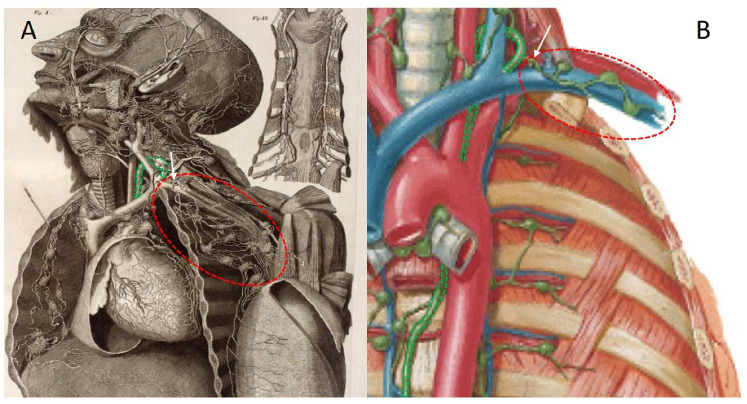
Lymphatic anatomy of the upper quadrant, showing the thoracic duct and the subclavian lymphatic trunk connected to its network of lymph nodes. The thoracic duct is highlighted in green. The subclavian lymphatic trunk (with the main vessel indicated by a white arrow) and the connecting lymph nodes are circled in red. (A) This historical plate provides an unobstructed overview of the lymphatics in the area of interest. Note that the subclavian lymphatic trunk does not first connect to the thoracic duct before joining the venous angle. Adapted from the original atlas plate of Mascagni (1787) [13] (Library of Medicine and Pharmacy, University of Pisa). (B) In this modern plate, the subclavian lymphatic trunk is much more stylised and it connects directly to the thoracic duct. Adapted from Netter’s atlas of human anatomy [74].
Figure 3
Figure 3
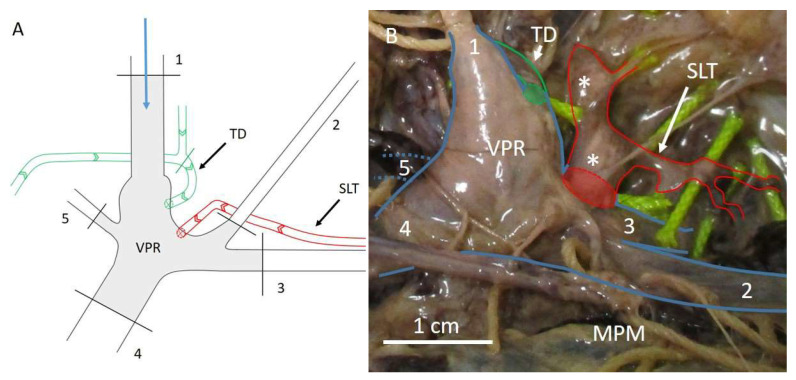
Schematic representation of the venous reservoir (A) and the venous reservoir in a cadaveric set up (B). The blue arrow in panel (A) represents the cannulation site and the flow direction of the contrast agent upon injection. The numbers represent the venous structures that need to be ligated in order to obtain the venous pressure reservoir. Arrows inside the lymphatic vessels in panel (A) depict the natural direction of lymph flow. Black lines represent ligation sites. The green line shows the ligation site at the thoracic duct, to prevent contrast agent from advancing into the thorax, instead focusing the built up pressure towards the SLT. Note that the external jugular vein (2) is retracted caudally in panel (B), in order to show the SLT that was partially filled with contrast agent as a result of the retrograde injection approach using the venous reservoir. The vertebral vein (5) in panel (B) is depicted as interrupted blue lines, because this structure runs posteriorly from the venous pressure reservoir, obscuring it from view. 1 = internal jugular vein, 2 = external jugular vein, 3 = subclavian vein, 4 = brachiocephalic vein, 5 = vertebral vein, MPM = major pectoral muscle, SLT = subclavian lymphatic trunk, TD = thoracic duct, VPR = venous pressure reservoir, * = lymph node. Green lines = thoracic duct, red lines = subclavian lymphatic trunk, blue lines = venous structures in panel (B). Adapted from Stouthandel et al. [77].
Figure 4
Figure 4
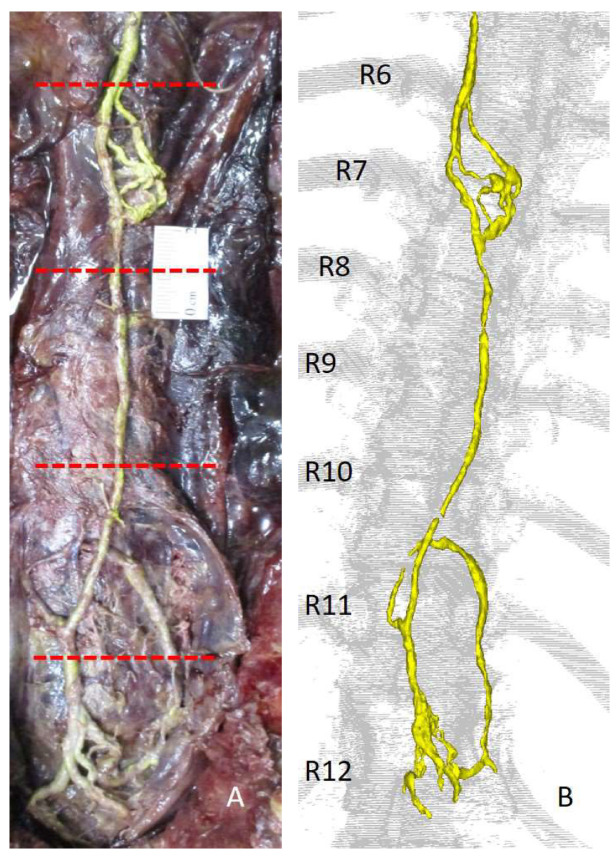
Dissection picture (A) and digital reconstruction from the corresponding CT scan (B), showing the contrast-filled lymphatics obtained after retrograde lymphatic injection of the thoracic duct. The red dotted lines in figure (A) show the possibility to make standardised test units to test retrograde lymphatic injection approaches by ligating the thoracic duct at equally spaced intervals (5 cm). The thoracic duct is shown in yellow. Note how the thoracic duct in the dissection picture and the 3D reconstruction perfectly resemble each other. Also note that this set up provides easy, unobstructed access to the thoracic duct, allowing easy cannulation and visual control of contrast agent advancement during injection. R6–R12 = rib 6–rib 12. Adapted from Stouthandel et al. [72].

References

    1. Łukasiewicz S., Czeczelewski M., Forma A., Baj J., Sitarz R., Stanisławek A. Breast Cancer-Epidemiology, Risk Factors, Classification, Prognostic Markers, and Current Treatment Strategies—An Updated Review. Cancers. 2021;13:4287. doi: 10.3390/cancers13174287. - DOI - PMC - PubMed
    1. Coughlin S.S. Epidemiology of Breast Cancer in Women. Adv. Exp. Med. Biol. 2019;1152:9–29. - PubMed
    1. Solanki M., Visscher D. Pathology of breast cancer in the last half century. Hum. Pathol. 2020;95:137–148. doi: 10.1016/j.humpath.2019.09.007. - DOI - PubMed
    1. Ekmektzoglou K.A., Xanthos T., German V., Zografos G.C. Breast cancer: From the earliest times through to the end of the 20th century. Eur. J. Obstet. Gynecol. Reprod. Biol. 2009;145:3–8. doi: 10.1016/j.ejogrb.2009.03.017. - DOI - PubMed
    1. Budh D.P., Sapra A. Cancer Breast Screening. StatPearls Publishing; Treasure Island, FL, USA: 2021.