


A Machine Learning Classification Model for Monitoring the Daily Physical Behaviour of Lower-Limb Amputees
- PMID: 34833534
- PMCID: PMC8625063
- DOI: 10.3390/s21227458
A Machine Learning Classification Model for Monitoring the Daily Physical Behaviour of Lower-Limb Amputees
Abstract
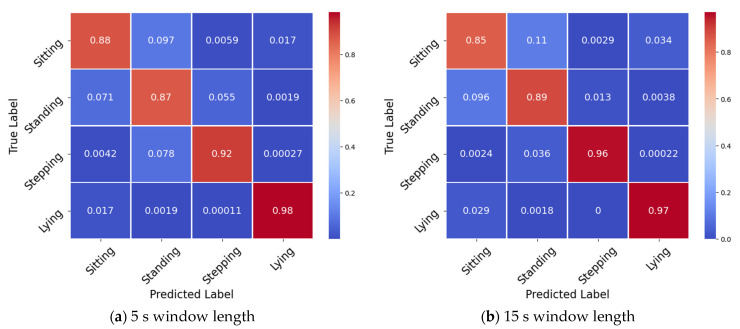
There are currently limited data on how prosthetic devices are used to support lower-limb prosthesis users in their free-living environment. Possessing the ability to monitor a patient's physical behaviour while using these devices would enhance our understanding of the impact of different prosthetic products. The current approaches for monitoring human physical behaviour use a single thigh or wrist-worn accelerometer, but in a lower-limb amputee population, we have the unique opportunity to embed a device within the prosthesis, eliminating compliance issues. This study aimed to develop a model capable of accurately classifying postures (sitting, standing, stepping, and lying) by using data from a single shank-worn accelerometer. Free-living posture data were collected from 14 anatomically intact participants and one amputee over three days. A thigh worn activity monitor collected labelled posture data, while a shank worn accelerometer collected 3-axis acceleration data. Postures and the corresponding shank accelerations were extracted in window lengths of 5-180 s and used to train several machine learning classifiers which were assessed by using stratified cross-validation. A random forest classifier with a 15 s window length provided the highest classification accuracy of 93% weighted average F-score and between 88 and 98% classification accuracy across all four posture classes, which is the best performance achieved to date with a shank-worn device. The results of this study show that data from a single shank-worn accelerometer with a machine learning classification model can be used to accurately identify postures that make up an individual's daily physical behaviour. This opens up the possibility of embedding an accelerometer-based activity monitor into the shank component of a prosthesis to capture physical behaviour information in both above and below-knee amputees. The models and software used in this study have been made open source in order to overcome the current restrictions of applying activity monitoring methods to lower-limb prosthesis users.
Keywords: accelerometer; activity monitor; classification; lower-limb amputee; machine learning; physical behaviour monitoring.
Conflict of interest statement
The authors declare no conflict of interest. The funders had no role in the design of the study; in the collection, analyses, or interpretation of data; in the writing of the manuscript; or in the decision to publish the results.
Figures



References
-
- World Health Organisation . WHO Standards for Prosthetics and Orthotics. WHO; Geneva, Switzerland: 2017.
MeSH terms
Grants and funding
LinkOut - more resources
Full Text Sources
Medical
