


Artificial Intelligence for Autonomous Molecular Design: A Perspective
- PMID: 34833853
- PMCID: PMC8619999
- DOI: 10.3390/molecules26226761
Artificial Intelligence for Autonomous Molecular Design: A Perspective
Abstract
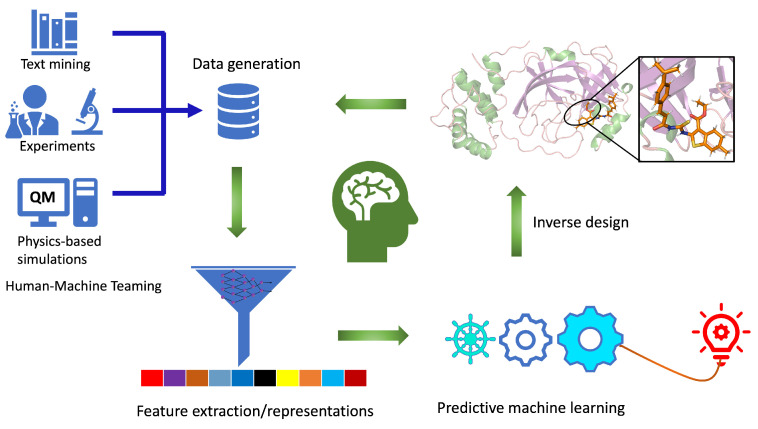
Domain-aware artificial intelligence has been increasingly adopted in recent years to expedite molecular design in various applications, including drug design and discovery. Recent advances in areas such as physics-informed machine learning and reasoning, software engineering, high-end hardware development, and computing infrastructures are providing opportunities to build scalable and explainable AI molecular discovery systems. This could improve a design hypothesis through feedback analysis, data integration that can provide a basis for the introduction of end-to-end automation for compound discovery and optimization, and enable more intelligent searches of chemical space. Several state-of-the-art ML architectures are predominantly and independently used for predicting the properties of small molecules, their high throughput synthesis, and screening, iteratively identifying and optimizing lead therapeutic candidates. However, such deep learning and ML approaches also raise considerable conceptual, technical, scalability, and end-to-end error quantification challenges, as well as skepticism about the current AI hype to build automated tools. To this end, synergistically and intelligently using these individual components along with robust quantum physics-based molecular representation and data generation tools in a closed-loop holds enormous promise for accelerated therapeutic design to critically analyze the opportunities and challenges for their more widespread application. This article aims to identify the most recent technology and breakthrough achieved by each of the components and discusses how such autonomous AI and ML workflows can be integrated to radically accelerate the protein target or disease model-based probe design that can be iteratively validated experimentally. Taken together, this could significantly reduce the timeline for end-to-end therapeutic discovery and optimization upon the arrival of any novel zoonotic transmission event. Our article serves as a guide for medicinal, computational chemistry and biology, analytical chemistry, and the ML community to practice autonomous molecular design in precision medicine and drug discovery.
Keywords: artificial intelligence; autonomous workflow; computational modeling and simulations; computer aided drug discovery; deep learning; machine learning; machine reasoning and causal inference and causal reasoning; quantum mechanics and quantum computing; therapeutic design.
Conflict of interest statement
The authors declare no conflict of interest.
Figures
References
-
- Zhavoronkov A., Ivanenkov Y.A., Aliper A., Veselov M.S., Aladinskiy V.A., Aladinskaya A.V., Terentiev V.A., Polykovskiy D.A., Kuznetsov M.D., Asadulaev A., et al. Deep learning enables rapid identification of potent DDR1 kinase inhibitors. Nat. Biotechnol. 2019;37:1038–1040. doi: 10.1038/s41587-019-0224-x. - DOI - PubMed
-
- Kackar R.N. Off-Line Quality Control, Parameter Design, and the Taguchi Method. J. Qual. Technol. 1985;17:176–188. doi: 10.1080/00224065.1985.11978964. - DOI
-
- DiMasi J.A., Grabowski H.G., Hansen R.W. Innovation in the pharmaceutical industry: New estimates of R&D costs. J. Health Econ. 2016;47:20–33. - PubMed
Publication types
MeSH terms
Grants and funding
LinkOut - more resources
Full Text Sources
