. 2021 Nov 17;26(22):6949.
doi: 10.3390/molecules26226949.

Quercetin Prevents LPS-Induced Oxidative Stress and Inflammation by Modulating NOX2/ROS/NF-kB in Lung Epithelial Cells

Affiliations

Quercetin Prevents LPS-Induced Oxidative Stress and Inflammation by Modulating NOX2/ROS/NF-kB in Lung Epithelial Cells

Ok-Joo Sul et al. Molecules. .

Abstract

Oxidative stress caused by the production of reactive oxygen species (ROS) plays a major role in inflammatory processes. We hypothesized that modulation of ROS via quercetin may protect against oxidative stress and inflammation. Thus, this study aimed to investigate the effects of quercetin on oxidative stress and inflammation in lung epithelial A549 cells. The lipopolysaccharide (LPS)-induced elevation of intracellular ROS levels was reduced after quercetin treatment, which also almost completely abolished the mRNA and protein expression of nicotinamide adenine dinucleotide phosphate oxidase 2 (NOX2) induced by LPS stimulation. In addition, quercetin suppressed the nuclear translocation of nuclear factor kappa B (NF-κB) and reduced levels of inflammatory cytokine tumor necrosis factor (TNF)-α, interleukin (IL)-1, and IL-6, which had increased significantly after LPS exposure. Our data demonstrated that quercetin decreased ROS-induced oxidative stress and inflammation by suppressing NOX2 production.

Keywords: NADPH oxidases; inflammation; oxidative stress; quercetin; reactive oxygen species.


Conflict of interest statement

The authors declare that they have no competing interests.

Figures

Figure 1
Figure 1
Structure of quercetin and its effect on cell viability: (A) Chemical structure of quercetin; (B) Lung epithelial A549 cells were treated with quercetin at various concentrations (0, 10, 20, 30 and 50 μM) for 4 h before addition of LPS (0, 1, 10, 20, 30 and 50 μg/mL) for 6 h. Cell viability was measured using the MTT assay. * p < 0.05 in comparison with non-treated cells. Similar results were obtained in three independent experiments.
Figure 2
Figure 2
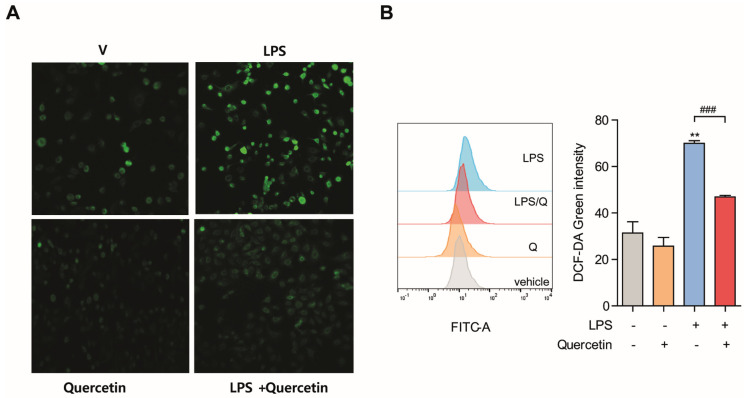
Quercetin prevents LPS−induced oxidative stress in lung epithelial cells. A549 cells were pretreated with quercetin (10 μM) for 4 h and then stimulated with LPS (10 μg/mL) for an additional 6 h. Production of intracellular ROS was determined by DCF-DA staining using confocal microscopy (A) and flow cytometry (B). Scale bar = 10 μm. ** p < 0.001 in comparison with non-treated cells. ### p < 0.001 compared with LPS-treated cells. Similar results were obtained in three independent experiments.
Figure 3
Figure 3
Quercetin prevents LPS−induced oxidative stress by suppressing NOX production. A549 cells were pretreated with quercetin (10 μM) for 4 h and then stimulated with LPS (10 μg/mL) for an additional 6 h. (A) The mRNA and protein levels of NOX2 were determined by qPCR and western blot, respectively. Band intensity was determined using the Image J program, then β-actin was used as the loading control protein to normalize target protein expression. The fold change was calculated by dividing the normalized expression from each lane by the normalized expression of the control sample. (B) Cells were pretreated with the NOX2 inhibitor NAC (5 mM) or DPI (10 μM) for 30 min or with quercetin (10 μM) for 4 h. Then, the cells were challenged with LPS (10 μg/mL) for another 6 h. Intracellular ROS was stained with DCF-DA and measured by flow cytometry. ** p < 0.01 in comparison with non-treated cells. # p < 0.05; ## p < 0.01 compared with LPS-treated cells. Similar results were obtained in three independent experiments.
Figure 4
Figure 4
Quercetin inhibits LPS−induced inflammation in lung epithelial cells. A549 cells pretreated with quercetin (10 μM) for 4 h and then stimulated with LPS (10 μg/mL) for an additional 6 h. (A) mRNA levels of TNF-α, IL-1β, and IL-6 were determined by qPCR. (B) Cells were pretreated with the NOX2 inhibitor NAC (5 mM) for 30 min followed by incubation with quercetin (10 μM) for 4 h. Then, the cells were challenged with LPS (10 μg/mL) for another 6 h. The conditioned supernatants were harvested, and the secreted levels of TNF-α and IL-6 were assessed by ELISA. ** p < 0.01; *** p < 0.001 in comparison with non-treated cells. # p < 0.05; ## p < 0.01; ### p < 0.001 compared with LPS-treated cells. Similar results were obtained in three independent experiments.
Figure 5
Figure 5
Quercetin significantly decreased LPS−induced nuclear translocation of NF-κB in lung epithelial cells. A549 cells were pretreated with quercetin (10 µM) for 4 h before treatment with 100 ng/mL LPS for 6 h. (A) The protein levels of IκB were determined by western blot. (B) Cells were pretreated with the NOX2 inhibitor NAC (5 mM) for 30 min followed by incubation with quercetin (10 μM) for 4 h. Then, the cells were challenged with LPS (10 μg/mL) for another 6 h. The protein levels of NF-κB were determined by western blotting in cytosolic or nuclear extracts. β-actin and lamin B were used as the loading control proteins to normalize the expression of cytosolic and nuclear proteins. Values are shown as means ± SEM. * p < 0.05; ** p < 0.01 in comparison with non-treated cells. # p < 0.05; ## p < 0.01 compared with LPS-treated cells. Similar results were obtained in three independent experiments.
Figure 6
Figure 6
Quercetin decreases reactive oxygen species (ROS)-induced oxidative stress and inflammation by suppressing NADPH oxidase 2 (NOX2) production. Lipopolysaccharide (LPS) activates its receptor and transmits a signal to generate ROS via NOX2. The LPS-induced ROS levels enhance IκBα degradation and the translocation of NF-κB to the nucleus. NF-κB regulates the expression of several inflammatory cytokines, such as TNF-α, IL-1β, and IL-6. Quercetin prevents LPS-induced NOX2 expression and suppresses IκBα degradation and the nuclear translocation of NF-κB, resulting in a reduction in the levels of the inflammatory cytokines.

References

    1. Matthay M.A., Zemans R.L. The acute respiratory distress syndrome: Pathogenesis and treatment. Annu. Rev. Pathol. 2011;6:147–163. doi: 10.1146/annurev-pathol-011110-130158. - DOI - PMC - PubMed
    1. Herrero R., Sanchez G., Lorente J.A. New insights into the mechanisms of pulmonary edema in acute lung injury. Ann. Transl. Med. 2018;6:32. doi: 10.21037/atm.2017.12.18. - DOI - PMC - PubMed
    1. Matthay M.A., Zimmerman G.A. Acute lung injury and the acute respiratory distress syndrome: Four decades of inquiry into pathogenesis and rational management. Am. J. Respir. Cell Mol. Biol. 2005;33:319–327. doi: 10.1165/rcmb.F305. - DOI - PMC - PubMed
    1. Kellner M., Noonepalle S., Lu Q., Srivastava A., Zemskov E., Black S.M. ROS Signaling in the pathogenesis of acute lung injury (ALI) and acute respiratory distress syndrome (ARDS) Adv. Exp. Med. Biol. 2017;967:105–137. - PMC - PubMed
    1. Lee I.T., Yang C.M. Role of NADPH oxidase/ROS in pro-inflammatory mediators-induced airway and pulmonary diseases. Biochem. Pharmacol. 2012;84:581–590. doi: 10.1016/j.bcp.2012.05.005. - DOI - PubMed

LinkOut - more resources