


3D-Printed Products for Topical Skin Applications: From Personalized Dressings to Drug Delivery
- PMID: 34834360
- PMCID: PMC8625283
- DOI: 10.3390/pharmaceutics13111946
3D-Printed Products for Topical Skin Applications: From Personalized Dressings to Drug Delivery
Abstract
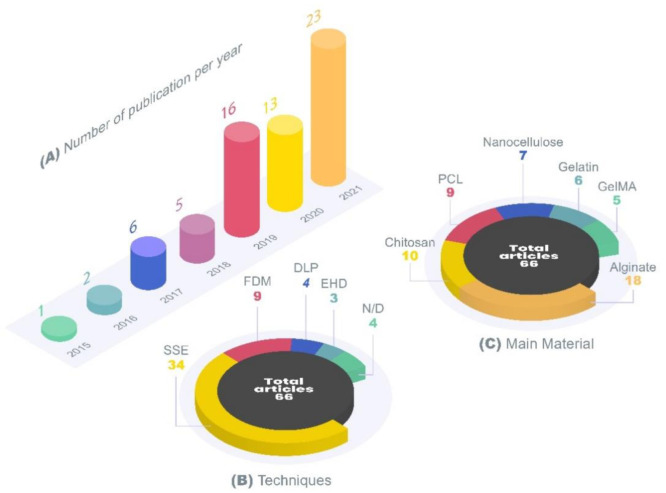
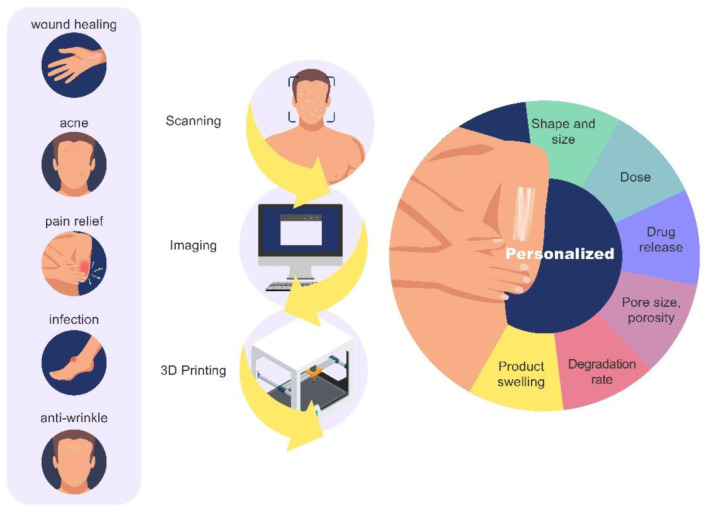
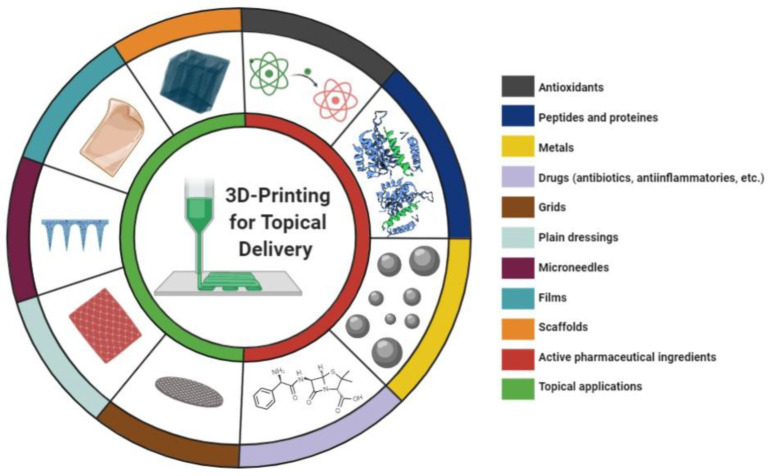
3D printing has been widely used for the personalization of therapies and on-demand production of complex pharmaceutical forms. Recently, 3D printing has been explored as a tool for the development of topical dosage forms and wound dressings. Thus, this review aims to present advances related to the use of 3D printing for the development of pharmaceutical and biomedical products for topical skin applications, covering plain dressing and products for the delivery of active ingredients to the skin. Based on the data acquired, the important growth in the number of publications over the last years confirms its interest. The semisolid extrusion technique has been the most reported one, probably because it allows the use of a broad range of polymers, creating the most diverse therapeutic approaches. 3D printing has been an excellent field for customizing dressings, according to individual needs. Studies discussed here imply the use of metals, nanoparticles, drugs, natural compounds and proteins and peptides for the treatment of wound healing, acne, pain relief, and anti-wrinkle, among others. The confluence of 3D printing and topical applications has undeniable advantages, and we would like to encourage the research groups to explore this field to improve the patient's life quality, adherence and treatment efficacy.
Keywords: 3D-printing; FDM; additive manufacturing; film; patch; skin disorders; wound dressing.
Conflict of interest statement
The authors declare no conflict of interest.
Figures
References
-
- Machado A.C.H.R., Lopes P.S., Raffier C.P., Haridass I.N., Roberts M., Grice J., Leite-Silva V.R. Skin Penetration. In: Sakamoto K., Lochhead H., Maibach H., Yamashita Y., editors. Cosmetic Science and Technology. Elsevier; Amsterdam, The Netherlands: 2017. pp. 741–755.
Publication types
Grants and funding
- 308160/2018-5/National Council for Scientific and Technological Development
- 17/2551-0001072-8/Fundação de Amparo à Pesquisa do Estado do Rio Grande do Sul
- Finance Code 001/Coordenação de Aperfeicoamento de Pessoal de Nível Superior
- PID2020-114530GA-100/Ministerio de Ciencia e Innovación/Agencia Estatal de Investigación
LinkOut - more resources
Full Text Sources
