


Virtual Reality-Based Therapy Reduces the Disabling Impact of Fibromyalgia Syndrome in Women: Systematic Review with Meta-Analysis of Randomized Controlled Trials
- PMID: 34834518
- PMCID: PMC8621064
- DOI: 10.3390/jpm11111167
Virtual Reality-Based Therapy Reduces the Disabling Impact of Fibromyalgia Syndrome in Women: Systematic Review with Meta-Analysis of Randomized Controlled Trials
Abstract
Background: Virtual reality-based therapy (VRBT) is a novel therapeutic approach to be used in women with fibromyalgia syndrome (FMS). The aim of our study is to assess the effect of VRBT to reduce the impact of FMS in outcomes such as pain, dynamic balance, aerobic capacity, fatigue, quality of life (QoL), anxiety and depression.
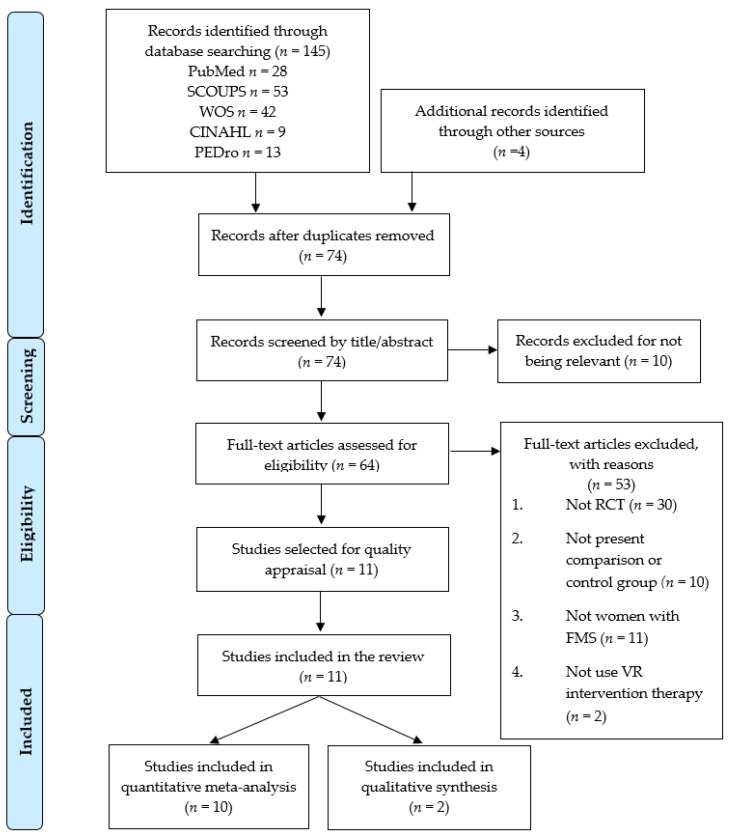
Methods: Systematic review with meta-analysis was conducted from a bibliographic search in PubMed, Scopus, PEDro, Web of Science and CINAHL until April 2021 in accordance with PRISMA guidelines. We included randomized controlled trials (RCTs) that compare VRBT versus others to assess the mentioned outcomes in women with FMS. Effect size was calculated with standardized mean difference (SMD) and its 95% confidence interval (95% CI).
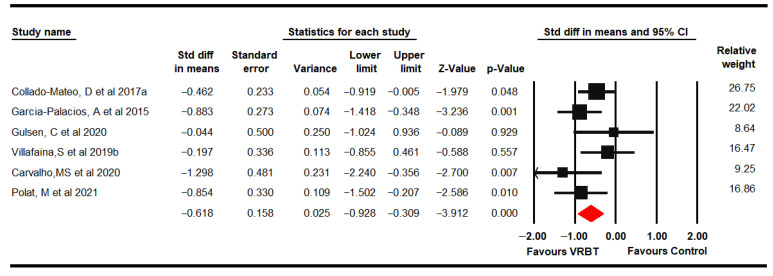
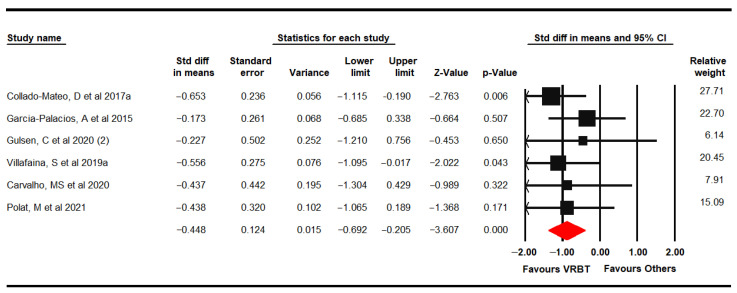
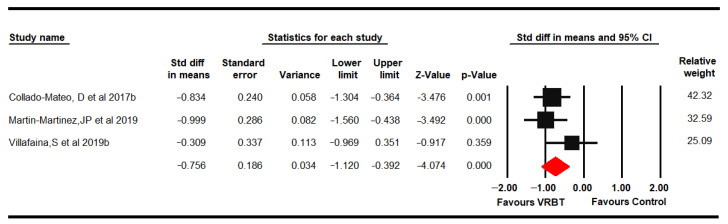
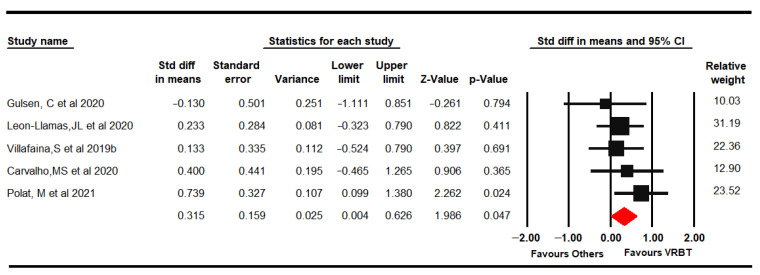
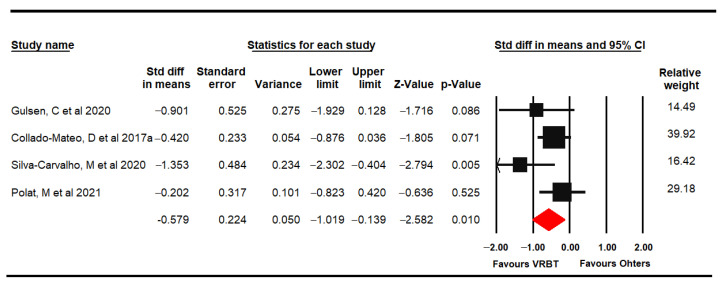
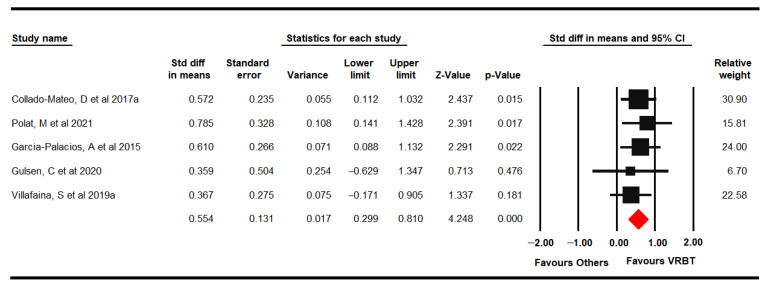
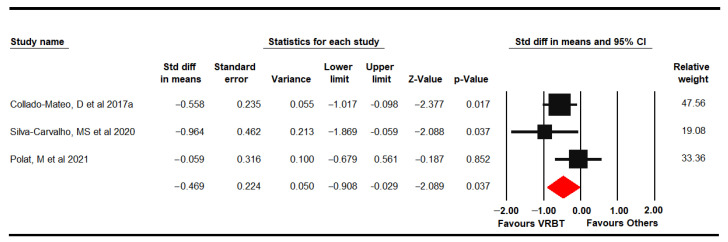
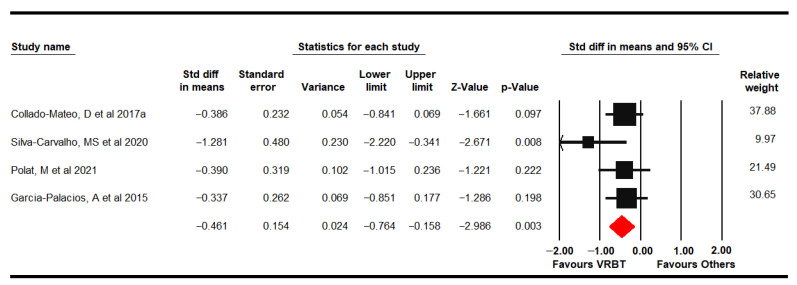
Results: Eleven RCTs involving 535 women with FMS were included. Using the PEDro scale, the mean methodological quality of the included studies was moderate (6.63 ± 0.51). Our findings showed an effect of VRBT on the impact of FMS (SMD -0.62, 95% CI -0.93 to -0.31); pain (SMD -0.45, 95% CI -0.69 to -0.21); dynamic balance (SMD -0.76, 95% CI -1.12 to -0.39); aerobic capacity (SMD 0.32, 95% CI 0.004 to 0.63); fatigue (SMD -0.58, 95% CI -1.02 to -0.14); QoL (SMD 0.55, 95% CI 0.3 to 0.81); anxiety (SMD -0.47, 95% CI -0.91 to -0.03) and depression (SMD -0.46, 95% CI -0.76 to -0.16).
Conclusions: VRBT is an effective therapy that reduces the impact of FMS, pain, fatigue, anxiety and depression and increases dynamic balance, aerobic capacity and quality of life in women with FMS. In addition, VRBT in combination with CTBTE showed a large effect in reducing the impact of FMS and fatigue and increasing QoL in these women.
Keywords: fatigue; fibromyalgia; meta-analysis; pain; physiotherapy; quality of life; virtual reality.
Conflict of interest statement
The authors declare no conflict of interest.
Figures
References
-
- Wolfe F., Clauw D.J., Fitzcharles M.-A., Goldenberg D.L., Katz R.S., Mease P., Russell A.S., Russell I.J., Winfield J.B., Yunus M.B. The American College of Rheumatology Preliminary Diagnostic Criteria for Fibromyalgia and Measurement of Symptom Severity. Arthritis Rheum. 2010;62:600–610. doi: 10.1002/acr.20140. - DOI - PubMed
-
- Lomas-Vega R., Rodríguez-Almagro D., Peinado-Rubia A.B., Zagalaz-Anula N., Molina F., Obrero-Gaitán E., Ibáñez-Vera A.J., Osuna-Pérez M.C. Joint Assessment of Equilibrium and Neuromotor Function: A Validation Study in Patients with Fibromyalgia. Diagnostics. 2020;10:1057. doi: 10.3390/diagnostics10121057. - DOI - PMC - PubMed
-
- Montoro C.I., del Paso G.A.R., Duschek S. Alexithymia in fibromyalgia syndrome. Pers. Individ. Differ. 2016;102:170–179. doi: 10.1016/j.paid.2016.06.072. - DOI
-
- Peinado-Rubia A., Osuna-Pérez M.C., Rodríguez-Almagro D., Zagalaz-Anula N., López-Ruiz M.C., Lomas-Vega R. Impaired Balance in Patients with Fibromyalgia Syndrome: Predictors of the Impact of This Disorder and Balance Confidence. Int. J. Environ. Res. Public Health. 2020;17:3160. doi: 10.3390/ijerph17093160. - DOI - PMC - PubMed
Publication types
LinkOut - more resources
Full Text Sources
Miscellaneous
