


Precision Medicine in Phaeochromocytoma and Paraganglioma
- PMID: 34834591
- PMCID: PMC8620689
- DOI: 10.3390/jpm11111239
Precision Medicine in Phaeochromocytoma and Paraganglioma
Abstract
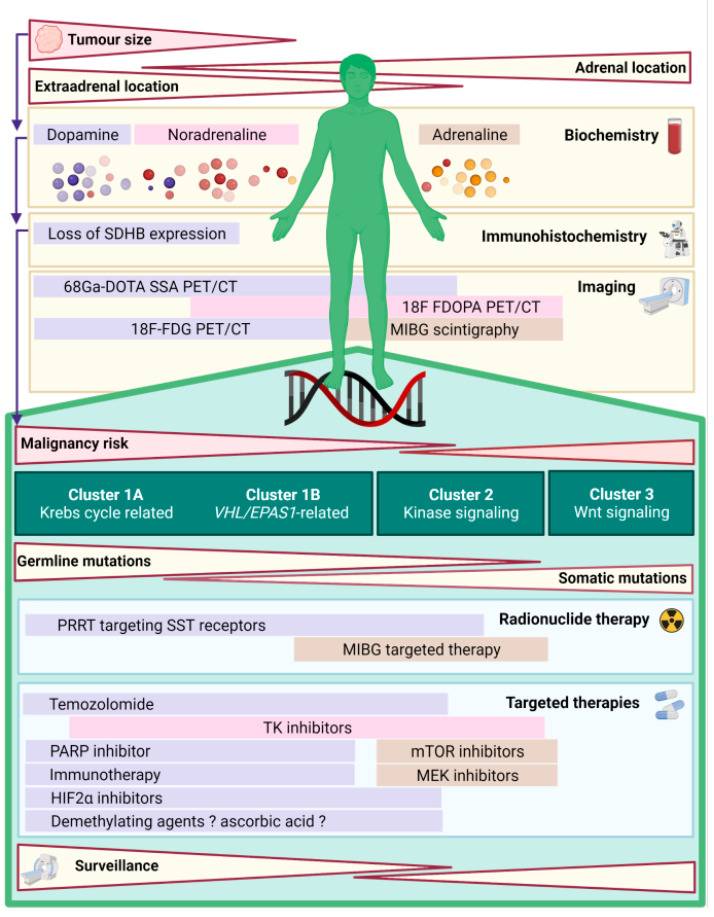
Precision medicine is a term used to describe medical care, which is specifically tailored to an individual patient or disease with the aim of ensuring the best clinical outcome whilst reducing the risk of adverse effects. Phaeochromocytoma and paraganglioma (PPGL) are rare neuroendocrine tumours with uncertain malignant potential. Over recent years, the molecular profiling of PPGLs has increased our understanding of the mechanisms that drive tumorigenesis. A high proportion of PPGLs are hereditary, with non-hereditary tumours commonly harbouring somatic mutations in known susceptibility genes. Through detailed interrogation of genotype-phenotype, correlations PPGLs can be classified into three different subgroups or clusters. Thus, PPGLs serve as an ideal paradigm for developing, testing and implementing precision medicine concepts in the clinic. In this review, we provide an overview of PPGLs and highlight how detailed molecular characterisation of these tumours provides current and future opportunities for precision oncology.
Keywords: molecular clusters; neuroendocrine tumours; paraganglioma; personalized medicine; phaeochromocytoma.
Conflict of interest statement
The authors report no conflict of interest.
Figures
References
-
- Beard C.M., Sheps S.G., Kurland L.T., Carney J.A., Lie J.T. Occurrence of pheochromocytoma in Rochester, Minnesota, 1950 through 1979. Mayo Clin. Proc. 1983;58:802–804. - PubMed
-
- Geroula A., Deutschbein T., Langton K., Masjkur J., Pamporaki C., Peitzsch M., Fliedner S., Timmers H., Bornstein S.R., Beuschlein F., et al. Pheochromocytoma and paraganglioma: Clinical feature-based disease probability in relation to catecholamine biochemistry and reason for disease suspicion. Eur. J. Endocrinol. 2019;181:409–420. doi: 10.1530/EJE-19-0159. - DOI - PubMed
-
- Kakoki K., Miyata Y., Shida Y., Hakariya T., Takehara K., Izumida S., Sekino M., Kinoshita N., Igawa T., Fukuoka J., et al. Pheochromocytoma multisystem crisis treated with emergency surgery: A case report and literature review. BMC Res. Notes. 2015;8:758. doi: 10.1186/s13104-015-1738-z. - DOI - PMC - PubMed
Publication types
Grants and funding
LinkOut - more resources
Full Text Sources
Medical
