


Impacts of Agriculture on the Environment and Soil Microbial Biodiversity
- PMID: 34834690
- PMCID: PMC8619008
- DOI: 10.3390/plants10112325
Impacts of Agriculture on the Environment and Soil Microbial Biodiversity
Abstract
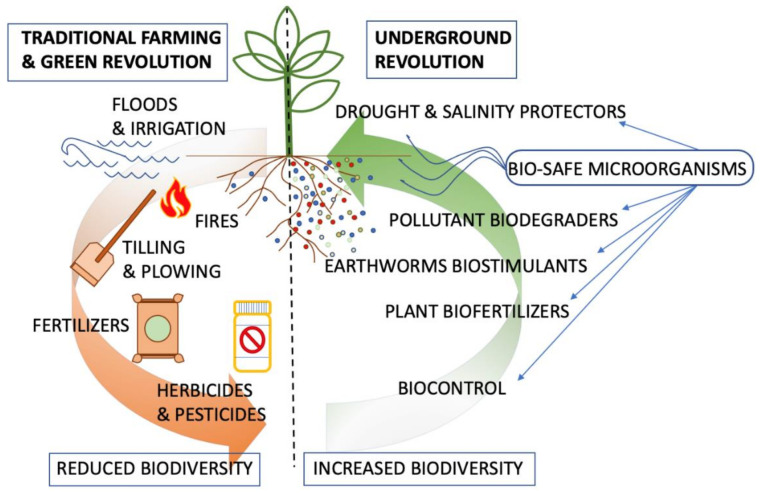
Agriculture represents an important mechanism in terms of reducing plant, animal, and microbial biodiversity and altering the environment. The pressure to cope with the increasing food demands of the human population has intensified the environmental impact, and alternative ways to produce food are required in order to minimize the decrease in biodiversity. Conventional agricultural practices, such as floods and irrigation systems; the removal of undesired vegetation by fires, tilling, and plowing; the use of herbicides, fertilizers, and pesticides; and the intensification of these practices over the last 50 years, have led to one of the most important environmental threats-a major loss of biodiversity. In this study, we review the impact that agriculture and its intensification have had on the environment and biodiversity since its invention. Moreover, we demonstrate how these impacts could be reduced through the use of microorganisms as biostimulants.
Keywords: agriculture; biodiversity; biostimulants; environmental threats.
Conflict of interest statement
The authors declare no conflict of interest.
Figures
References
-
- Maddison A. The World Economy. A Millenial Perspective. OECD Publishing; Paris, France: 2001.
-
- Nielsen R.W. Growth of the world population in the past 12,000 years and its link to the economic growth. J. Econ. Bibliogr. 2016;3:1–12. doi: 10.1453/jeb.v3i1.607. - DOI
Publication types
Grants and funding
LinkOut - more resources
Full Text Sources
