


Role of Benzoic Acid and Lettucenin A in the Defense Response of Lettuce against Soil-Borne Pathogens
- PMID: 34834699
- PMCID: PMC8618419
- DOI: 10.3390/plants10112336
Role of Benzoic Acid and Lettucenin A in the Defense Response of Lettuce against Soil-Borne Pathogens
Abstract
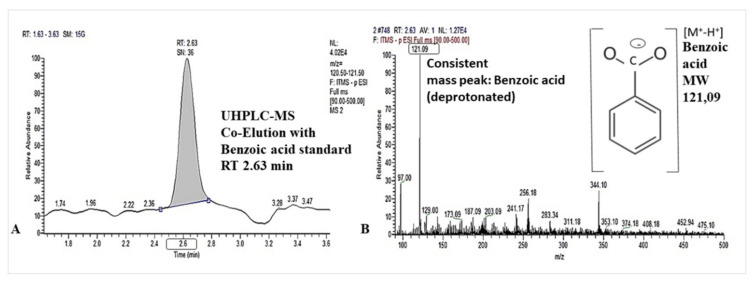
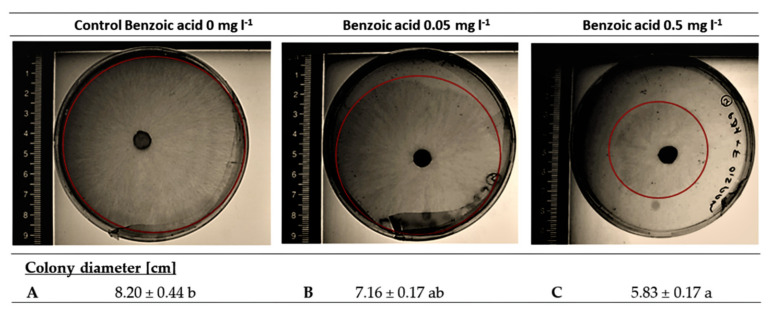
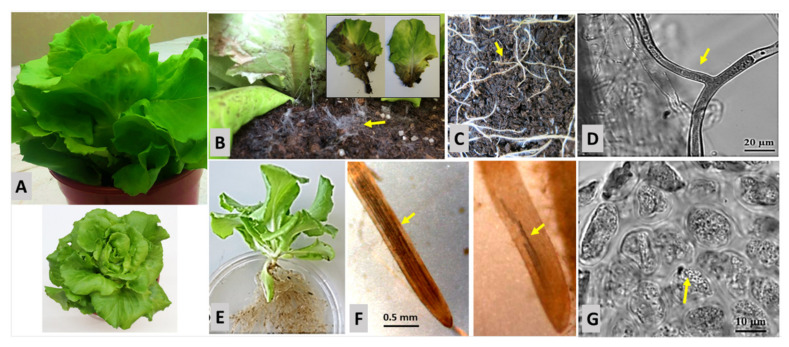
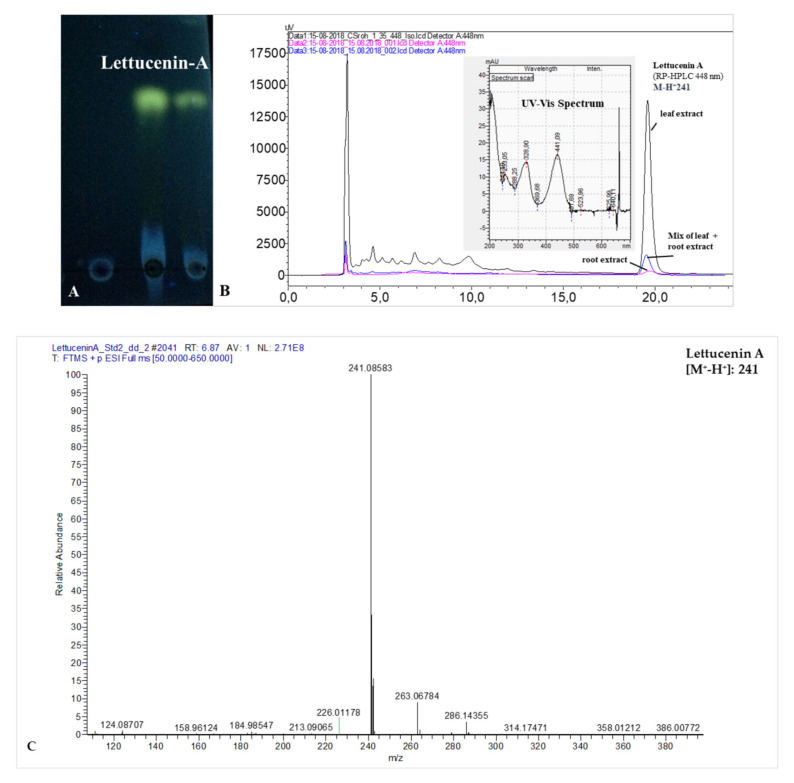
Soil-borne pathogens can severely limit plant productivity. Induced defense responses are plant strategies to counteract pathogen-related damage and yield loss. In this study, we hypothesized that benzoic acid and lettucenin A are involved as defense compounds against Rhizoctonia solani and Olpidium virulentus in lettuce. To address this hypothesis, we conducted growth chamber experiments using hydroponics, peat culture substrate and soil culture in pots and minirhizotrons. Benzoic acid was identified as root exudate released from lettuce plants upon pathogen infection, with pre-accumulation of benzoic acid esters in the root tissue. The amounts were sufficient to inhibit hyphal growth of R. solani in vitro (30%), to mitigate growth retardation (51%) and damage of fine roots (130%) in lettuce plants caused by R. solani, but were not able to overcome plant growth suppression induced by Olpidium infection. Additionally, lettucenin A was identified as major phytoalexin, with local accumulation in affected plant tissues upon infection with pathogens or chemical elicitation (CuSO4) and detected in trace amounts in root exudates. The results suggest a two-stage defense mechanism with pathogen-induced benzoic acid exudation initially located in the rhizosphere followed by accumulation of lettucenin A locally restricted to affected root and leaf tissues.
Keywords: benzoic acid; defense reaction; lettuce; lettucenin; phytoalexin; plant health; root exudates.
Conflict of interest statement
The authors declare that the research was conducted in the absence of any commercial of financial relationships that could be construed as a potential conflict of interest.
Figures
References
-
- Grisebach H., Ebel J. Phytoalexine und Resistenz von Pflanzen gegenüber Schadorganismen. Biol. Unserer Zeit. 1983;13:129–136. doi: 10.1002/biuz.19830130504. - DOI
-
- Oerke E.-C. Crop losses to pests. J. Agric. Sci. 2006;144:31–43. doi: 10.1017/S0021859605005708. - DOI
-
- Hallmann J. Einführung in die Thematik. Jul. Kühn Inst. 2010;155:2–9.
-
- Hyakumachi M., Ui T. The Role of the overwintered Plant Debris and Sclerotia as Inoculum in the field occurred with Sugarbeet Root Rot. Ann. Phytopath. Soc. Jpn. 1982;48:628–633. doi: 10.3186/jjphytopath.48.628. - DOI
-
- Campbell R.N. Longevity of Olpidium brassicae in air-dry soil and the persistence of the lettuce big-vein agent. Can. J. Bot. 1985;63:2288–2289. doi: 10.1139/b85-326. - DOI
Grants and funding
LinkOut - more resources
Full Text Sources
