


Full Viral Genome Sequencing and Phylogenomic Analysis of Feline Herpesvirus Type 1 (FHV-1) in Cheetahs (Acinonyx jubatus)
- PMID: 34835113
- PMCID: PMC8625435
- DOI: 10.3390/v13112307
Full Viral Genome Sequencing and Phylogenomic Analysis of Feline Herpesvirus Type 1 (FHV-1) in Cheetahs (Acinonyx jubatus)
Abstract
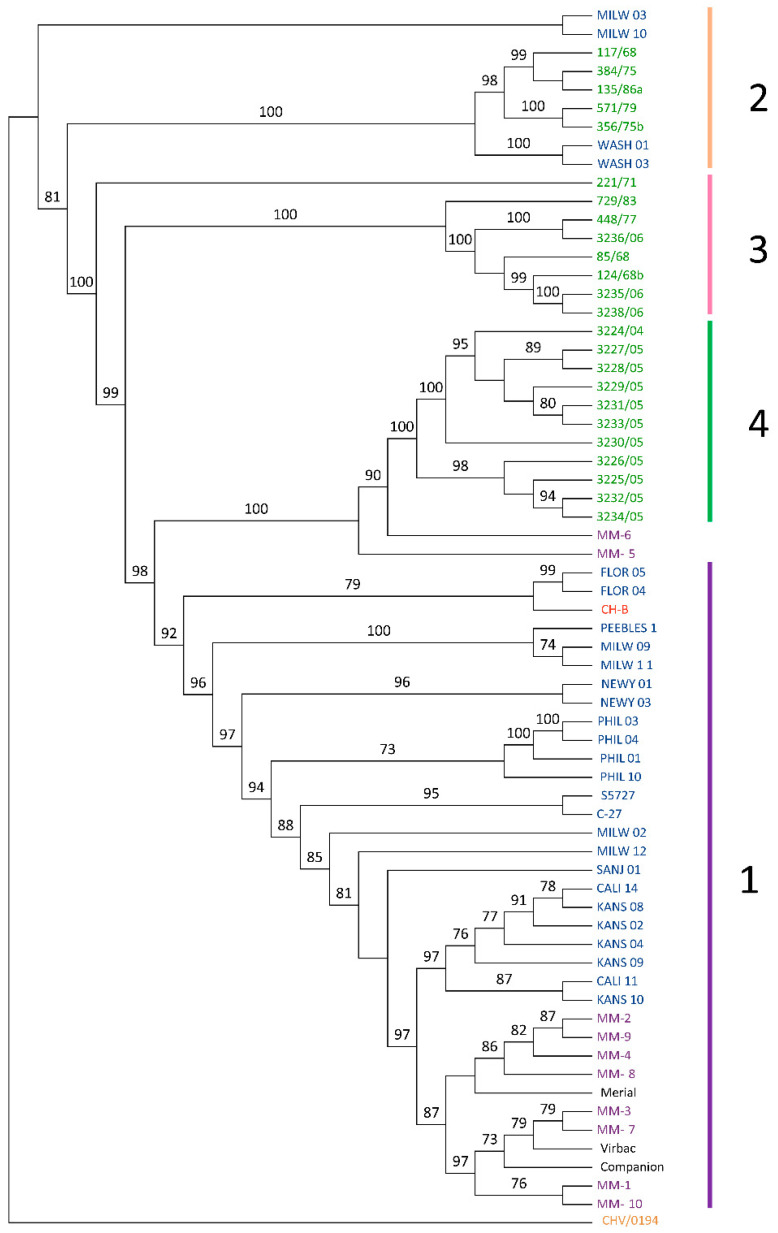
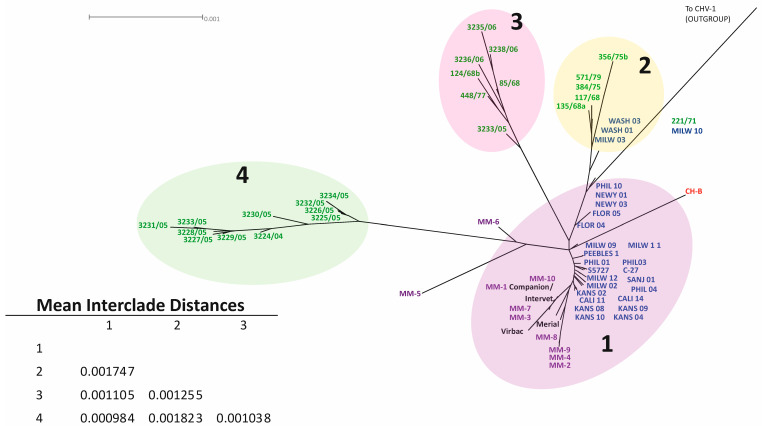
Feline herpesvirus type 1 (FHV-1) is endemic in captive cheetahs and sporadically causes devastating disease. Modified live vaccines (MLV), intended for use in domestic cats, are used in some captive cheetah populations and have been anecdotally linked to disease in certain subpopulations. Ten FHV-1 isolates from ten captive cheetahs and one isolate from an MLV used to inoculate four of the host animals were analyzed. Viral DNA was extracted for full-genome sequencing by Illumina MiSeq with viral genomes then used for phylogenomic and recombinational analyses. The FHV-1 shed by vaccinated cheetahs were almost identical to the MLV, with few variants among viral genomes. Eight cheetah FHV-1 isolates and the MLV were grouped in a clade along with FHV-1 isolates from domestic cats in the USA. The remaining two cheetah FHV-1 isolates (unknown host vaccine status) were not associated with a clade. The likely ancestral origin of these two isolates involves recombination events between Australian domestic cat and cheetah FHV-1 isolates. Collectively, these data suggest that the MLV is capable of causing clinical disease and viral shedding in some cheetahs and represents evidence of interspecies transmission of virus between domestic and wild cats.
Keywords: Varicellovirus; cheetah; feline herpesvirus; genome sequencing; herpes; modified live vaccine; phylogenomic; vaccines; veterinary.
Conflict of interest statement
The authors declare no conflict of interest.
Figures
References
-
- Durant S., Mitchell N., Ipavec A., Groom R. Acinonyx jubatus. The IUCN Red List of Threatened Species 2015: e. T219A50649567. [(accessed on 15 November 2021)]. Available online: https://www.iucnredlist.org/species/219/50649567.
-
- Evermann J.F., Laurenson M.K., McKeirnan A.J., Caro T.M. Infectious disease surveillance in captive and free-living cheetahs: An integral part of the species survival plan. Zoo Biol. 1993;12:125–133. doi: 10.1002/zoo.1430120111. - DOI
-
- Witte C.L., Lamberski N., Rideout B.A., Vaida F., Citino S.B., Barrie M.T., Haefele H.J., Junge R.E., Murray S., Hungerford L.L. Epidemiology of clinical feline herpesvirus infection in zoo-housed cheetahs (Acinonyx jubatus) J. Am. Vet. Med Assoc. 2017;251:946–956. doi: 10.2460/javma.251.8.946. - DOI - PMC - PubMed
Publication types
MeSH terms
Substances
Supplementary concepts
LinkOut - more resources
Full Text Sources
Miscellaneous
