. 2021 Nov 9;9(11):2314.
doi: 10.3390/microorganisms9112314.

Insights into the Oral Bacterial Microbiota of Sows

Affiliations

Insights into the Oral Bacterial Microbiota of Sows

Jasmine Hattab et al. Microorganisms. .

Abstract

The investigation of bacterial microbiota represents a developing research field in veterinary medicine intended to look for correlations between animal health and the balance within bacterial populations. The aim of the present work was to define the bacterial microbiota of the oral cavity of healthy sows, which had not been thoroughly described so far. In total, 22 samples of oral fluid were collected and analyzed by 16S-rRNA gene sequencing. CLC Genomics Workbench 20.0 (QIAGEN Digital Insights, Aarhus, Denmark) was then used to examine the results. The predominant orders were Lactobacillales, Clostridiales, and Corynebacteriales. Lactobacillaceae, Corynebacteriaceae, Moraxellaceae, Aerococcaceae, and Staphylococcaceae were the most represented families. As regards the most abundant genera, Lactobacillus, Corynebacterium, Acinetobacter, Staphylococcus, Rothia, Aerococcus, and Clostridium can be pointed out as the bacterial core microbiota. Sows were also divided into "gestating" and "lactating" groups, and mild differences were found between pregnant and lactating sows. The data herein described represent an original contribution to the knowledge of the porcine bacterial microbiota. Moreover, the choice of sows as experimental animals was strategic for identifying the adult microbial community. These data provide a basis for further studies on the oral bacterial microbiota of pigs.

Keywords: oral bacterial microbiota; oral fluid; saliva; sow.


Conflict of interest statement

The authors declare no conflict of interest.

Figures
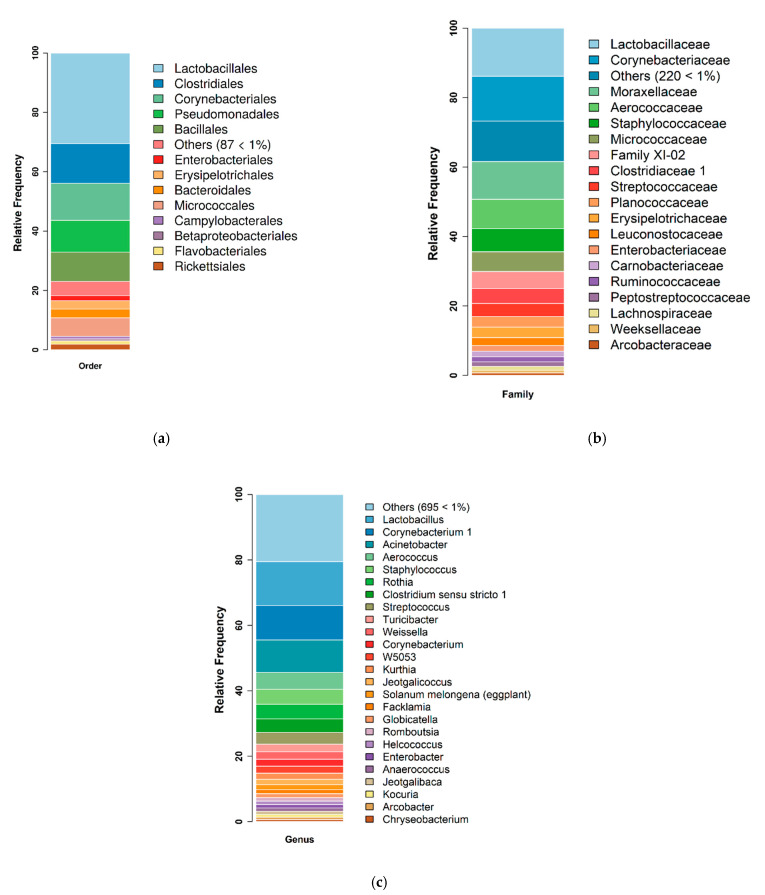
Figure 1
Figure 1
Bacterial microbiota structure of the oral fluid in sows (n=22). (a) Bacterial microbiota structure at the order level of the oral fluid in sows (n = 22). Only the bacterial orders that shared >1% abundance are indicated by different colors, while the others were grouped together. (b) Bacterial microbiota structure at the family level of the oral fluid in sows (n = 22). Only the bacterial families that shared >1% abundance are indicated by different colors, while the others were grouped together. (c). Bacterial microbiota structure at the genus level of oral fluid in sows (n = 22). Only the bacterial genera that shared >1% abundance are indicated by different colors, while the others were grouped together.
Figure 2
Figure 2
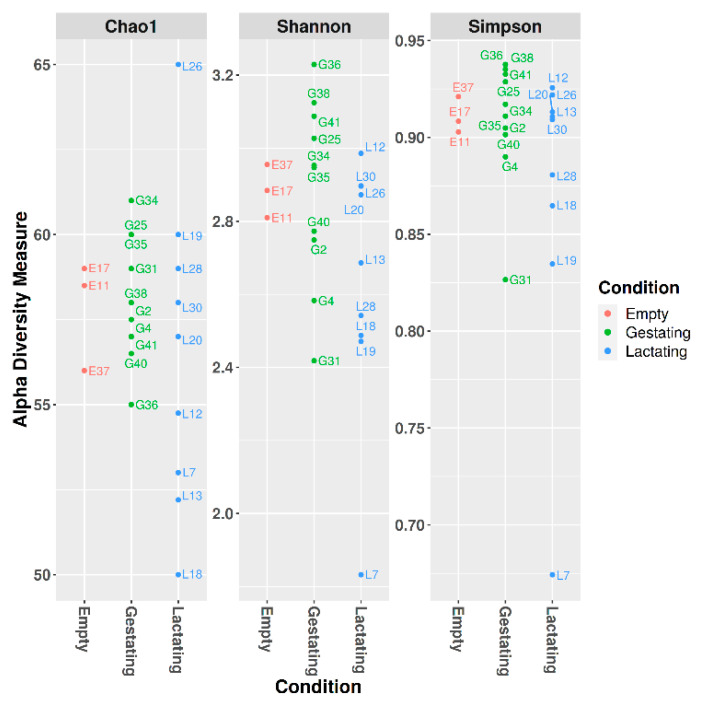
Alpha diversity based on the Chao1, Shannon, and Simpson indices.
Figure 3
Figure 3
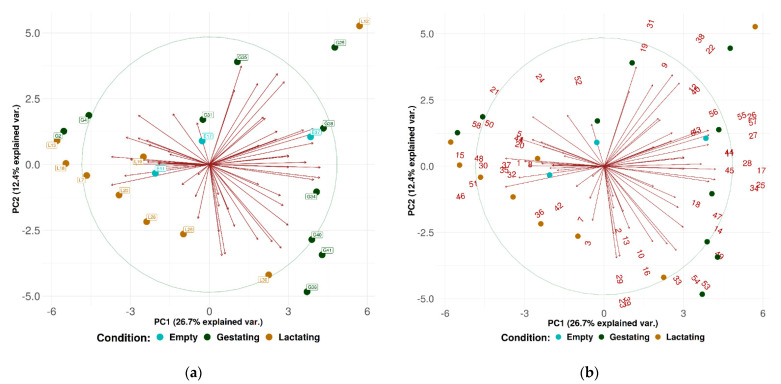
(a). Principal component analysis (PCA) characterizing the oral fluid bacterial microbiota of sows. Plot illustrating the distribution of the samples (n = 22) in the main two axes. (b) Principal component analysis (PCA) characterizing the oral fluid bacterial microbiota of sows. Plot illustrating the distribution of the main genera (n = 58) in the main two axes.
Figure 4
Figure 4
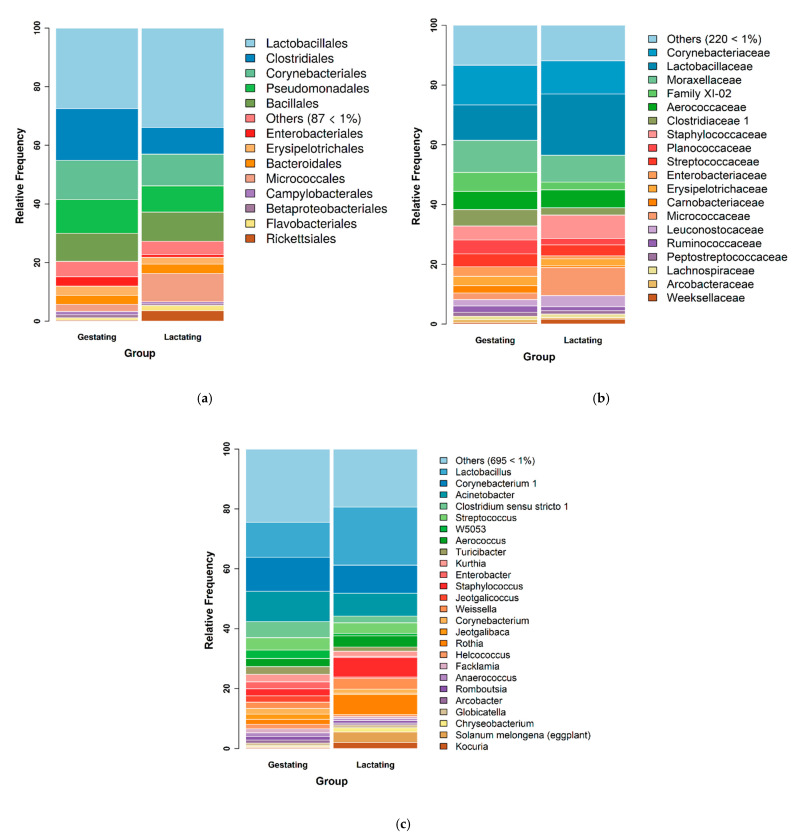
Bacterial microbiota structure of the oral fluid in gestating (n = 10) and lactating (n = 9) sows. (a). Bacterial microbiota structure at the order level of the oral fluid in gestating (n = 10) and lactating (n = 9) sows. Only the bacterial orders that shared >1% abundance are indicated by different colors, while the others were grouped together. (b) Bacterial microbiota structure at the family level of the oral fluid in gestating (n = 10) and lactating (n = 9) sows. Only the bacterial families that shared >1% abundance are indicated by different colors, while the others were grouped together. (c) Bacterial microbiota structure at the genus level of the oral fluid in gestating (n = 10) and lactating (n = 9) sows. Only the bacterial genera that shared >1% abundance are indicated by different colors, while the others were grouped together.

Similar articles

Cited by

References

    1. Berg G., Rybakova D., Fischer D., Cernava T., Vergès M.C., Charles T., Chen X., Cocolin L., Eversole K., Corral G.H., et al. Microbiome definition re-visited: Old concepts and new challenges. Microbiome. 2020;8:103. doi: 10.1186/s40168-020-00875-0. - DOI - PMC - PubMed
    1. Marchesi J.R., Ravel J. The vocabulary of microbiome research: A proposal. Microbiome. 2015;3:31. doi: 10.1186/s40168-015-0094-5. - DOI - PMC - PubMed
    1. Zaura E., Keijser B.J., Huse S.M., Crielaard W. Defining the healthy “core microbiome” of oral microbial communities. BMC Microbiol. 2009;15:259. doi: 10.1186/1471-2180-9-259. - DOI - PMC - PubMed
    1. He J., Li Y., Cao Y., Xue J., Zhou X. The oral microbiome diversity and its relation to human diseases. Folia Microbiol. 2015;60:69–80. doi: 10.1007/s12223-014-0342-2. - DOI - PubMed
    1. Murase K., Watanabe T., Arai S., Kim H., Tohya M., Ishida-Kuroki K., Võ T.H., Nguyễn T.P.B., Nakagawa I., Osawa R., et al. Characterization of pig saliva as the major natural habitat of Streptococcus suis by analyzing oral, fecal, vaginal, and environmental microbiota. PLoS ONE. 2019;14:e0215983. doi: 10.1371/journal.pone.0215983. - DOI - PMC - PubMed