. 2021 Nov 16;9(11):2364.
doi: 10.3390/microorganisms9112364.

Subgingival Microbiota and Cytokines Profile Changes in Patients with Periodontitis: A Pilot Study Comparing Healthy and Diseased Sites in the Same Oral Cavities

Affiliations

Subgingival Microbiota and Cytokines Profile Changes in Patients with Periodontitis: A Pilot Study Comparing Healthy and Diseased Sites in the Same Oral Cavities

Pauline Esparbès et al. Microorganisms. .

Abstract

Periodontitis is a common condition characterized by an exacerbated pro-inflammatory response, which leads to tissue destruction and, ultimately, alveolar bone loss. In this pilot study, we assess the microbiota composition and cytokine profile changes in patients with stage III/IV, grade B/C periodontitis, specifically by comparing healthy and diseased sites in the same oral cavity. Overall, we found that microbiota architecture was significantly disrupted between diseased and healthy sites, and that the clustering was driven, in part, by the increased relative abundances of Synergistetes in diseased sites, as well as the increased abundances of Firmicutes in healthy sites. We also observed that diseased sites were enriched in Synergistetes, TM7, SR1, Spirochaetes, Bacteroidetes and Fusobacteria, and depleted in Firmicutes, Proteobacteria, Tenericutes and Actinobacteria compared to healthy sites. We found that Interleukin-1b, Interleukin-4, Interleukin-10, and Interleukin-17A were significantly overexpressed in diseased sites, whereas Interleukin-6 and TNF-alpha do not differ significantly between healthy and diseased sites. Here, we observed concomitant changes in the subgingival plaque microbiota and cytokines profile, suggesting that this combined alteration could contribute to the pathobiology of periodontitis.

Keywords: 16S rRNA gene sequencing; dysbiosis; gingival crevicular fluid; periodontitis; subgingival microbiota.


Conflict of interest statement

The authors declare no conflict of interest.

Figures
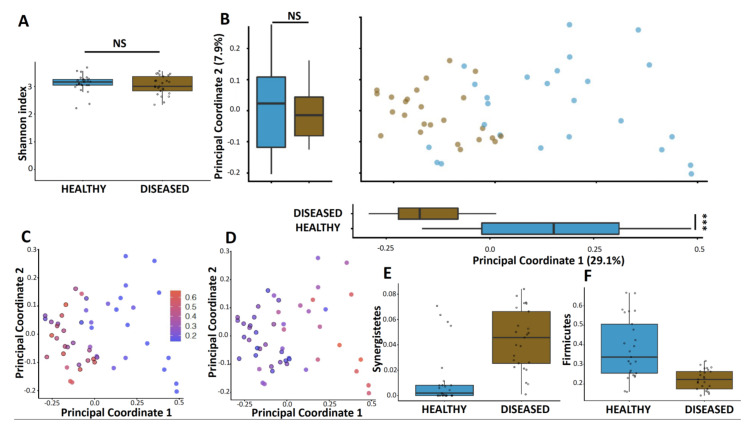
Figure 1
Figure 1
Microbiome diversity is altered in periodontitis sites compared to healthy sites. (A) Alpha diversity of periodontitis sites and healthy sites, depicted by the Shannon index, compared by the use of Mann-Whitney U test. (B) Principal-coordinate analysis of unweighted UniFrac distances for periodontitis sites and healthy sites. Box plots shown along each axis represent the median and interquartile range and indicate the distribution of samples along the given axis. Each point represents a single sample and is colored by site. PERMANOVA values, R2 values, and p values are shown. The same principal-coordinate analysis colored by the relative abundances of phyla, ***: p < 0.001 (C) Synergistetes and (D) Firmicutes. Relative abundances of phyla (E) Synergistetes and (F) Firmicutes within the periodontitis sites and the healthy sites, as assessed by Mann-Whitney tests with false-discovery-rate correction.
Figure 2
Figure 2
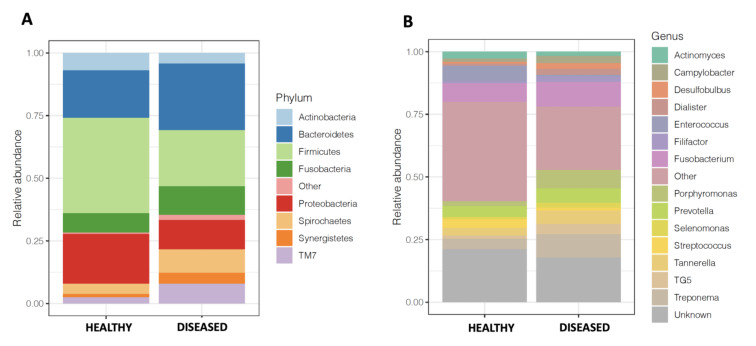
Taxonomic profile of the oral microbiomes of the samples collected in periodontitis sites and healthy sites. (A) Mean relative taxa abundance plots for individuals from the samples collected in periodontitis sites and healthy sites, summarized at the phylum level. (B) Mean relative taxa abundance plots for individuals from the samples collected in periodontitis sites and healthy sites, summarized at the genus level.
Figure 3
Figure 3
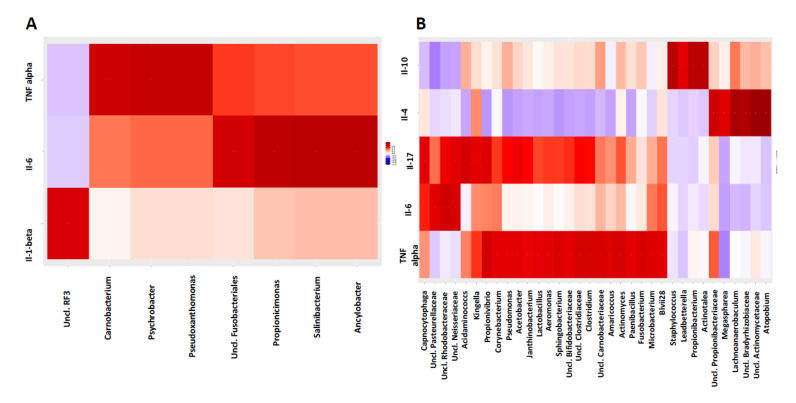
Correlation heatmaps for cytokines and oral microbiomes collapsed at genus level in the samples collected in (A) healthy sites and in (B) periodontitis sites. Increasing values are translated into colors from blue (negative correlation) to red (positive correlation).

References

    1. Petersen P.E., Ogawa H. The global burden of periodontal disease: Towards integration with chronic disease prevention and control. Periodontology 2000. 2012;60:15–39. doi: 10.1111/j.1600-0757.2011.00425.x. - DOI - PubMed
    1. Hajishengallis G., Lamont R.J. Beyond the red complex and into more complexity: The polymicrobial synergy and dysbiosis (PSD) model of periodontal disease etiology. Mol. Oral Microbiol. 2012;27:409–419. doi: 10.1111/j.2041-1014.2012.00663.x. - DOI - PMC - PubMed
    1. Armitage G.C. Development of a classification system for periodontal diseases and conditions. Ann. Periodontol. 1999;4:1–6. doi: 10.1902/annals.1999.4.1.1. - DOI - PubMed
    1. Armitage G.C. Classifying periodontal diseases—A long-standing dilemma. Periodontology. 2002;30:9–23. doi: 10.1034/j.1600-0757.2002.03002.x. - DOI - PubMed
    1. Papapanou P.N., Sanz M., Buduneli N., Dietrich T., Feres M., Fine D.H., Flemming T.F., Garcia R., Giannobile W.V., Graziani F. Periodontitis: Consensus report of workgroup 2 of the 2017 World Workshop on the Classification of Periodontal and Peri-Implant Diseases and Conditions. J. Periodontol. 2018;89:S173–S182. doi: 10.1002/JPER.17-0721. - DOI - PubMed

LinkOut - more resources