


Effects of Nutrition on Cognitive Function in Adults with or without Cognitive Impairment: A Systematic Review of Randomized Controlled Clinical Trials
- PMID: 34835984
- PMCID: PMC8621754
- DOI: 10.3390/nu13113728
Effects of Nutrition on Cognitive Function in Adults with or without Cognitive Impairment: A Systematic Review of Randomized Controlled Clinical Trials
Abstract
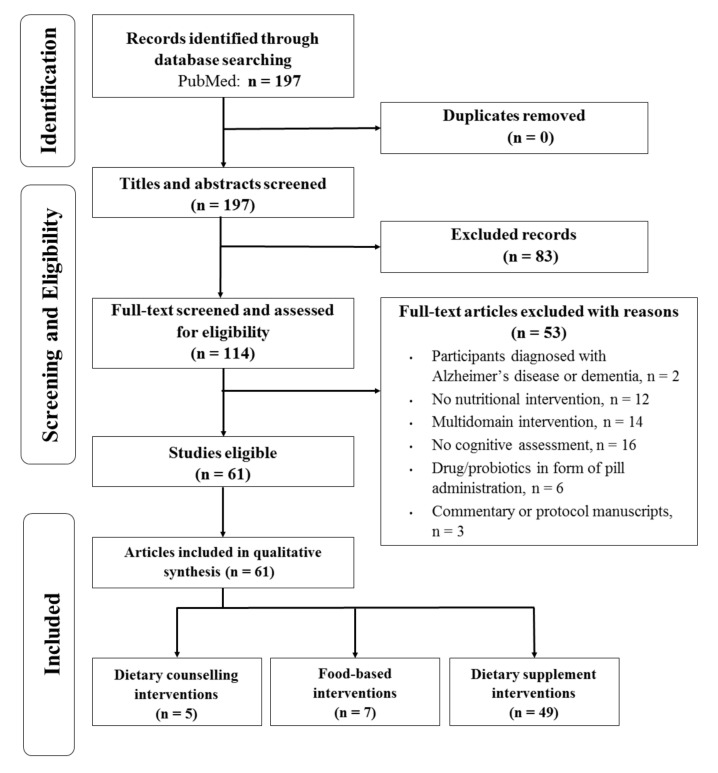
New dietary approaches for the prevention of cognitive impairment are being investigated. However, evidence from dietary interventions is mainly from food and nutrient supplement interventions, with inconsistent results and high heterogeneity between trials. We conducted a comprehensive systematic search of randomized controlled trials (RCTs) published in MEDLINE-PubMed, from January 2018 to July 2021, investigating the impact of dietary counseling, as well as food-based and dietary supplement interventions on cognitive function in adults with or without cognitive impairment. Based on the search strategy, 197 eligible publications were used for data abstraction. Finally, 61 articles were included in the analysis. There was reasonable evidence that dietary patterns, as well as food and dietary supplements improved cognitive domains or measures of brain integrity. The Mediterranean diet showed promising results, whereas the role of the DASH diet was not clear. Healthy food consumption improved cognitive function, although the quality of these studies was relatively low. The role of dietary supplements was mixed, with strong evidence of the benefits of polyphenols and combinations of nutrients, but with low evidence for PUFAs, vitamin D, specific protein, amino acids, and other types of supplements. Further well-designed RCTs are needed to guide the development of dietary approaches for the prevention of cognitive impairment.
Keywords: Alzheimer’s disease; cognitive impairment; diet; dietary interventions; food; healthy; subjective cognitive decline; supplements.
Conflict of interest statement
The authors declare no conflict of interest.
Figures
References
-
- Dementia. [(accessed on 6 September 2021)]. Available online: https://www.who.int/news-room/fact-sheets/detail/dementia.
-
- Daviglus M.L., Bell C.C., Berrettini W., Bowen P.E., Connolly E.S., Cox N.J., Dunbar-Jacob J.M., Granieri E.C., Hunt G., McGarry K., et al. NIH State-of-the-Science Conference Statement: Preventing Alzheimer’s Disease and Cognitive Decline. NIH Consens. State Sci. Statements. 2010;27:1–30. - PubMed
-
- Panza F., Seripa D., Solfrizzi V., Imbimbo B.P., Lozupone M., Leo A., Sardone R., Gagliardi G., Lofano L., Creanza B.C., et al. Emerging Drugs to Reduce Abnormal β-Amyloid Protein in Alzheimer’s Disease Patients. Expert Opin. Emerg. Drugs. 2016;21:377–391. doi: 10.1080/14728214.2016.1241232. - DOI - PubMed
Publication types
MeSH terms
Substances
Grants and funding
LinkOut - more resources
Full Text Sources
Medical
