


Relationship between Dietary Patterns with Benign Prostatic Hyperplasia and Erectile Dysfunction: A Collaborative Review
- PMID: 34836403
- PMCID: PMC8618879
- DOI: 10.3390/nu13114148
Relationship between Dietary Patterns with Benign Prostatic Hyperplasia and Erectile Dysfunction: A Collaborative Review
Abstract
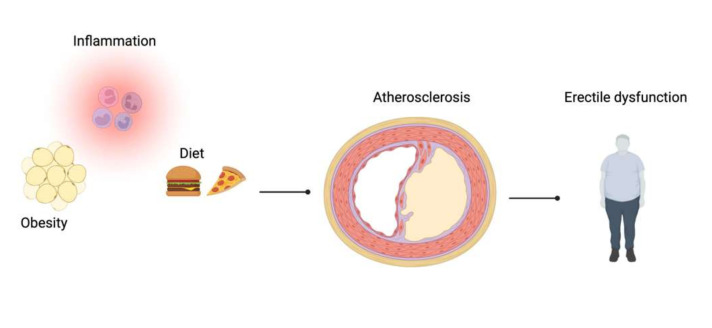
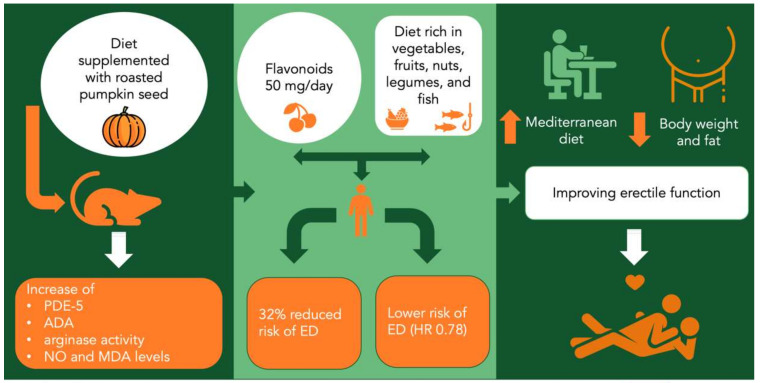
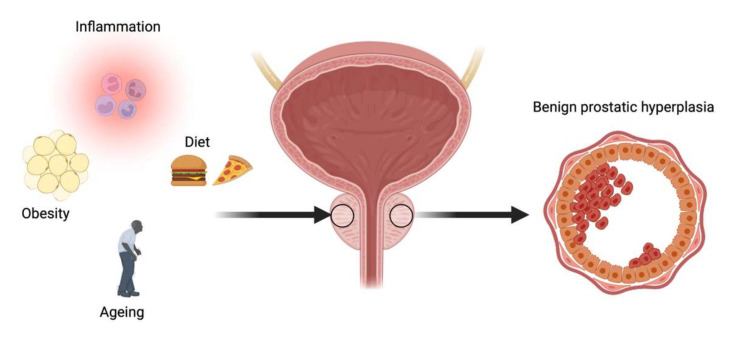
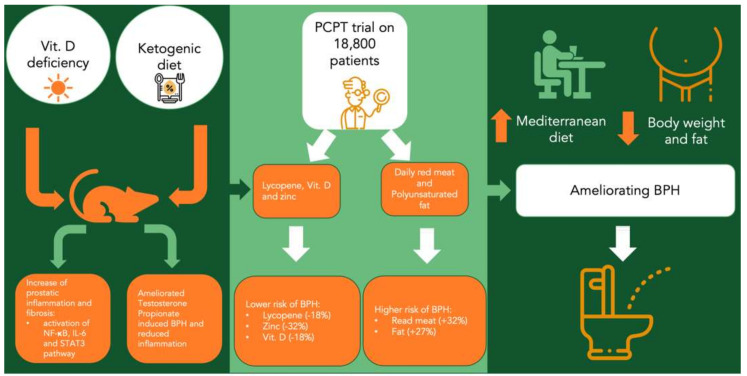
Interest in the role of dietary patterns has been consistently emerging in recent years due to much research that has documented the impact of metabolism on erectile dysfunction (ED) and/or benign prostatic hyperplasia (BPH). We conducted a non-systematic review of English articles published from 1964 to September 2021. The search terms were: ("dietary patterns" OR "diet") AND/OR ("erectile dysfunction") AND/OR ("benign prostatic hyperplasia"). In the present review, we have highlighted how the association between dietary patterns and two of the most frequent pathologies in urology, namely erectile dysfunction and benign prostatic hyperplasia, is present in the literature. The data suggested that a diet that is more adherent to the Mediterranean diet or that emphasizes the presence of vegetables, fruits, nuts, legumes, and fish or other sources of long-chain (n-3) fats, in addition to reduced content of red meat, may have a beneficial role on erectile function. At the same time, the same beneficial effects can be transferred to BPH as a result of the indirect regulatory effects on prostatic growth and smooth muscle tone, thus determining an improvement in symptoms. Certainly, in-depth studies and translational medicine are needed to confirm these encouraging data.
Keywords: benign prostatic hyperplasia; diet; erectile dysfunction; metabolism; prostate.
Conflict of interest statement
The authors declare no conflict of interest.
Figures
References
-
- Russo G.I., Cimino S., Fragalà E., Privitera S., La Vignera S., Condorelli R., Calogero A.E., Castelli T., Favilla V., Morgia G. Insulin resistance is an independent predictor of severe lower urinary tract symptoms and of erectile dysfunction: Results from a cross-sectional study. J. Sex. Med. 2014;11:2074–2082. doi: 10.1111/jsm.12587. - DOI - PubMed
-
- Russo G.I., Castelli T., Urzì D., Privitera S., La Vignera S., Condorelli R.A., Calogero A.E., Favilla V., Cimino S., Morgia G. Emerging links between non-neurogenic lower urinary tract symptoms secondary to benign prostatic obstruction, metabolic syndrome and its components: A systematic review. Int. J. Urol. 2015;22:982–990. doi: 10.1111/iju.12877. - DOI - PubMed
-
- Russo G.I., Campisi D., Mauro M.D., Regis F., Reale G., Marranzano M., Ragusa R., Solinas T., Madonia M., Cimino S., et al. Dietary consumption of phenolic acids and prostate cancer: A case-control study in sicily, Southern Italy. Molecules. 2017;22:2159. doi: 10.3390/molecules22122159. - DOI - PMC - PubMed
Publication types
MeSH terms
LinkOut - more resources
Full Text Sources
Other Literature Sources
Medical
