


School Health Predictors of the School-to-Prison Pipeline: Substance Use and Developmental Risk and Resilience Factors
- PMID: 34836805
- PMCID: PMC8860848
- DOI: 10.1016/j.jadohealth.2021.09.032
School Health Predictors of the School-to-Prison Pipeline: Substance Use and Developmental Risk and Resilience Factors
Abstract
Purpose: The purpose of the study is to establish prospective relationships among school mean levels of substance use, developmental risk and resilience factors, and school discipline.
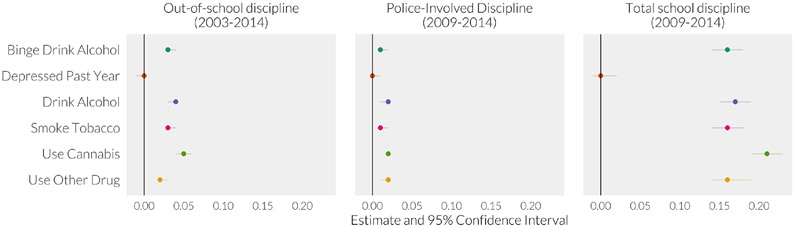
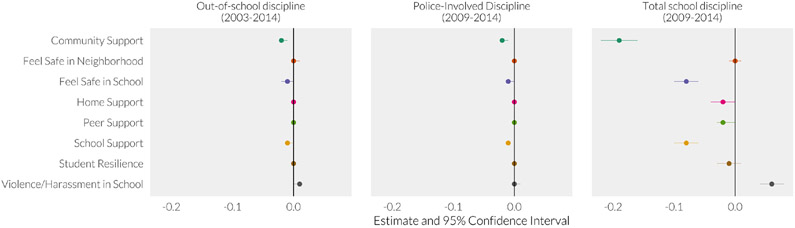
Methods: We linked 2003-2014 data from the California Healthy Kids Survey and the Civil Rights Data Collection, from more than 4,800 schools and 4,950,000 students. With lagged multilevel linear models, we estimated relationships among standardized school average levels of six substance use measures; eight developmental risk and resilience factors; and the prevalence of total discipline, out-of-school discipline, and police-involved discipline.
Results: School mean substance use and risk/resilience factors predicted subsequent prevalence of discipline. For example, a one-standard deviation higher school mean level of smoking, binge drinking, and cannabis use was associated, respectively, with 16% (95% confidence interval [CI]: 14%, 18%), 18% (95% CI: 16%, 20%), and 21% (95% CI: 19%, 23%) higher subsequent prevalence of total discipline. A one-standard deviation higher mean level of community support and feeling safe in school was associated, respectively, with 21% (95% CI: 18%, 23%) and 9% (95% CI: 7%, 11%) lower total discipline. Higher violence/harassment was associated with 5% (95% CI: 4%, 7%) higher total discipline. Peer and home support, student resilience, and neighborhood safety were not associated with total discipline. Nearly all associations remained, attenuated, when we restricted to out-of-school and police-involved discipline.
Conclusions: Schools with students who, on average, have higher substance use, less school and community support, and feel less safe in schools have a higher prevalence of school discipline and police contact. The public health implications of mass criminalization extend beyond criminal legal system settings and into schools.
Keywords: School discipline; School-to-prison pipeline; Substance use.
Copyright © 2021 Society for Adolescent Health and Medicine. Published by Elsevier Inc. All rights reserved.
Conflict of interest statement
The authors have no conflicts of interest to declare.
Figures
References
-
- Wildeman C. Invited commentary: (Mass) Imprisonment and (Inequities in) Health. Am J Epidemiol 2011;173:488–91. - PubMed
-
- Mallett CA. The School-to-Prison Pipeline: A Critical Review of the Punitive Paradigm Shift. Child and Adolescent Social Work Journal 2016;33:15–24.
